|
Expansion of Hong Kong International Airport into a Three-Runway System |
1
Introduction
1.1
Purpose
of the Manual
1.1.1.1
In accordance with Condition 3.1 of Environmental Permit (EP) (EP No.
EP-489/2014), an updated Environmental Monitoring and Audit (EM&A) Manual
shall be prepared before the commencement of construction works. The first
submission of Updated EM&A was made to the Environmental Protection
Department (EPD) on 18 September 2015, and finalised and release via the
project’s dedicated website in January 2016.
1.1.1.2 The purpose of this updated EM&A Manual (hereafter
referred to as the Manual) is to guide the setup of an EM&A programme to
ensure compliance with the recommendations in the approved Environmental Impact
Assessment (EIA) Report (Register No. AEIAR-185/2014), to assess the
effectiveness of the recommended mitigation measures and to identify any
further need for additional mitigation measures or remedial action. This Manual
outlines the monitoring and audit programme proposed for the “Expansion of Hong
Kong International Airport into a Three-Runway System” (the project).
1.1.1.3
In this updated submission, Section 4
incorporates the updated status of construction noise monitoring station.
Section 7 incorporates the revised operation phase monitoring requipments for
waste management. Appendix A incorporates the updated three-runway system (3RS)
Phasing Programme.
1.2
Project
Description
1.2.1.1 The project will
consist of a new third runway with associated taxiways, aprons (or aircraft
stands), as well as new passenger concourse buildings and expansion of the
existing Terminal 2 (T2) building. Included in the project will be related
airside and landside works and associated ancillary and supporting facilities.
1.2.2
Land
Formation
1.2.2.1 Based on the preferred
airport development option identified, land is required to be formed to the
north of the existing airport island, which will provide a platform for the
development. The proposed land formation works will mainly include:
● Land formation of not more than 650 ha to the north of the existing airport island with partial construction over the contaminated mud pits. The area of land formation is defined to be the area at and above the high water mark of +2.3 mPD; and
● Modification and integration of the existing seawall at the northern, western and eastern sides of the existing North Runway into the new land formation and re-provisioning of new seawall around the land formation.
1.2.3
Airfield
Facilities
1.2.3.1 The proposed
airfield facilities will mainly include:
● Construction of a third runway, related taxiway systems, associated airfield infrastructure, aircraft navigational aids, approach lighting systems and new Hong Kong International Airport Approach Area (HKIAAA) beacons;
● Construction of the Terminal 2 Concourse (T2C) aprons;
● Temporary closure and modification of the existing North Runway along with related taxiway systems; and
● Expansion of the freighter aprons in the existing Midfield area between the existing North and South runways.
1.2.4
Passenger
Facilities
1.2.4.1 The proposed
passenger facilities will mainly include:
● Construction of the T2C and passenger fixed link bridges;
● Expansion of the existing T2;
● Extension of the automated people mover (APM) and associated depot and maintenance / stabling areas; and
● Expansion of the baggage handling system (BHS) and associated baggage halls and early bag store.
1.2.5
Ancillary
Facilities
1.2.5.1 New ancillary
facilities will be provided to support the operational needs of the T2C and airfield facilities. These ancillary
facilities will be located on the west and east sides of the proposed land
formation area (i.e. within the western support area and the eastern support
area respectively) and will accommodate utility buildings, airport support
developments, air cargo staging, catering, aircraft maintenance, aircraft
engine run-up (engine testing) facilities, ground services equipment area,
early bag storage facility, fire station, fire training facility, petrol
fuelling station, new air traffic control towers (ATCTs), Hong Kong Observatory
(HKO) facility, mobile phone system antenna towers, stores, security gate
houses, etc.
1.2.6
Infrastructure
and Utilities
1.2.6.1 The proposed
infrastructure and utilities will mainly include:
● Expansion of the landside and airside road network in the passenger, cargo and maintenance areas and landside transportation facilities, including new car parks;
● Construction of new airside road access, including the construction of new airside road tunnels and ramps, to connect the new third runway facilities with the existing airport;
●
Modification to
existing and construction of new land based infrastructure including the
seawater cooling and flushing system, stormwater drainage system, greywater
system, sewerage network and potable water supply, Towngas supply,
132 kV / 11 kV and other power supply networks; communication networks; and
● Modifications and re-provisions to existing marine facilities including the underwater aviation fuel pipelines between Hong Kong International Airport (HKIA) and the off-airport fuel receiving facilities at Sha Chau, the associated underwater 11 kV cable and pilot cable and sea rescue boat points.
1.2.6.2 The key project
components are shown in Drawing No. MCL/P132/EMA/1-001 to MCL/P132/EMA/1-004. Drawing No. MCL/P132/EMA/1-002 to MCL/P132/EMA/1-004 are updated in this version (April 2026).
1.3
Tentative
Construction Programme
1.3.1.1 Given the scale and
complexity of the project, construction and the concurrent runway operational
configuration were implemented in phases. The new North Runway was commissioned in November 2022 and following the
completion of the reconfiguration works on the Centre Runway, the 3RS commenced
full operations on 28 November 2024. The tentative phasing programme is
provided in Appendix A which
is based on the currently available information.
1.4
Project
Organisation
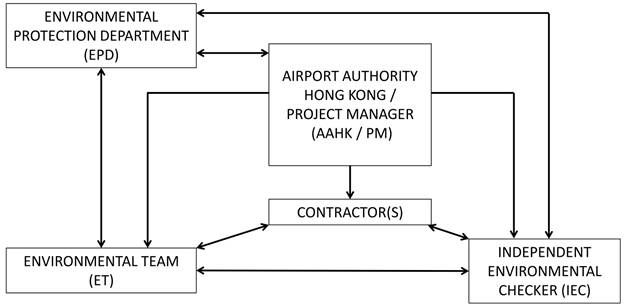
1.4.1.1 The proposed
project organisation is shown in Chart 1-1 below.
|
Chart 1‑1: Project Organisation Chart |
|
|
1.4.2 Airport Authority Hong Kong (AAHK)
1.4.2.1 AAHK is the project
proponent for the development of the project, and will assume overall
responsibility for the project.
1.4.3
Environmental
Protection Department (EPD)
1.4.3.1 EPD is the
statutory enforcement body for environmental protection matters in Hong Kong.
1.4.4
Project
Manager (PM)
1.4.4.1 The Project Manager
(PM) or the PM’s Representative is responsible
for overseeing the construction works and for ensuring that the works are
undertaken by the Contractor in accordance with the specification and contract
requirements. The duties and responsibilities of the PM with respect to
EM&A include:
● To monitor the Contractor’s compliance with Contract Specifications, including the effective implementation and operation of the environmental mitigation measures;
● To employ an Independent Environmental Checker (IEC) to audit the results of the EM&A works carried out by the Environmental Team (ET);
● To monitor Contractors’ compliance with the requirements in the EP and updated EM&A Manual;
● To facilitate ET’s implementation of the EM&A programme;
● To participate in joint site inspection by the ET and IEC;
● To oversee the implementation of the agreed Event and Action Plan in the event of any exceedance; and
● To adhere to the procedures for carrying out complaint investigation.
1.4.5
Contractors
1.4.5.1The Contractors employed by AAHK, including Contractors working on the
project on a joint venture (JV) basis, should report to the PM or the PM’s
Representative. The duties and responsibilities of the Contractors include:
● To comply with the relevant contract conditions and specifications on environmental protection;
● To facilitate ET’s monitoring and site inspection activities;
● To participate in the site inspections undertake by the ET and IEC, and undertake any corrective actions;
● To provide information / advice to the ET regarding works programme and activities which may contribute to the generation of adverse environmental impacts;
● To submit proposals on mitigation measures in case of exceedance of Action and Limit Levels in accordance with the Event and Action Plans;
● To implement measures to reduce impact where Action and Limit Levels are exceeded; and
● To adhere to the complaint handling procedures in accordance with this Manual and the Complaint Management Plan.
1.4.6
Environmental
Team (ET)
1.4.6.1 A full time on-site
ET should be employed by the AAHK / PM to conduct the EM&A programme no
later than one month before the commencement of construction of the project.
The ET should not be in any way an associated body of the Contractor or the IEC
for the project. The ET should be headed by the full time on-site ET Leader
(ETL). The ETL should have relevant professional qualifications in
environmental control and possess at least seven years of experience in
EM&A or environmental management. Suitably qualified staff should be
included in the ET, and resources for the implementation of the EM&A
programme should be allocated to enable fulfilment of the project’s EM&A
requirements during construction of the project. The ET should report to AAHK /
PM and the duties should include:
● To carry out field sampling, field measurement, testing, assessment, and reporting for various environmental parameters as required in this EM&A Manual;
● To analyse the EM&A data, review the success of EM&A programme and the adequacy of mitigation measures implemented, confirm the validity of the EIA predictions and identify any adverse environmental impacts arising and recommend suitable mitigation measures;
● To monitor compliance with conditions in the EP, environmental protection, pollution prevention and control regulations and contract specifications;
● To carry out regular site inspection at least once per week so as to investigate and audit Contractor’s site practice, equipment and work methodologies with respect to pollution control and environmental mitigation;
● To report on the EM&A results to the AAHK / PM, IEC, EPD and Contractors;
● To vet the Contractor’s method statements, design plans and submissions and check that the relevant environmental protection and pollution control measures have been included and are sufficient to comply with contractual and statutory requirements;
● To inform the AAHK / PM, IEC and Contractors the recommend suitable mitigation measures in the case of exceedance of Action and Limit Levels in accordance with the Event and Action Plans;
● To liaise with the IEC on all environmental performance matters, and ensure timely submission of all relevant EM&A pro forma for IEC’s approval;
● To provide advice to the Contractors on environmental improvement, awareness and enhancement matters, etc. on site;
● To prepare, certify and submit the Baseline, Monthly, Quarterly, Annual and Final EM&A Review Reports to the AAHK / PM, IEC and EPD timely;
● To keep a contemporaneous log-book of each and every instance or circumstance or change of circumstances, which may affect the compliance with the recommendations of the approved EIA Report and the EP; and
● To set up and manage the dedicated complaint hotline and email channel, and manage the complaint handling procedures in accordance with this Manual and the Complaint Management Plan.
1.4.7
Independent
Environmental Checker (IEC)
1.4.7.1 The IEC is
empowered to audit the environmental performance of construction, but is
independent from the management of construction works. As such, the IEC should
not be in any way an associated body of the Contractor or the ET for the
project. A full time on-site IEC with a supporting team should be employed by
the AAHK / PM no later than one month prior to the commencement of the
construction of the project. The IEC should be a person who has relevant
professional qualifications in environmental control and at least seven years
of experience in EM&A or environmental management. The duties and
responsibilities of the IEC are:
● To provide proactive advice to the AAHK / PM on EM&A matters related to the project;
● To verify the environmental acceptability of permanent and temporary works and relevant design plans;
● To review and verify the monitoring data and all submissions in connection with the EP, any subsequent Variations of EP (VEPs) and / or Further EP (FEPs), and EM&A reports submitted by the ET;
● To arrange and conduct at least monthly site inspections of the works during the construction phase, and to carry out ad hoc inspections if significant environmental problems are identified;
● To validate and check the accuracy of environmental monitoring;
● To audit the compliance with the complaint handling procedures in accordance with this Manual and the Complaint Management Plan;
● To verify the ET’s log-book and the investigation result of any environmental exceedance, non-compliance and complaint cases, compliance with the agreed Event and Action Plan and the effectiveness of corrective actions / measures;
● To feedback audit results to the ET by signing off relevant EM&A pro forma;
● To verify EM&A reports that have been certified by the ETL;
● To audit EIA recommendations and requirements against the status of implementation of environmental mitigation measures on site;
● To report the works conducted, and the findings, recommendations and improvements of the site inspections, after reviewing ET’s and Contractor’s works, to the AAHK / PM on a monthly basis; and
●
To review the
effectiveness of the EM&A programme, EIA recommendations and the adequacy
of mitigation measures implemented.
2
Air Quality Impact
2.1 Construction Air Quality Monitoring
2.1.1
General
2.1.1.1 The project is
anticipated to give rise to construction dust impacts. The key activities that
would potentially result in dust emissions include land formation works;
construction works on the newly formed land and on the existing airport island;
operation of concrete batching plants, asphalt batching plants, crushing plant,
and barging points; haul roads; diversion of submarine fuel pipeline; diversion
of submarine 11 kV cable; and modifications to existing outfalls. Construction
phase dust monitoring is considered necessary to check and ensure compliance
that the relevant recommended mitigation measures are properly implemented.
2.1.1.2 The key objectives
of the construction phase dust monitoring are:
● To identify the extent of dust impact during construction phase on sensitive receivers;
● To audit the compliance of the Contractor with regard to dust control, contract conditions and the relevant dust impact criteria;
● To determine the effectiveness of mitigation measures to control fugitive dust emission from activities during the construction phase;
● To recommend further mitigation measures if found to be necessary; and
● To comply with Action and Limit Levels for air quality as defined in this Manual.
2.1.2
Air
Quality Parameters
2.1.2.1 Monitoring and audit of 24-hour Respirable Suspended
Particulates (RSP or PM10) and 24-hour Fine Suspended Particulates (FSP or
PM2.5) levels are not proposed. This is because even under the
hypothetical worst case Tier 1 mitigated scenario both 24-hour RSP and 24-hour
FSP would comply with the corresponding Air Quality Objectives (AQO) at all Air
Sensitive Receivers (ASR) throughout the construction period, except the
limited non-compliance with the AQO for 24-hour RSP at up to three ASR in three
of the eight construction years. Hence no significant RSP or FSP impacts are
anticipated. Therefore, only 1-hour Total Suspended Particulates (TSP) will be
monitored and audited at the proposed monitoring locations. Details of
the proposed monitoring locations are presented in Section 2.1.5.
2.1.2.2 One-hour TSP levels
shall be measured to indicate the impacts of construction dust on air quality.
The TSP levels shall be measured by following the standard high volume sampling method as set out in the Title 40
of the Code of Federal Regulations, Chapter 1 (Part 50), Appendix B. Upon approval of the AAHK / PM, as an alternative to
using high volume sampling method, 1-hour TSP levels can be measured by direct
reading methods which are capable of producing comparable results as that by
the high volume sampling method, to indicate short event impacts.
2.1.2.3 All relevant data
including temperature, pressure, weather conditions, elapsed-time meter reading
for the start and stop of the sampler, identification and weight of the filter
paper, and any other local atmospheric factors affecting or affected by site conditions
etc. shall be recorded down in detail. A sample data sheet is shown in Appendix B. The ET may
develop project specific data sheet to suit this EM&A programme.
2.1.3
Monitoring
Equipment
Technical Specifications as Presented in the Original EM&A Manual
2.1.3.1 High volume sampler (HVS) shall be used for carrying
out the 1-hour TSP monitoring.
2.1.3.2 The ET is responsible
for provision of the monitoring equipment. They shall ensure that sufficient
number of samplers with an appropriate calibration kit is available for
carrying out the baseline monitoring, regular impact monitoring and ad hoc
monitoring. The samplers shall be equipped with an electronic mass flow
controller and be calibrated against a traceable standard at regular intervals.
All the equipment, calibration kit, filter papers, etc. shall be clearly
labelled.
2.1.3.3 Initial calibration
of dust monitoring equipment shall be conducted upon installation and
thereafter at bi-monthly intervals. The transfer standard shall be traceable to
the internationally recognised primary standard and be calibrated annually. The
calibration data shall be properly documented for future reference by the
concerned parties such as the IEC. All the data shall be converted into
standard temperature and pressure condition.
2.1.3.4 The flow-rate of
the sampler before and after the sampling exercise with the filter in position
shall be verified to be constant and be recorded down in the data sheet as
shown in Appendix B.
2.1.3.5 If the ET proposes
to use a direct reading dust meter to measure 1-hour TSP levels, they shall
submit sufficient information to the IEC to prove that the instrument is
capable of achieving a comparable result as that of the HVS and may be used for
the 1-hour sampling. The instrument shall also be calibrated regularly, and the
1-hour sampling shall be determined periodically by HVS to check the validity
and accuracy of the results measured by direct reading method.
2.1.3.6 Wind data
monitoring equipment shall also be provided and set up at conspicuous locations
for logging wind speed and wind direction near to the dust monitoring
locations. The equipment installation location shall be proposed by the ET and
agreed with the IEC. For installation and operation of wind data monitoring
equipment, the following points shall be observed:
● The wind sensors shall be installed on masts at an elevated level 10 m above ground so that they are clear of obstructions or turbulence caused by the buildings;
● The wind data shall be captured by a data logger. The data recorded in the data logger shall be downloaded periodically for analysis at least once a month;
● The wind data monitoring equipment shall be re-calibrated at least once every six months; and
● Wind direction shall be divided into 16 sectors of 22.5 degrees each.
2.1.3.7 In exceptional
situations, the ET may propose alternative methods to obtain representative
wind data upon approval from the AAHK / PM and agreement from the IEC.
Proposed Use of Portable Direct Reading Dust Meter and
Existing Wind Data from Chek Lap Kok Wind Station
2.1.3.8 Based on the provisions and requirements set out in Section
2.1.3.5 above, a proposal of using portable direct reading dust meter in
undertaking the EM&A for the 3RS project was submitted to the IEC, and
agreement from the IEC was obtained. The proposal concluded that the portable
direct reading dust meter is capable to provide comparable results of
monitoring data as that provided by HVS, and with the benefits of allowing
prompt and direct results for the EM&A reporting. The portable direct reading
dust meter will be calibrated every year against HVS to check the validity an
accuracy of the results measured by direct reading method.
2.1.3.9 On the other hand, the proposed use of existing wind
data from Chek Lap Kok Wind Station operated by HKO for wind data collection
instead of setting up a separate station near the existing station was
submitted to the IEC. Agreement from the AAHK / PM and IEC’s approval was
obtained.
2.1.4
Laboratory
Measurement / Analysis
2.1.4.1 A clean laboratory
with constant temperature and humidity control, and equipped with necessary
measuring and conditioning instruments, to handle the dust samples collected,
shall be available for sample analysis, and equipment calibration and
maintenance. The laboratory should be the Hong Kong
Laboratory Accreditation Scheme (HOKLAS)
accredited or other internationally accredited.
2.1.4.2 If a site
laboratory is set up or a non-HOKLAS accredited laboratory is hired for
carrying out the laboratory analysis, the laboratory equipment shall be
approved by the AAHK / PM and the measurement procedures should be witnessed by
the IEC. Measurement performed by the laboratory shall be demonstrated to the
satisfaction of the AAHK / PM and the IEC. The IEC shall conduct regular audit
to the measurement performed by the laboratory to ensure the accuracy of
measurement results. The ET shall provide the AAHK / PM with one copy of the
Title 40 of the Code of Federal regulations, Chapter 1 (part 50), Appendix B
for his reference.
2.1.4.3 Filter paper of 8”
X 10” shall be labelled before sampling of TSP. It shall be a clean filter
paper with no pin holes, and shall be conditioned in a humidity controlled
chamber for over 24-hour and be pre-weighed before use for the sampling.
2.1.4.4 After sampling, the
filter paper loaded with dust shall be kept in a clean and tightly sealed
plastic bag. The filter paper is then returned to the laboratory for
reconditioning in the humidity controlled chamber followed by accurate weighing
by an electronic balance with a readout down to 0.1 mg. The balance shall be
regularly calibrated against a traceable standard.
2.1.4.5 All the collected
samples shall be kept in a good condition for six months before disposal.
2.1.5 Monitoring Locations
Technical
Specifications as Presented in the Original EM&A Manual
2.1.5.1 Two separate air quality monitoring locations are
proposed and summarised in Table 2‑1. The status and locations of dust sensitive
receivers may change after issuing this Manual. If such cases exist, the ET
should propose updated monitoring locations and seek agreement from EPD, and
agreement from the AAHK / PM and IEC before baseline monitoring commences.
Table 2‑1: Construction Air Quality Monitoring Stations
|
ID |
ID Adopted in EIA |
Description |
Monitoring Parameters |
|
AR1 |
TC-13 |
Seaview Crescent Block 1 |
1-hour TSP |
|
AR2 |
ST-1 |
Village house at Tin Sum |
1-hour TSP |
2.1.5.2 When alternative
monitoring locations are proposed, the following criteria, as far as
practicable, shall be followed:
● At the site boundary or such locations close to the major dust emission source;
● Close to the sensitive receptors; and
● Take into account the prevailing meteorological conditions.
2.1.5.3 Monitoring
equipment must be positioned, sited and orientated properly. The ET should
agree with the AAHK / PM in consultation with the IEC on the position of the
samplers for the installation of the monitoring equipment. When positioning the
samplers, the following points shall be noted:
● A horizontal platform with appropriate support to secure the samplers against gusty wind shall be provided;
● No two samplers shall be placed less than 2 m apart;
● The distance between the sampler and an obstacle, such as buildings, must be at least twice the height that the obstacle protrudes above the sampler;
● A minimum of 2 m of separation from walls, parapets and penthouses is required for rooftop samplers;
● A minimum of 2 m separation from any supporting structure, measured horizontally is required;
● No furnace or incinerator flue is nearby;
● Airflow around the sampler is unrestricted;
● The sampler is more than 20 m from the dripline;
● Any wire fence and gate, to protect the sampler, shall not cause any obstruction during monitoring;
● Permission must be obtained to set up the samplers and to obtain access to the monitoring stations; and
● A secured supply of electricity is needed to operate the samplers.
2.1.5.4 The ET may,
depending on site conditions and monitoring results, decide whether additional
monitoring locations should be included or any monitoring locations could be
removed / relocated during any stage of the construction phase.
Updated Monitoring
Locations
2.1.5.5 Based on the provisions and requirements set out in Sections
2.1.5.1 and 2.1.5.2 above, a change in monitoring location was
proposed for AR1 (Block 1 at Seaview Crescent), and agreement was obtained from
the AAHK / PM and IEC and EPD. The location of the alternative monitoring
station, AR1A, is shown in Drawing No.
MCL/P132/EMA/2-001. The location of the originally proposed monitoring
location AR1 is also shown in the same drawing for easy reference. Table 2‑2 summarises the updated locations of the
construction air quality monitoring stations.
2.1.5.6 A change of the monitoring location in both the
baseline and subsequent impact monitoring for AR1 was identified necessary as
access was not granted for setting up the onsite monitoring station. The
new monitoring location AR1A is situated in close proximity to Seaview Crescent
and it is also considered to be a representative location for monitoring the
construction phase air quality impact from the project.
Table 2‑2: Updated Locations of Construction Air Quality Monitoring Stations
|
ID |
ID Adopted in EIA |
Description |
Monitoring Parameters |
|
AR1A(1) |
- |
Man Tung Road Park |
1-hour TSP |
|
AR2 |
ST-1 |
Village house at Tin Sum |
1-hour TSP |
Note: (1) alternative air quality monitoring location
2.1.6 Baseline Monitoring
2.1.6.1 Baseline monitoring
should be conducted at all designated monitoring locations, see Table 2‑1, for at least 14 consecutive days before commencement
of construction work to obtain ambient 1‑hour TSP samples. The
commencement date of baseline monitoring shall be agreed between the ET / IEC /
AAHK / PM to ensure timely submission of the baseline monitoring report to EPD.
The selected baseline monitoring stations should reflect baseline conditions at
the stations. One-hour TSP sampling shall also be done at least three times per
day. The baseline monitoring will provide data for the determination of the
appropriate Action Levels with the Limit Levels set against statutory or
otherwise agreed limits. General meteorological conditions (wind speed, wind
direction and precipitation) and notes regarding any significant adjacent dust
producing sources should also be recorded throughout the baseline monitoring
period.
2.1.6.2 Before commencing
the baseline monitoring, the ET shall inform the IEC of the baseline monitoring
programme such that the IEC can conduct on-site audit to ensure accuracy of the
baseline monitoring results. During the baseline monitoring, there should not
be any construction dust generating activities in the vicinity of the
monitoring stations.
2.1.6.3 In case the
baseline monitoring cannot be carried out at the designated monitoring
locations during the baseline monitoring period, the ET shall carry out the
monitoring at alternative locations that can effectively represent the baseline
conditions at the impact monitoring locations. The alternative baseline
monitoring locations should be approved by the AAHK / PM and agreed with the
IEC.
2.1.6.4 In exceptional
cases, when insufficient baseline monitoring data or questionable results are
obtained, the ET should liaise with the IEC and EPD to agree on an appropriate
set of data to be used as baseline reference and submit to EPD for approval.
2.1.6.5 Ambient conditions
may vary seasonally and should be reviewed once every six months. If the ET
considers that significant changes in the ambient conditions have risen, a
repeat of the baseline monitoring may be carried out to update the baseline
levels and air quality criteria after consultation and agreement with the AAHK
/ PM, IEC and EPD. The monitoring should be undertaken at times when
Contractor’s activities are not generating dust, at least in the proximity of
the monitoring stations. Should change in ambient conditions be determined, the
baseline levels and, in turn, the air quality criteria, shall be revised. The
revised baseline levels and air quality criteria shall be agreed with the IEC
and EPD. If the ET considers that significant changes in the ambient
conditions have risen but a repeat of the 14-day baseline monitoring is not
found feasible due to the presence of ongoing construction work, the ET may
propose an alternative method for updating the baseline levels and air quality
criteria but this shall be subject to the agreement with the IEC and EPD.
2.1.7
Impact Monitoring
2.1.7.1 The monthly
schedule of the compliance and impact monitoring programme should be drawn up
by the ET one month prior to the commencement of the scheduled construction
period.
2.1.7.2 The ET should carry
out impact monitoring throughout the entire course of the Works. For 1-hour TSP
monitoring, the sampling frequency of at least three times in every six days
should be undertaken when the highest dust impact is expected to occur. Highest
dust impacts will be determined by the actual construction site condition,
program and the works to be carried out. Before commencing the impact
monitoring, the ET should inform the IEC of the impact monitoring programme
such that the IEC can conduct on-site audit to ensure accuracy of the impact
monitoring results.
2.1.7.3 In case of
non-compliance with the air quality criteria, more frequent monitoring
exercise, as specified in the Event and Action Plan, should be conducted within
24 hours after the result is obtained. This additional monitoring shall be
continued until the excessive dust emission or the deterioration in air quality
is rectified.
2.1.8
Event
and Action Plan
2.1.8.1 Baseline 1-hour TSP
monitoring was conducted for 14 consecutive days between 6 November 2015 and 27
November 2015 at two air quality monitoring stations of AR1A and AR2. The
Action Levels for 1-hr TSP during impact monitoring are established based on
the measured baseline TSP levels for assessing the impact and compliance during
the construction of the project. Table 2‑3 shows the air quality criteria, namely Action Level (AL) and Limit
Level (LL) to be used. Should non-compliance of the air quality criteria
occurs, actions in accordance with the Event and Action Plan in Table 2‑4 should
be carried out.
Table 2‑3: Action and Limit Levels for Air Quality
|
Parameters |
Action Level [1]
|
Limit Level (µg/m3) |
|
1-hour TSP Level in µg/m3 |
For baseline level ≤ 384 µg/m3, Action Level = (130% of baseline level + Limit Level)/2 For baseline level ˃ 384 µg/m3, Action Level = Limit Level |
500 |
[1] According to the latest submission of Baseline Monitoring Report approved by EPD, the Action Levels for AR1A and AR2 are 306 µg/m3 and 298 µg/m3 respectively.
Table 2‑4: Event and Action Plan for Air Quality
|
Event |
ET |
IEC |
Action AAHK / PM |
Contractor |
|
Action Level |
|
|
|
|
|
1. Exceedance for one sample |
1. Identify source, investigate the causes of exceedance and propose remedial measures; 2. Inform IEC and AAHK / PM; 3. Repeat measurement to confirm finding; 4. Increase monitoring frequency to daily. |
1. Check monitoring data submitted by ET; 2. Check Contractor’s working method. |
1. Notify Contractor. |
1. Rectify any unacceptable practice; 2. Amend working methods if appropriate. |
|
2. Exceedance for two or more consecutive samples |
1. Identify source; 2. Inform IEC and AAHK / PM; 3. Advise the AAHK / PM on the effectiveness of the proposed remedial measures; 4. Increase monitoring frequency to daily; 5. Discuss with IEC and Contractor on remedial actions required 6. If exceedance continues, arrange meeting with IEC and AAHK / PM 7. If exceedance stops, cease additional monitoring. |
1. Check monitoring data submitted by ET; 2. Check Contractor’s working method 3. Discuss with ET and Contractor on possible remedial measures; 4. Advise AAHK / PM on the effectiveness of the proposed remedial measures; 5. Supervisor implementation of remedial measures. |
1. Confirm receipt of notification of failure in writing; 2. Notify Contractor; 3. Ensure remedial measures properly implemented. |
1. Submit proposals for remedial actions to IEC within three working days of notification; 2. Implement the agreed proposals; 3. Amend proposal if appropriate. |
|
Limit Level |
|
|
|
|
|
1. Exceedance for one sample |
1. Identify the source, investigate the causes of exceedance and propose remedial measures; 2. Inform AAHK / PM and Contractor. If the exceedance is valid, inform EPD; 3. Repeat measurement to confirm finding; 4. Increase monitoring frequency to daily; 5. Assess effectiveness of Contractor’s remedial actions and keep AAHK / PM, IEC and EPD informed of the results. |
1. Check monitoring data submitted by ET; 2. Check Contractor’s working method; 3. Discuss with ET and Contractor on possible remedial measures; 4. Advise AAHK / PM on the effectiveness of the proposed remedial measures; 5. Monitor the implementation of remedial measures. |
1. Confirm receipt of notification of failure in writing; 2. Notify Contractor; 3. Ensure remedial measures properly implemented. |
1. Take immediate action to avoid further exceedance; 2. Submit proposals for remedial actions to IEC within three working days of notification; 3. Implement the agreed proposals; 4. Amend proposal if appropriate. |
|
2. Exceedance for two or more consecutive sample |
1. Notify AAHK / PM, IEC, Contractor and EPD; 2. Identify source; 3. Repeat measurement to confirm finding; 4. Increase monitoring frequency to daily; 5. Carry out analysis of Contractor’s working procedures to determine possible mitigation to be implemented; 6. Arrange meeting with AAHK / PM and IEC to discuss the remedial actions to be taken; 7. Assess effectiveness of Contractor’s remedial actions and keep AAHK / PM, IEC and EPD informed of the results; 8. If exceedance stops, cease additional monitoring. |
1. Check monitoring data submitted by ET; 2. Check Contractor’s working method; 3. Discuss amongst AAHK / PM, ET, and Contractor on the potential remedial actions; 4. Review Contractor’s remedial actions whenever necessary to assure their effectiveness and advise AAHK / PM accordingly; 5. Monitor the implementation of remedial measures. |
1. Confirm receipt of notification of failure in writing; 2. Notify Contractor; 3. In consultation with IEC, agree with the Contractor on the remedial measures to be implemented; 4. Ensure remedial measures properly implemented; 5. If exceedance continues, consider what portion of the work is responsible and instruct the Contractor to stop that portion of work until the exceedance is abated. |
1. Take immediate action to avoid further exceedance; 2. Submit proposals for remedial actions to IEC within three working days of notification; 3. Implement the agreed proposals; 4. Resubmit proposals if problem still not under control; 5. Stop the relevant portion of works as determined by AAHK / PM until the exceedance is abated. |
2.1.9
Mitigation
Measures
2.1.9.1 Appropriate dust
suppression measures should be adopted as required under the Air Pollution
Control (Construction Dust) Regulation as well as the Specified Process
licences for the concrete batching plants, asphalt batching plants and rock
crushing plant. A control programme can be instigated to monitor the
construction process in order to enforce dust controls and modify methods of
works where feasible to reduce the dust emission down to acceptable levels. The
implementation schedule of the recommended air quality mitigation measures is
presented in Appendix C.
2.2
Operational Air Quality Monitoring
2.2.1
General
2.2.1.1 The operational air quality impact assessment
presented as part of the EIA Report has concluded that the operation of the
project will not give rise to adverse residual air quality impacts. The
assessment findings for Year 2031 3RS scenario indicated that cumulative NO2,
RSP, FSP, SO2 and CO levels comply with the relevant AQOs at all
ASR. Nevertheless, to be prudent, it is proposed that AAHK should carry out
regular reviews of the operation phase air quality monitoring results and
relevant operation data in order to:
● Monitor the variations in pollutant concentrations and compare these with the operation air quality assessment results presented in the EIA Report;
● Determine the effectiveness of AAHK’s measures and initiatives aimed at further reducing air pollutant emissions from airport activities and operations; and
● Identify follow-up actions and / or further investigation that may be undertaken where necessary with a view to further reducing air emissions associated with the operation of the project.
2.2.2
Regular
Review of Air Quality Monitoring Results
Existing Air
Quality Monitoring Stations
2.2.2.1 While the
establishment of additional air quality monitoring station was not identified
necessary, the EIA Report recommended that the current airport air quality
monitoring stations shall be maintained. These include three air quality
monitoring stations (AQMSs) operated by AAHK, with one at Sha Chau (SC) and two
on the existing airport island, namely the North Station (PH1) and South
Station (PH5), as shown in Drawing No. MCL/P132/EMA/2-002. The AQMS at Tung Chung (TC) operated by EPD is
also shown in the drawing.
2.2.2.2 The PH1 and PH5 stations are positioned on the airport
island close to the existing north runway (or the future middle runway after
the airport expansion) and the existing south runway respectively; the SC
station is over 2.8 km to the north of the expanded airport island; while the
TC station is located on the southeast side of the airport island. This network
of existing AQMSs is considered to be able to provide representative monitoring
data on the air quality on the expanded airport island and its surrounding
areas. Therefore, the AQMSs currently operated by AAHK are to be
maintained and the monitoring data obtained from these stations should be used,
together with that from the TC AQMS operated by EPD, for regular reviews of the
operation phase air quality.
2.2.2.3 Table 2-5 summaries the existing AQMSs operated by AAHK.
Table 2-5: Operational Air Quality Monitoring
|
Station ID |
Station Name |
Location |
Operated by |
Monitoring Parameters |
|
SC |
Sha Chau |
Sha Chau |
Airport Authority |
Conc. of NO2, RSP, FSP, O3, SO2 and CO reported on hourly basis |
|
PH1 |
North Station |
Existing airport island |
Airport Authority |
Conc. of NO2, RSP, FSP, O3, SO2 and CO reported on hourly basis |
|
PH5 |
South Station |
Existing airport island |
Airport Authority |
Conc. of NO2, RSP, FSP, O3, SO2 and CO reported on hourly basis |
Existing Monitoring
Equipment
2.2.2.4 The existing monitoring equipment of NO2,
RSP, FSP, O3, SO2 and CO at the three AQMSs operated by
AAHK are summarised in Table 2-6. As the equipment
may be replaced due to certain period of utilisation, the monitoring equipment
shall be reviewed by the ET prior to the monitoring during operational phase of
the project.
Table 2-6: The Existing Monitoring Equipment Adopted at South Station, North Station and Sha Chau Station
|
Parameters |
Adopted Technique |
Existing monitoring equipment |
|
NO2 |
Gas Phase Chemiluminescence |
Ecotech EC9841B / Thermo Scientific 42i |
|
RSP |
Drawing air through a filter at a constant rate, continuously weighing the filter and calculating near real-time mass concentrations |
TEOM 1405DF Ambient Particulate Monitor |
|
FSP |
||
|
O3 |
Non-dispersive ultraviolet (UV) photometer |
Thermo Scientific 49i/ Ecotech EC9810B |
|
SO2 |
Ultraviolet Flourescence |
Thermo Scientific 43i/ Ecotech EC9850B |
|
CO |
Gas Filter Correlation photometry |
Thermo Scientific 48i/ Ecotech EC9830B |
Selection of Air Quality Parameters for Review
2.2.2.5 NOx is the key air pollutant associated with airport
operations. The source contribution breakdown for the cumulative annual average
NO2 impact at the key sensitive areas under the 3RS scenario in the
worst assessment year of 2031 presented in Table 5.5.2 of the EIA Report are
reproduced in Table 2-7 below. The dominant
emission sources were identified to be from ambient emissions, which
contributed in most cases more than 60% of the total NO2
concentrations. This is followed by proximity infrastructure emissions
(10 – 30%) and airport-related emissions (< 10%), except for Sha Lo Wan.
Table 2-7: Concentration Breakdown for the Cumulative Annual NO2 Impact at the Key Sensitive Area under the 3RS scenario in Year 2031
|
Area |
ASR |
Airport Related Emission (µg/ m3) |
Proximity Infrastructure Emission (µg/ m3) |
Ambient (µg/ m3) |
Cumulative Impact (µg/ m3) |
|
Tung Chung |
TC-22 |
2 |
9 |
22 |
33 |
|
Tung Chung West |
TC-P7 |
2 |
6 |
22 |
30 |
|
Tung Chung East |
TC-P12 |
2 |
4 |
22 |
28 |
|
Sha Lo Wan |
SLW-1 |
12 |
4 |
20 |
36 |
|
Tuen Mun[1] |
TM-10 |
2 [1] |
9 |
27 |
38 |
Note:
[1] Airport related emission is included in ambient in PATH model for Tuen Mun area
2.2.2.6 Based on the operational air quality assessment
findings presented in the EIA Report, NO2 is considered as the key
parameter for which the available monitoring data obtained at AAHK’s AQMSs
together with that obtained at EPD’s AQMS in TC should be regularly reviewed
during the operation phase of the project. The regular review shall also analyse
and present the measured NO and NOx concentrations for estimating
the pollutant contribution due to airport operations. To be prudent, available
monitoring data on RSP and FSP should also be included in the regular reviews.
Frequency of Review
2.2.2.7 It is recommended that the first review of NO2,
RSP and FSP monitoring results should be carried out after the first year of
operation of 3RS. Regular review should then be carried out at regular interval
of at least every five years during the first 20 years of operation of the
project. The frequency of the reviews may be subject to changes depending on
the review results.
2.2.3 Operational Phase Air Quality Monitoring and Audit
Requirements
2.2.3.1 During the regular review of NO2, RSP and
FSP monitoring results, a detailed examination of the temporal and spatial
variations of pollutant levels measured at AAHK’s AQMSs shall be presented and
the analysis shall also take into consideration the available monitoring data
obtained at EPD’s AQMS in TC. With consideration of the available data
including those on meteorological conditions (i.e., wind direction, wind speed,
temperature, precipitation, etc), the review shall characterise the mean seasonal
and diurnal variation of pollutant concentrations, with a view to evaluating
the significance of the contribution of air quality impact from airport
emissions on the nearby air sensitive receivers. Also, the regular review shall
include the compilation of an updated inventory of major emission sources,
including emissions from aircraft landing take-off (LTO) cycle, associated with
the airport operations. AAHK shall collect the relevant information for
development of the latest airport emissions inventory as part of the review.
2.2.3.2 As part of the regular review, the effectiveness of
existing measures and initiatives implemented by AAHK aimed at further reducing
air pollutant emissions from airport operation shall also be evaluated.
Follow-up actions and/or further investigation work that may be undertaken
where necessary with a view to further reducing air emissions associated with
the operation of the project should be recommended as part of the regular
review.
2.2.3.3 The detailed air quality monitoring and auditing
requirements should be presented as part of the Airport Operation related
Emissions Control Plan that shall be submitted no later than 3 months before
the operation of the project in accordance to EP Condition 2.24.
3
Hazard to Human Life
3.1
Introduction
3.1.1.1 A hazard identification
workshop has been conducted in the EIA Report to identify potential hazards
associated with the construction and operation phase of the project. Mitigation
measures have also been explored to prevent the hazards from happening and they
will be implemented in the project.
3.1.1.2 A hazard assessment has been conducted in the EIA
Report which concluded that the risk level for the construction phase is within
the acceptable region and mitigation measure is not required. The risk level
for the operation phase has been evaluated to be in As Low As Reasonably
Practicable (ALARP) region and the major risk contributor is aircraft
refuelling operation. Practicable and cost effective mitigations have been
proposed to reduce the risk of aircraft refuelling operation.
3.2
Recommendation
3.2.1.1 The recommended
measures as outlined in the Implementation Schedule included as Appendix C in this EM&A
Manual should be implemented to meet the Technical Memorandum on Environmental
Impact Assessment Process (EIAO-TM) requirements.
4
Noise Impact
4.1 Aircraft Noise Monitoring
4.1.1 Aircraft Noise Monitoring and Audit
Requirements
4.1.1.1 As per the requirements set out in Section 7, Appendix
C of the EIA Study Brief, the aircraft noise monitoring and audit plan shall:
● Provide data and information for verifying predictions on the effectiveness of measures to mitigate aircraft noise impact of the project;
● Formulate audit requirements, including any necessary compliance and post-project audit program, in order to review the monitoring data and identify any remedial works, as necessary, required to address unacceptable or unanticipated aircraft noise impacts; and
● Provide tools, procedures and supplementary information, including noise descriptor and flight tracks, which are useful and relevant for communicating the aircraft noise of the project to the general public.
4.1.1.2 The Procedures for Mitigation of Aircraft Noise that
shall be submitted no later than 3 months before the operation of the project
in accordance to EP Condition 2.21.
4.1.2
Program
Elements
4.1.2.1 Taking into account the EIA Study Brief requirements
as described above, it is proposed that the aircraft noise monitoring and audit
plan should consist of the following key elements:
● An exercise by AAHK to verify predictions on the effectiveness of measures to mitigate aircraft noise impact and the preparation of a Prediction Verification Report;
● Review Report, prepared on an annual basis by AAHK, for detailing the compliance with noise abatement procedures and unanticipated events, as well as any further necessary investigation and/or remedial action(s); and
● Noise Contour Report, prepared in at least every five years by AAHK, to compare actual airport operation to forecast airport operation with respect to aircraft noise, taking into account data collected on actual aircraft operational levels, fleet mix, runway and flight track utilizations; and produce an updated noise contour using the most currently available and internationally accepted noise modelling methodology.
4.1.2.2 In additional to the above reporting requirements,
AAHK shall continue to engage with the neighbouring communities in the vicinity
of HKIA, other stakeholders and interested parties on aircraft noise issues
associated with the operation of the project.
4.1.3 Prediction Verification
4.1.3.1 The purpose of this task is for verification of predictions
on the effectiveness of measures to mitigate aircraft noise impact of the
project. This verification exercise shall be undertaken upon availability of
relevant airport operation data for the first full year operation of the third
runway of the project. A Prediction
Verification Report, certified by the ETL and verified by the IEC, shall be
submitted to EPD for approval.
4.1.3.2 As part of the prediction verification exercise, AAHK
should collect radar data showing airport and flight operations for the first
full year operation of the proposed third runway from Civil Aviation Department
(CAD). Based on the radar data collected, the AAHK should carry out
aircraft noise contour simulation. Similar approach adopted to process
radar data for the prevailing scenario contour as presented in Chapter 7 of the
EIA Report might be applied (individual radar data be pre-processed and annual
daily average noise contours be produced by Integrated Noise Model (INM) for
daily results) and the detailed methodology shall be agreed with EPD. The
computational model to be used shall also be agreed with EPD prior to the
analysis.
4.1.3.3 The Noise Exposure Forecast (NEF) 25 contour prepared
based on radar data should be compared against the noise contours presented in
Chapter 7 of the EIA Report for verifying the effectiveness of measures to
mitigate the aircraft noise impact of the project. If the comparison of
contours shows a reasonable converge, this would imply the aircraft noise
prediction by computer simulation with forecast, assumptions and proposal of
mitigation measures would reliably reflect that by actual airport and flight
operations. In case discrepancies are observed, explanation shall be
given and analysed as part of the Prediction Verification Report.
4.1.3.4 It shall be noted that the noise contours presented in
Chapter 7 of the EIA Report are based on reasonable assumptions and input data
including air traffic forecast, runway mode of operation, flight tracks and
flight track utilisation, and proposed mitigation measures. Therefore,
whilst it is being compared with the one generated by actual airport and flight
operations, variances within reasonable ranges are envisaged and considered
acceptable. Having said that, it is essential to ensure that with the
mitigation measures recommended in the EIA Report, no additional noise
sensitive receivers should be subject to adverse environmental impact under the
requirements of the EIAO-TM. Detailed examination should be followed
especially for those areas with major variances and the underneath rationale(s)
will be elaborated.
4.1.4 Review Report
4.1.4.1 The Review Report, prepared on an annual basis by AAHK
shall include an analysis of how well aircraft flight follow each of the
aircraft noise mitigation measures recommended in Chapter 7 of the EIA
Report. Information to be collected shall include available radar data
showing airport and flight operations from CAD, and this is to be analysed in
terms of flight tracks and runway utilisation for checking the effective
implementation of the noise reduction measures. AAHK may make references to available
operational noise data collated by the relevant authorities. Wind record in the
year should also be collected from HKO. The Review Report should review
the data collected including measured noise levels at representative locations,
statistics of flight tracks, flight tracks dispersion and aircraft using
proposed mitigation measures and existing noise mitigation measures,
etc.
4.1.4.2 The annual review and reporting process will allow
AAHK to measure exactly how it stands compared to predicted operations used in
the preparation of the EIA Report. If there are any major variances /
discrepancies / abnormalities that are observed during the ongoing process of
data collection and analysis for preparation of the annual review when compared
with the assumptions / measures adopted in the assessment, early investigation
shall be carried out for identification of the possible causes of the variances
/ discrepancies / abnormalities and whether these would significantly affect
the aircraft noise environment.
4.1.5 Noise Contour Report
4.1.5.1 As the aircraft noise impact assessment was undertaken
on the basis of projected air traffic movements and estimated fleet mix, it is
recommended that at regular intervals of at least every five years during the
first 20 operational years of the project, actual flight data obtained from
local Air Traffic Control radar systems should be acquired and analysed with a
similar aircraft noise modelling methodology to confirm the representativeness
of the earlier noise analyses. The first Noise Contour Report
shall be prepared upon availability of the airport operation data for the first
full year operation of the third runway of the project. In accordance with the
requirements set out in Condition 2.22 of the EP, an updated NEF 25 contour
shall also be submitted no later than 3 months after a full year of operation
of the 3RS project. Similar approach adopted to process radar data for
prevailing scenario contour might be applied and the detailed methodology shall
be agreed with EPD.
4.1.5.2 At such time that it is determined that the noise
contours obtained using actual airport data may start to encroach onto any
additional noise sensitive receivers, or when it is considered that there are
major deviations from the assumptions adopted in the EIA Report, additional
analysis would be necessary to update the NEF 25 contour. The need and
feasibility of introducing additional mitigation measures should also be
assessed to ensure that no adverse environmental impact would be resulted from
the implementation of the project with respect to aircraft noise.
4.1.6 Community Liaison
4.1.6.1 AAHK has been actively engaging with neighbouring
communities in the vicinity of the airport, other stakeholders groups and
interested parties to communicate issues and gauge views on aircraft noise and
other environmental aspects. Briefings and airport visits are organised to
explain subjects including but not limited to flight paths under the planned
3RS and the proposed aircraft noise mitigation measures. These engagement
activities will continue after commencement of the project and a community
liaison plan that presents details of the planned programme, including proposed
communication channels, tools, procedures and supplementary information,
including noise descriptor and flight tracks in accordance with Section 7.3,
Appendix C of the Study Brief and activities that would facilitate
communications with stakeholders on aircraft noise issues, will be developed by
AAHK as part of the detailed Aircraft Noise Monitoring and Audit Plan presented
in Section 4.1.7 below.
4.1.7 Detailed Aircraft Noise Monitoring
and Audit Plan
4.1.7.1 The above subsections set out a clear EM&A
framework with respect to aircraft noise. It is not yet mature to define
all the monitoring and audit details as at the course of assessment whilst the
EM&A task will only be started with operation commencement of the third
runway of the project because computation model and data analysis tools are in
rapid evolution nowadays.
4.1.7.2 Prior to commencement of project operation, a detailed
Aircraft Noise Monitoring and Audit
(ANM&A) Plan, proposing (i) work programme; (ii) actual data
collection; (iii) methodologies / procedures, including proposed computation
model, to process data into indicators of measures / assumptions adopted; (iv)
quality control and assurance procedure; (v) action / investigation plan if any
non-compliance, including associated Action and Limit Levels; (vi) community
liaison plan; (vii) relevant proforma forming part of the reports; (viii) any
foreseeable uncertainties, etc, should be submitted to EPD for agreement.
4.1.7.3 In accordance with the requirements set out in EP
Condition 2.23, the ANM&A Plan shall include information on aircraft noise
monitoring at representative locations in Tung Chung, Ma Wan, Tsing Yi, Tsuen
Wan, Ting Kau, Siu Lam and Tuen Mun. The ANM&A Plan shall make use of
available aircraft noise and flight track monitoring data including measured
noise levels in terms of dB(A) and their distribution, flight tracks, aircraft
fleet mix data and other relevant information at the above-mentioned locations.
The ANM&A Plan shall also include an action plan, as approved by
Director-General of Civil Aviation, to review the noise data to assess the
effectiveness of the mitigation measures and to take appropriate action with
reference to the prevailing internationally recognised standards in aircraft
noise mitigation.
4.1.7.4 Before submission to the Director of Environmental
Protection for approval, the ANM&A Plan shall be certified by the ETL and
verified by the IEC as conforming to the information and recommendations
described in the EIA Report, and taking into account any specific requirements
with respect to the latest in-situ conditions of the project.
4.1.7.5 When developing the detailed plan, references should
be made to relevant international guidelines such as SAE ARP4721 Part 1 –
Monitoring Aircraft Noise and Operations in the Vicinity of Airports: System
Description, Acquisition, and Operation, if applicable, for the purpose of
review and describe the project operation. The latest monitoring and audit
practice / presentation adopted by similar international airports should be
reviewed and reference during the course of preparation of this detailed
plan.
4.2
Fixed
Noise Sources Monitoring
4.2.1 Maximum Permissible Sound Power
Levels of Fixed Plant
4.2.1.1 The maximum permissible sound power levels of the
identified fixed noise sources of the project were predicted in the EIA Report.
The specified sound power levels should be implemented and refined by the
Contractor as appropriate to ensure that the noise impact associated with the
fixed plant operations would comply with the noise standards stipulated in the
EIAO-TM and Noise Control Ordinance (NCO).
4.2.2 Commissioning Test
4.2.2.1 Prior to the operation of the project, the Contractor
should conduct noise commissioning tests for all major fixed plant noise
sources (excluding the ground noise sources associated with the aircraft
taxiing and the operation of auxiliary power units (APUs)) within HKIA to
ensure the noise emission at the fixed plant noise source comply with the EIA
Report assessed scenario. The test should be carried out by a qualified person
possessing at least seven years of noise control experience and a corporate
membership of Hong Kong Institute of Acoustics or equivalent. The noise
commissioning test report should be submitted to the AAHK / PM, ET and IEC for
approval. The ET and IEC should review design changes to ensure the cumulative
noise impact from fixed noise sources comply with the EIA Report assessed
scenario.
4.2.2.2 Noise commissioning tests are also required for noise
enclosure of aircraft engine run-up facilities. ISO 10847 – In-situ
determination of insertion loss of outdoor noise barriers of all types shall be
employed to ensure the required noise reduction (insertion loss) in the EIA
Report (at least 15 dB(A)) would be achieved. The test should be carried out by
a qualified person possessing at least seven years of noise control experience
and a corporate membership of Hong Kong Institute of Acoustics or
equivalent. The noise commissioning test report should be submitted to
the AAHK / PM, ET and IEC for approval.
4.2.2.3 No adverse noise impacts are anticipated from aircraft
taxiing and APU operation, hence no environmental monitoring and audit is
proposed.
4.2.3 Mitigation Measures
4.2.3.1 The relevant noise mitigation measures have been
recommended in the EIA Report. The implementation schedule of the
mitigation measures is given in Appendix
C.
4.3
Construction
Airborne Noise Monitoring
4.3.1
Noise
Parameter
4.3.1.1 The construction
noise level should be measured in terms of the A-weighted equivalent continuous
sound pressure level (Leq). Leq(30 minutes) should be
used as the monitoring parameter for the time period between 0700-1900 hours on
normal weekdays. For all other time periods, a Construction Noise Permit (CNP)
under the NCO would apply.
4.3.1.2 As supplementary
information for data auditing, statistical results such as L10 and L90
should also be obtained for reference. A sample data record sheet based on the
one presented in the “EM&A Guidelines for Development Projects in Hong
Kong” is shown in Appendix B for reference.
4.3.2
Monitoring
Equipment
4.3.2.1 As referred to in
the Technical Memorandum (TM) issued under the NCO, sound level meters in
compliance with the International Electrotechnical Commission Publications
651:1979 (Type 1) and 804:1985 (Type 1) specifications should be used for
carrying out the noise monitoring. Immediately prior to and following each
noise measurement the accuracy of the sound level meter should be checked using
an acoustic calibrator generating a known sound pressure level at a known
frequency. Measurements may be accepted as valid only if the calibration level
from before and after the noise measurement agrees to within 1.0 dB.
4.3.2.2 Noise measurements
should be made in accordance with standard acoustical principles and practices
in relation to weather conditions. Handheld wind meter should be used for measuring and checking the wind
speed (in m/s) during the noise monitoring.
4.3.2.3 The ET is responsible for the availability of
monitoring equipment and should ensure that sufficient noise measuring
equipment and associated instrumentation are available for carrying out the
baseline monitoring, regular impact monitoring and ad hoc monitoring. All the
equipment and associated instrumentation should be clearly labelled.
4.3.3
Monitoring Locations
Technical Specifications as Presented in the Original EM&A Manual
4.3.3.1 The noise monitoring locations are summarised in Table 4‑1. The status and locations of noise
sensitive receivers may change after issuing this manual. If such case exists,
the ET should propose updated monitoring locations and seek approval from the
AAHK / PM and agreement from the IEC and EPD of the proposal.
Table 4‑1: Construction Noise Monitoring Stations
|
ID |
ID adopted in EIA |
Description |
|
NM1 |
TC-1 |
Seaview Crescent Block 1 |
|
NM2 |
TC-5 |
Tung Chung West Development (Monitoring to start after occupation of development in 2023/24, subject to the construction programme of the project) |
|
NM3 |
TC-30 |
Ho Yu College |
|
NM4 |
TC-37 |
Ching Chung Hau Po Woon Primary School |
|
NM5 |
TS-1 |
House, Tin Sum |
|
NM6 |
SLW-1 |
House No. 1, Sha Lo Wan |
4.3.3.2 When alternative
monitoring locations are proposed, the monitoring locations should be chosen
based on the following criteria:
● Monitoring at sensitive receivers close to the major site activities which are likely to have noise impacts;
● Monitoring at the noise sensitive receivers as defined in the Technical Memorandum; and
● Assurance of minimal disturbance to the occupants during monitoring.
4.3.3.3 The monitoring
station should normally be at a point 1 m from the exterior of the sensitive
receivers building facade and be at position 1.2 m above the ground. If there
is a problem with access to the normal monitoring position, an alternative
position may be chosen, and a correction to the measurements should be made.
For reference, a correction of +3 dB(A) should be made to the free field
measurements. The ET should agree with the IEC on the monitoring position and
the corrections adopted. Once the positions for the monitoring stations are
chosen, the baseline monitoring and the impact monitoring should be carried out
at the same positions.
Updated Monitoring
Locations
4.3.3.4 Based on the provisions and requirements set out in Sections
4.3.3.1 and 4.3.3.2 above, a change in monitoring location was
proposed for NM1, NM2 and NM3. Agreement from the AAHK / PM, IEC and
EPD’s approval were obtained for the changes. The locations of the alternative
monitoring stations, including NM1A, NM2* and NM3A, are shown in Drawing No.
MCL/P132/EMA/4-001. The locations of the originally proposed monitoring
locations (NM1, NM2 and NM3) are also shown in the same drawing for easy
reference. Table 4‑2 summarises the updated
locations of the construction noise monitoring stations.
4.3.3.5 The noise monitoring location in both the baseline and
subsequent impact monitoring for NM1 was changed to NM1A as access to NM1 was
not granted for setting up an onsite monitoring station.
4.3.3.6 The noise monitoring location in both the baseline and
subsequent impact monitoring for NM3 was changed to NM3A also as access to NM3
was not granted for setting up an onsite monitoring station. Moreover, when
construction works of Tung Chung East Development near NM3A is in place, the
monitoring will be temporary suspended with duration subjected to the programme
of the development works and actual site conditions, and will be resumed when
the development works is completed. Actual arrangement of this station will be
reflected in relevant Monthly EM&A Reports.
4.3.3.7 Baseline noise monitoring at NM2 was undertaken at
NM2* (Tung Chung Battery) as Tung Chung West Development had not yet been
constructed. In accordance with the Tung Chung New Town Extension EIA Report
(approved on 8 April 2016), the west reclamation area is no longer required and
occupation of residential buildings in the reclaimed area will not take place.
Thus, impact monitoring at NM2 will not be commenced.
Table 4‑2: Updated Locations of Construction Noise Monitoring Stations
|
ID |
ID adopted in EIA |
Description |
|
NM1A(1) |
- |
Man Tung Road Park |
|
NM2 |
TC-5 |
Tung Chung West Development (In accordance with the Tung Chung New Town Extension EIA Report (approved on 8 April 2016), the west reclamation area is no longer required and occupation of residential buildings in the reclaimed area will not take place. Thus, impact monitoring at NM2 will not be commenced.) |
|
NM3A(1) |
- |
Site Office at the northern edge of the reclaimed land (Monitoring to be temporarily suspended during construction works of Tung Chung East Development subject to programme of the works and actual site conditions) |
|
NM4 |
TC-37 |
Ching Chung Hau Po Woon Primary School |
|
NM5 |
TS-1 |
House, Tin Sum |
|
NM6 |
SLW-1 |
House No. 1, Sha Lo Wan |
Note: (1) alternative noise monitoring location
4.3.4
Baseline Monitoring
4.3.4.1 The ET should carry
out baseline noise monitoring prior to the commencement of the project-related
construction activities. The baseline monitoring should be carried out daily
for a period of at least two weeks. The commencement date of baseline
monitoring shall be agreed between the ET / IEC / AAHK / PM to ensure timely
submission of the baseline monitoring report to EPD. Before commencing the
baseline monitoring, the ET should develop and submit to the IEC the baseline
monitoring programme such that the IEC can conduct on-site audit to check
accuracy of the baseline monitoring results.
4.3.4.2 There should not be
any construction activities in the vicinity of the stations during the baseline
monitoring.
4.3.4.3 In exceptional
cases, when insufficient baseline monitoring data or questionable results are
obtained, the ET should liaise with the AAHK / PM, IEC and EPD to agree on an
appropriate set of data to be used as a baseline reference and submit to the
AAHK / PM and IEC for agreement and EPD for approval.
4.3.5
Impact
Monitoring
4.3.5.1 Noise monitoring
should be carried out at all the designated monitoring stations when there are
project-related construction activities undertaken. The monitoring frequency
should depend on the scale of the construction activities. The following is an
initial guide on the regular monitoring frequency for each station on a weekly
basis when noise generating activities are underway:
● One set of measurements between 0700-1900 hours on normal weekdays.
4.3.5.2 If construction
works are extended to include works during the hours of 1900-0700 as well as
public holidays and Sundays, additional impact monitoring (including monitoring
locations) during respective periods of restricted hours should be subject to
the CNP requirements by EPD. Applicable permits under NCO should also be
obtained by the Contractor.
4.3.5.3 For schools located near the HKIA (e.g. NM4), noise
monitoring should be carried out at the monitoring stations for the schools
during the school examination periods. The ET should liaise with the school’s
personnel and the Examination Authority to ascertain the exact dates and times
of all examination periods during the course of the contract.
4.3.5.4 In case of
non-compliance with the construction noise criteria, more frequent monitoring,
as specified in the Event and Action Plan in Table 4‑4, should be carried out. This additional monitoring should be continued
until the recorded noise levels are rectified or proved to be irrelevant to the
construction activities.
4.3.6
Event
and Action Plan for Noise
4.3.6.1 The Action and
Limit Levels for construction noise are defined in Table 4‑3. Should non-compliance of the criteria occur, action
in accordance with the Event and Action Plan in Table 4‑4,
should be carried out.
Table 4‑3: Action and Limit Levels for Construction Noise
|
Time Period |
Action |
Limit |
|
0700-1900 hours on normal weekdays |
When one valid documented complaint is received. |
75* dB(A) |
Note: * reduce to 70 dB(A) for schools and 65 dB(A) during school examination periods.
Table 4‑4: Event and Action Plan for Construction Noise
|
Event |
ET |
IEC |
Action AAHK / PM |
Contractor |
|
|
Action Level |
1. Notify AAHK / PM, IEC and Contractor; 2. Carry out investigation; 3. Report the results of investigation to the AAHK / PM, IEC and Contractor; 4. Discuss with IEC and Contractor on remedial measures required; 5. Increase monitoring frequency to check mitigation effectiveness. |
1. Review the investigation results submitted by the ET; 2. Review the proposed remedial measures by the Contractor and advise the AAHK / PM accordingly; 3. Advise AAHK / PM on the effectiveness of the proposed remedial measures. |
1. Confirm receipt of notification of failure in writing; 2. Notify Contractor; 3. In consolidation with IEC, agree with the Contractor on the remedial measures to be implemented; 4. Supervise the implementation of remedial measures. |
1. Submit noise mitigation proposals to AAHK / PM and IEC; 2. Implement noise mitigation proposals. |
|
|
Limit Level |
1. Inform AAHK / PM, IEC and Contractor; 2. Repeat measurements to confirm findings; 3. Inform EPD after confirming the validity of exceedance; 4. Increase monitoring frequency; 5. Identify source and investigate the cause of exceedance; 6. Carry out analysis of Contractor’s working procedures; 7. Discus with AAHK / PM, IEC and Contractor on remedial measures required; 8. Assess effectiveness of Contractor’s remedial actions and keep AAHK / PM, IEC and EPD informed of the results; 9. If exceedance stops, cease additional monitoring. |
1. Discuss amongst AAHK / PM, ET and Contractor on the potential remedial actions; 2. Review contractor’s remedial actions whenever necessary to assure their effectiveness and advise AAHK / PM accordingly. |
1. Confirm receipt of notification of failure in writing; 2. Notify Contractor; 3. In consolidation with IEC, agree with the Contractor on the remedial measures to be implemented; 4. Supervise the implementation of remedial measures; 5. If exceedance continues, consider stopping the Contractor to continue working on that portion of work which causes the exceedance until the exceedance is abated. |
1. Take immediate action to avoid further exceedance; 2. Submit proposals for remedial actions to AAHK / PM and IEC within three working days of notification; 3. Implement the agreed proposals; 4. Submit further proposal if problem still not under control; 5. Stop the relevant portion of works as instructed by AAHK / PM until the exceedance is abated. |
|
4.3.7 Mitigation Measures
4.3.7.1 Recommended construction
noise control and mitigation measures are proposed in the EIA Report. The
Contractor should be responsible for the design and implementation of these
measures under the supervision of the AAHK / PM and be monitored by the ET. The
implementation schedule of the recommended noise mitigation measures is
presented in Appendix C.
4.4 Road Traffic and Marine Traffic Noise Monitoring
4.4.1.1 No adverse road or marine traffic noise impacts are
anticipated from operation of the project, hence no environmental monitoring
and audit is proposed.
5
Water Quality Impact
5.1 Construction Water Quality
Monitoring
5.1.1
Introduction
5.1.1.1 The main potential water quality impact during
construction phase is the release of suspended solids (SS) during land
formation. Water jetting and field joint excavation works for the submarine
cable diversion may also generate some SS release. Environmental monitoring for
these marine works are described in Section 5.1.8.
5.1.1.2 The potential risk of contaminants released from pore
water during ground improvement via deep cement mixing (DCM) within the
contaminated mud pit areas has also been identified as a concern. While the
results of the water quality impact assessment suggests that potential
contaminant release from pore water would be insignificant, it is recognised
that full scale ground improvement works over the completed and capped
contaminated mud pits (CMPs) have not previously been implemented in Hong Kong.
Therefore, specific environmental monitoring for the initial DCM activities are
included as part of the EM&A requirements and are described in Section
5.1.9.
5.1.2
Water
Quality Parameters
5.1.2.1 Monitoring of Dissolved Oxygen (DO), Dissolved Oxygen
Saturation (DO%), pH, temperature, turbidity, salinity, and SS should be
undertaken at all designated monitoring locations. Current speed and direction
should also be measured at all monitoring locations except for sensitive
receivers that are enclosed or surrounded by silt curtains (namely SR1A and
SR8).
5.1.2.2 For monitoring of DCM works, there will be an initial
intensive monitoring of DO, DO%, pH, temperature, turbidity, salinity, total
alkalinity, SS, heavy metals and nutrients at designated DCM-specific
monitoring stations. Thereafter, total alkalinity and two representative heavy
metals will be monitored at the general monitoring locations.
5.1.2.3 The general and DCM-specific monitoring locations are
described in Section 5.1.5. All parameters should be measured in-situ
while total alkalinity should be measured on-site and SS, heavy metals and
nutrients which should be determined by laboratory. DO should be presented in
mg/L and in % saturation.
5.1.2.4 Other relevant data should also be recorded, including
monitoring location, time, tidal stages, weather conditions, sea conditions and
any special phenomena and work underway at the construction site.
5.1.3 Sampling Procedures and Monitoring Equipment
5.1.3.1
Water samples for all monitoring
parameters should be collected, stored, preserved and analysed according
to the Standard Methods, APHA 22nd ed. and/or other methods as
agreed by the EPD. In-situ measurements at monitoring locations including
temperature, DO, turbidity, pH, salinity and water depth should be collected by
equipment with the characteristics and functions listed in the following
sections.
5.1.3.2
Sample data record sheets based on
the one presented in the “EM&A Guidelines for Development Projects in Hong
Kong” are shown in Appendix B
for reference.
5.1.3.3
The following monitoring equipment
and facilities should be provided by the ET.
Dissolved Oxygen and Temperature Measuring Equipment
5.1.3.4 The instrument should be portable and weatherproof
using a DC power source. It should have a membrane electrode with automatic
temperature compensation complete with a cable. The equipment should be capable
of measuring:
● A dissolved oxygen level in the range of 0-20 mg/L and 0-200 % saturation; and
● A temperature of 0-45 degree Celsius with a capability of measuring to ±0.1 degree Celsius
pH Measuring Equipment
5.1.3.5 A portable pH meter capable of measuring a range
between 0.0 and 14.0 should be provided to measure pH under the specified
conditions according to the Standard Methods, APHA.
Turbidity Measurement Instrument
5.1.3.6 The instrument should be portable and weatherproof
using a DC power source. It should have a photoelectric sensor capable of measuring
turbidity between 0-1000 NTU.
Salinity
5.1.3.7 A portable salinometer capable of measuring salinity
in the range of 0-40 ppt should be provided for measuring salinity of the water
at each monitoring location.
Total Alkalinity
5.1.3.8 A digital titrator capable of dispensing 0.002ml at
one single dispense should be provided to measure the amount of sulphuric acid
used in determination of total alkalinity.
Nutrient, Heavy Metals and Suspended Solids (SS)
5.1.3.9 A water sampler comprising a transparent PVC cylinder
with a capacity of not less than two litres, and could be effectively sealed
with latex cups at both ends, should be used. The sampler should have a
positive latching system to keep it open and prevent premature closure until
released by a messenger when the sampler is at the selected water depth (e.g.
Kahlsico Water Sampler or a similar instrument approved by the AAHK / PM and
ET).
5.1.3.10 Water samples for
nutrients, heavy metals and SS analysis should be stored in high density
polythene bottles with no preservatives added, packed in ice (cooled to 4 ºC
without being frozen), and delivered to the laboratory within 24 hours of
collection.
Water Depth Detector
5.1.3.11 A portable,
battery-operated echo sounder should be used for the determination of water
depth at each designated monitoring station. The unit would either be handheld
or affixed to the bottom of the work boat, if the same vessel is to be used
throughout the monitoring programme.
Positioning Device
5.1.3.12 A hand-held or
boat-fixed type digital Global Positioning System (dGPS) with way point bearing
indication or other equivalent instrument of similar accuracy should be
provided and used during monitoring to ensure the monitoring vessel is at the
correct location before taking measurements.
Calibration of In-situ Instruments
5.1.3.13 In-situ monitoring
instruments for the monitoring of temperature, DO, turbidity, pH and salinity
should be checked, calibrated and certified by a laboratory accredited under
HOKLAS (or other international accreditation scheme that is HOKLAS-equivalent)
before use, and subsequently re-calibrated at three monthly intervals
throughout all stages of the water quality monitoring. Responses of sensors and
electrodes should be checked with certified standard solutions before use.
5.1.3.14 Wet bulb
calibration for the DO meter should be carried out before commencement of
monitoring and after completion of all measurements each day. A zero check in
distilled water should be performed with the turbidity probe at least once per
monitoring day. The probe should then be calibrated with a solution of known
NTU. In addition, the turbidity probe should be calibrated at least twice per
month to establish the relationship between turbidity readings (in NTU) and
levels of suspended solids (in mg/L). Accuracy check of the digital
titrator should be performed at least once per monitoring day.
5.1.3.15 For the on-site
calibration of field equipment, the BS 1427:2009, Guide to on-site test methods
for the analysis of waters should be observed.
5.1.3.16 Sufficient stocks
of spare parts should be maintained for replacements when necessary. Backup
monitoring equipment should also be made available so that monitoring can
proceed uninterrupted even when some equipment is under maintenance,
calibration etc.
5.1.4
Laboratory Measurement / Analysis
5.1.4.1
Analysis of nutrients, heavy metals and
SS should be carried out in a HOKLAS laboratory (or other international
accredited laboratory that is HOKLAS-equivalent). Sufficient water samples
should be collected at the monitoring stations for carrying out the laboratory
nutrients, heavy metals and SS determination. The nutrients, heavy metals and
SS determination work should start within 24 hours after collection of the
water samples. The analysis of nutrients, heavy metals and SS should follow the
standard methods summarised in Table 5‑1.
Table 5‑1: Laboratory Analysis for SS, Nutrients and Heavy Metals
|
Parameters |
Instrumentation |
Analytical Method |
Reporting Limit |
|
Suspended Solid (SS) |
Analytical Balance |
APHA 2540D |
2 mg/L |
|
Nutrients |
|
|
|
|
Ammonia as N |
FIA |
APHA 4500 |
0.01 mg/L |
|
Unionised ammonia (NH3)* |
By calculation |
By calculation |
By calculation |
|
Nitrite as N |
FIA |
APHA 4500 |
0.01 mg/L |
|
Nitrate as N |
FIA |
APHA 4500 |
0.01 mg/L |
|
TKN as N |
Titration |
APHA 4500 |
0.1 mg/L |
|
Total Phosphorus |
Colorimetric |
APHA 4500 |
0.01 mg/L |
|
Reactive Phosphorus |
FIA |
APHA 4500 |
0.01 mg/L |
|
Heavy Metals |
|
|
|
|
Cadmium (Cd) |
ICP-MS |
USEPA 6020A |
0.1 µg/L |
|
Chromium (Cr) |
ICP-MS |
USEPA 6020A |
0.2 µg/L |
|
Copper (Cu) |
ICP-MS |
USEPA 6020A |
0.2 µg/L |
|
Nickel (Ni) |
ICP-MS |
USEPA 6020A |
0.2 µg/L |
|
Lead (Pb) |
ICP-MS |
USEPA 6020A |
0.2 µg/L |
|
Zinc (Zn) |
ICP-MS |
USEPA 6020A |
1 µg/L |
|
Arsenic (As) |
ICP-MS |
USEPA 6020A |
1 µg/L |
|
Silver (Ag) |
ICP-MS |
USEPA 6020A |
0.1 µg/L |
|
Mercury (Hg) |
ICP-MS |
APHA 7470A |
0.05 µg/L |
Note:
* Calculation based on the laboratory result of ammonia nitrogen (NH4-N) and in-situ measured pH, salinity and temperature.
5.1.4.2 If in-house or non-standard methods are proposed,
details of the method verification should, if required, be submitted to EPD. In
any circumstances, the sample testing should have comprehensive quality
assurance (QA) and quality control (QC) programmes. The laboratory should be
prepared to demonstrate the QC programmes to EPD or their representative if and
when required.
5.1.4.3
Additional duplicate samples may be
required by EPD for inter laboratory calibration. Remaining samples after
analysis should be kept by the laboratory for three months in case repeat
analysis is required.
5.1.4.4 If a site laboratory is set up or a non-HOKLAS and
non-international accredited laboratory is hired for carrying out the
laboratory analysis, the laboratory equipment, analytical procedures, and QC
shall be approved by EPD. All the analysis shall be witnessed by the AAHK
/ PM. The ETL shall provide the AAHK / PM and IEC with one copy of the
relevant chapters of the “APHA Standard Methods for the Examination of Water
and Wastewater” 22nd edition and any other relevant document for
their reference.
5.1.5
Monitoring
Locations
General Monitoring
Locations (during absence of the enhanced silt curtain)
5.1.5.1 A total of 25 water quality monitoring locations
(comprising 14 impact stations, eight sensitive receiver stations and three
control stations) have been proposed for the construction and post-construction
phases. The coordinates are shown in Table 5‑2
and the locations are shown in Drawing
No. MCL/P132/EMA/5-001 and MCL/P132/EMA/5-002b.
The final locations and number of monitoring points should be agreed with EPD
at least two weeks before undertaking any works.
Table 5‑2: Water Quality Monitoring Stations (Baseline and Impact Monitoring)
|
Monitoring Stations |
|
Coordinates |
Parameters |
|
|
|
|
|
Description |
Easting |
Northing |
Baseline Monitoring |
Impact Monitoring (excl. intensive DCM) |
Construction Activities Monitored |
|
C1 |
Control |
804247 |
815620 |
DO, pH, Temperature, Salinity, Turbidity, SS
|
General Parameters DO, pH, Temperature, Salinity, Turbidity, SS DCM Parameters Total Alkalinity, Two Representative Heavy Metals
|
General Parameters From commencement of advance marine works (submarine 11 kV cable diversion) until completion of all marine filling works for land formation DCM Parameters From commencement until completion of all marine-based DCM works |
|
C2 |
Control |
806945 |
825682 |
|||
|
C3(1) |
Control |
817803 |
822109 |
|||
|
SR2(1) |
Planned marine park / hard corals at The Brothers / Tai Mo To |
814166 |
821463 |
|||
|
IM1 |
Impact |
806458 |
818351 |
DO, pH, Temperature, Salinity, Turbidity, SS Total Alkalinity
|
General Parameters DO, pH, Temperature, Salinity, Turbidity, SS DCM Parameters Total Alkalinity, Two Representative Heavy Metals |
General Parameters From commencement of land formation until completion of all marine filling works DCM Parameters From commencement until completion of all marine-based DCM works |
|
IM7 |
Impact |
806835 |
821349 |
|||
|
IM2 |
Impact |
806193 |
818852 |
DO, pH, Temperature, Salinity, Turbidity, SS Total Alkalinity
|
General Parameters DO, pH, Temperature, Salinity, Turbidity, SS DCM Parameters Total Alkalinity, Two Representative Heavy Metals
|
General Parameters From commencement of land formation until completion of nearest 1 km of seawall DCM Parameters From commencement until completion of all marine-based DCM works |
|
IM3 |
Impact |
806019 |
819411 |
|||
|
IM4 |
Impact |
805039 |
819570 |
|||
|
IM5 |
Impact |
804924 |
820564 |
|||
|
IM6 |
Impact |
805828 |
821060 |
|||
|
IM8 |
Impact |
807838 |
821695 |
|||
|
IM9* |
Impact |
808811 |
822094 |
DO, pH, Temperature, Salinity, Turbidity, SS, Total Alkalinity, Heavy metals and Nutrients
|
General Parameters From commencement of land formation until completion of nearest 1 km of seawall DCM Parameters From commencement until completion of all marine-based DCM works |
|
|
IM12* |
Impact |
811519 |
821162 |
|||
|
IM10* |
Impact |
809838 |
822240 |
General Parameters From commencement of land formation until completion of all marine filling works DCM Parameters From commencement until completion of all marine-based DCM works |
||
|
IM11* |
Impact |
810545 |
821501 |
|||
|
IM13 |
Impact (for submarine 11 kV cable diversion) |
Mobile station (500 m envelope of water jetting works) |
n/a |
General Parameters only DO, pH, Temperature, Salinity, Turbidity, SS
|
General Parameters only From commencement until completion of water jetting works |
|
|
IM14 |
Impact (for submarine 11 kV cable diversion) |
Mobile station (500 m envelope of field joint excavation works) |
General Parameters only From commencement until completion of field joint excavation works |
|||
|
SR1A(2)(3) |
Hong Kong-Zhuhai-Macao Bridge (HZMB) Hong Kong Boundary Crossing Facilities (HKBCF) Seawater Intake for cooling |
812586 |
820069 |
DO, pH, Temperature, Salinity, Turbidity, SS
|
General Parameters only DO, pH, Temperature, Salinity, Turbidity, SS
|
General Parameters only From commencement of advance marine works (submarine 11 kV cable diversion) until completion of all marine filling works for land formation |
|
812660 |
819977 |
|||||
|
(since 5 Jan 2019) |
||||||
|
SR3 |
Sha Chau and Lung Kwu Chau Marine Park / fishing and spawning grounds in North Lantau |
807571 |
822147 |
|||
|
SR4A(3) |
Sha Lo Wan |
807810 |
817189 |
|||
|
SR5A(3) |
San Tau Beach SSSI |
810696 |
816593 |
|||
|
SR6(4) |
Tai Ho Bay, Near Tai Ho Stream SSSI |
814663 |
817899 |
|||
|
SR6A(4) |
814739 |
817963 |
||||
|
(since 8 Aug 2019) |
||||||
|
SR7 |
Ma Wan Fish Culture Zone (FCZ) |
823742 |
823636 |
|||
|
SR8(5) |
Seawater Intake for cooling at Hong Kong International Airport (East) |
811593 |
820417 |
|||
|
(before 1 Jul 2017) |
||||||
|
811418 |
820246 |
|||||
|
(1 Jul 2017 to 4 Jan 2019) |
||||||
|
811623 |
820390 |
|||||
|
(since 5 Jan 2019) |
||||||
Notes:
* Denotes monitoring stations for providing baseline nutrient and heavy metal data for DCM-specific monitoring
(1) According to the Baseline Water Quality Monitoring Report, C3 station is not adequately representative as a control station of impact/ SR stations during the flood tide. The control reference has been changed from C3 to SR2 from 1 September 2016 onwards.
(2) With the operation of HKBCF, water quality monitoring at SR1A was commenced on 25 October 2018. The monitoring location of SR1A was shifted closer to the intake to better reflect the water quality in the immediate vicinity starting from 5 January 2019. The approval from the IEC and EPD on the updated monitoring location had been sought before the relocation.
(3) The monitoring locations for SR1, SR4 and SR5 have been updated (to SR1A, SR4A and SR5A) based on the Baseline Water Quality Monitoring Report.
(4) As the access to SR6 was obstructed by the construction activities and temporary structures for Tung Chung New Town Extension, the monitoring location has been relocated to SR6A starting from 8 August 2019. The approval from the IEC and EPD on the updated monitoring location had been sought before the relocation.
(5) The monitoring location for SR8 is subject to further changes due to silt curtain arrangements and the progressive relocation of this seawater intake. The approval from the IEC and EPD on the updated monitoring location had been sought before the relocation.
5.1.5.2 For SR8, the monitoring location has been modified slightly
due to the installation of localised silt curtains which are required for
protecting this sensitive receiver. To ensure the water quality monitoring at
this location is able to represent the water quality at the seawater intake,
the monitoring location will be moved closer to the intakes and within the area
protected by the localised silt curtain.
5.1.5.3 For submarine 11 kV cable diversion works, two specific
impact stations (IM13 and IM14) are proposed for the construction phase. These
impact stations will be mobile stations located within a 500 m envelope of the
respective water jetting / field joint excavation works. The indicative areas
are shown in Drawing
No. MCL/P132/EMA/5-001. Exact locations will depend on the tidal
conditions (i.e. the impact station should always be downstream of the
respective water jetting / field joint excavation works). In case where
relocation of the impact stations is required, a minimum of 2 mobile impact
stations at representative locations should be proposed by ET and approved by
the AAHK / PM and IEC.
5.1.5.4 The status and locations of water sensitive receivers
may change after issuing this Manual. If such case exists, the ETL should
propose updated monitoring locations and seek approval from the IEC and
EPD. The selection of these locations should follow the below criteria:
● Impact (IM) stations should be within the 500 m envelope of construction works;
● Sensitive receivers (SR) stations should be at close proximity to key sensitive receivers; and
● Control stations (C), as far as practicable, should be at representative locations of the water body being monitored while undisturbed by the project.
Impact Monitoring Locations (during deployment of the
enhanced silt curtain)
5.1.5.5 During deployment of the enhanced silt curtain as
specified in the Silt Curtain Deployment Plan, some of the IM stations
surrounding the land formation footprint (IM1 to IM12) will be relocated to the
locations shown in Drawing
No. MCL/P132/EMA/5-002c to maintain an appropriate buffer distance away from the enhanced silt
curtain. The coordinates are shown in Table 5‑3.
Table 5‑3: Location of IM1 to IM12 during Deployment of the Enhanced Silt Curtains
|
Monitoring Stations |
Easting |
Northing |
|
IM1 |
807132 |
817949 |
|
IM2 |
806166 |
818163 |
|
IM3 |
805594 |
818784 |
|
IM4 |
804607 |
819725 |
|
IM5 |
804867 |
820735 |
|
IM6 |
805828 |
821060 |
|
IM7 |
806835 |
821349 |
|
IM8 |
808140 |
821830 |
|
IM9 |
808811 |
822094 |
|
IM10 |
809794 |
822385 |
|
IM11 |
811460 |
822057 |
|
IM12 |
812046 |
821459 |
5.1.5.6 After the enhanced silt curtain is removed, the location
of IM1 to IM12 will revert to the locations shown in Drawing
No. MCL/P132/EMA/5-002b.
DCM-Specific Monitoring Locations
5.1.5.7 For the initial intensive DCM-specific water quality
monitoring programme, monitoring should be conducted within 3 months of
commencement of actual full scale DCM works and as soon as there are five DCM
rigs working within a work front of 500m x 500m within the CMPs. Details of the
DCM-specific water quality monitoring programme are specified in the Detailed
Plan on DCM. A total of 12 monitoring stations will be deployed with the
following arrangement:
i. Two monitoring stations upstream and at 150 m envelope of DCM group works area (Control stations);
ii. Five monitoring stations downstream and at 150 m envelope of DCM group works area (Impact 1 stations);
iii. Five monitoring stations downstream and at 250 m envelope of DCM group works area (Impact 2 stations);
iv. Monitoring stations should be at least 50 m apart; and
v. Downstream monitoring stations should be perpendicular to the tidal direction.
5.1.5.8 Drawing
No. MCL/P132/EMA/5-003 shows an
indicative arrangement for the DCM work front.
5.1.5.9 After completion of the initial intensive DCM-specific
water quality monitoring programme, DCM monitoring locations will revert to the
general (control and impact) monitoring locations presented in Table 5‑2.
5.1.6 Baseline Monitoring
5.1.6.1 Baseline conditions for water quality shall be
established and agreed with EPD prior to the commencement of works. The purpose
of the baseline monitoring is to establish ambient conditions prior to the
commencement of the marine works and to demonstrate the suitability of the
proposed impact and control monitoring stations. The baseline conditions shall
be established by measuring DO, DO%, pH, temperature, turbidity, salinity, and
SS at all designated stationary monitoring stations. To provide the baseline
water quality for the DCM-specific monitoring, total alkalinity shall be
measured at all the relevant stationary impact stations, plus nutrients and
heavy metals at the “IM*” stations (which represent the contaminated mud pit
locations). The measurements should be taken three days per week, at mid-flood
and mid-ebb tides, for at least four weeks prior to the commencement of marine
works. Samples should be taken at three depths (at 1m below surface, at
mid-depth, and at 1m above bottom) for locations with water depth >6m. For
locations with water depth between 3m and 6m, two depths (surface and bottom)
should be taken. Locations with water depth <3m, only surface depth should
be taken. The commencement date of baseline monitoring shall be agreed between
the ET / IEC / AAHK / PM to ensure timely submission of the baseline monitoring
report to EPD. Duplicate water samples should be taken and analysed.
5.1.6.2 As far as possible there should not be any marine
construction activities in the vicinity of the stations during the baseline
monitoring.
5.1.6.3 In exceptional cases when insufficient baseline
monitoring data or questionable results are obtained, the ET should seek
approval from the IEC and EPD on an appropriate set of data to be used as
baseline reference.
5.1.6.4 Baseline monitoring schedule should be faxed to EPD at
least two weeks prior to the commencement of baseline monitoring. The interval
between two sets of monitoring should be not less than 36 hours.
5.1.7 Efficiency of Silt Curtain System
5.1.7.1 Type II and/or Type III silt curtains[1] have been recommended in the EIA Report. These are to
be implemented as a double layer arrangement. Details of the silt curtain
arrangements and the pilot test on the efficiency of the silt curtain system
are specified in the Silt Curtain Deployment Plan. The ET should conduct tests
to confirm that the silt curtain system specified in the Silt Curtain
Deployment Plan satisfies the requirements in the EIA Report.
5.1.7.2 A pilot test should be carried out during the early
stage of construction to confirm whether the silt removal efficiency of the
double layer floating type silt curtains can achieve 61 % silt removal
efficiency for sand blanket laying and marine filling activities. The pilot
test should be undertaken during the highest current speed condition (covering
both flood and ebb tide) and include measurements of current speed and
direction, turbidity and suspended solids. The water quality monitoring points
to be selected should be close to the locations of the marine works. Monitoring
should be conducted on both sides of the silt curtains deployed. If the pilot
test is conducted in dry season, a verification test should be carried out
during wet season at the highest current speed condition to re-confirm the
findings. The details for the pilot test should be proposed by the ET and
agreed with the IEC and EPD, taking into account of the Contractor’s proposed
actual locations of the works.
5.1.7.3 Regardless of the measured efficiency of the silt
curtain system, the Event and Action Plan should only be based on the
monitoring results at the designated stationary monitoring stations.
5.1.8
General
Impact Monitoring
5.1.8.1
During marine construction works,
impact monitoring should be undertaken at all designated monitoring stations
three days per week (refer to Table 5‑2 for
the activities to be monitored). Monitoring should be undertaken at mid-flood
(within ± 1.75 hour of the predicted time) and mid-ebb (within ± 1.75 hour of
the predicted time) tides. Samples should be taken at three depths (at 1m below
surface, at mid-depth, and at 1m above bottom) for locations with water depth
>6m. For locations with water depth between 3m and 6m, two depths (surface
and bottom) should be taken. Locations with water depth <3 m, only surface
depth should be taken. The interval between two sets of monitoring should be
not less than 36 hours except when the Action Level and/or Limit Level is/are
exceeded, in which case the monitoring frequency may be increased. For
DCM impact monitoring, please refer to Section 5.1.8.3.
5.1.8.2
Two consecutive measurements of DO
concentrations (mg/L), DO saturation (%) and turbidity (NTU) should be taken
in-situ according to the stated sampling method. Where the difference in value
between the first and second measurement of DO or turbidity parameters is more
than 25 % of the value of the first reading, the reading should be
discarded and further readings would be taken. Water samples for SS (mg/L)
measurements should be collected at the same depths. Duplicate water samples
should be taken and analysed.
5.1.8.3 In addition to the above in-situ measurements, water
temperature and pH should be determined at all designated monitoring stations
at the same depths, as specified above. The monitoring location / position,
time, weather conditions and any special phenomena should also be recorded.
5.1.9 DCM Impact Monitoring
Initial Intensive DCM Monitoring
5.1.9.1 According to the current design, DCM would be
conducted within the CMPs during land formation. As specified in the Detailed Plan
for DCM, within 3 months of the commencement of full-scale DCM works and as
soon as there are five DCM rigs working within a work front of 500 m x 500 m
within the CMPs, the ET is required to conduct an initial intensive
DCM-specific water quality monitoring programme for a period of at least four
weeks to ensure that the criteria for various contaminants are complied. This
would be conducted for a group of five DCM rigs as specified in Section
5.1.5.7.
5.1.9.2 Daily monitoring at mid-flood (within ± 1.75 hour of
the predicted time) and mid-ebb (within ± 1.75 hour of the predicted time)
tides is required during the initial intensive DCM monitoring as shown in Chart 5-1. Samples should be taken at three depths (at
1m below surface, at mid-depth, and at 1 m above bottom) for locations with
water depth >6m. For locations with water depth between 3 m and 6 m, two
depths (surface and bottom) should be taken. Locations with water depth <3m,
only surface depth should be taken.
5.1.9.3 Two consecutive
measurements of DO, DO%, pH, temperature (oC), turbidity (NTU), and
salinity (ppt) should be taken in-situ according to the stated sampling method.
Water samples for total alkalinity (ppm), SS (mg/L), nutrients (mg/L) and heavy
metals (µg/L) measurements should be collected at the same depths. Monitoring
parameters for nutrients and heavy metals include those listed in Table 5‑1. Duplicate water samples should be taken
and analysed. If no exceedance[2] is recorded within
two weeks, then the monitoring frequency can be reduced to every two days. If
no exceedance is recorded after another two weeks, the initial intensive DCM
specific monitoring will be terminated and DCM monitoring will continue as part
of the regular DCM monitoring.
|
Chart 5‑1:
Flow Chart for DCM Monitoring
|
|
|
|
* During regular DCM monitoring, exceedances for total alkalinity and the two representative heavy metals should be confirmed by ET and verified by the IEC as project-related. |
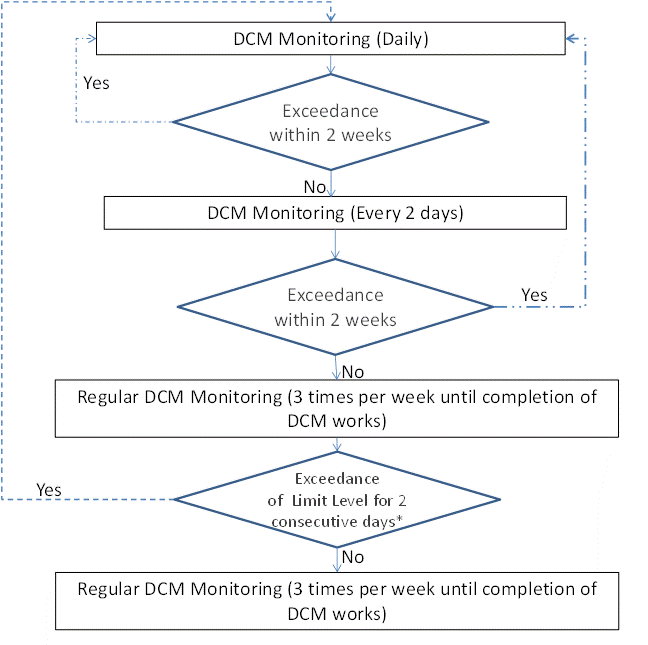

Regular DCM Monitoring
5.1.9.4 After completion of the initial intensive DCM monitoring,
regular DCM monitoring will be conducted as part of the general impact
monitoring presented in Section 5.1.8 for the remaining duration of the
DCM works. During this period, total alkalinity and two representative heavy
metals will be monitored at all stationary control and impact monitoring
stations as specified in Table 5‑2. The two
representative heavy metals shall be proposed by the ET taking into account the
findings of the initial intensive DCM monitoring. The selection criteria for
determining the representative heavy metals should include but not limited to
the following:
● Low natural (baseline) concentrations in the marine environment
● Present in elevated concentrations in the CMPs (based on past vibrocores taken from the CMPs)
● Concentrations in the CMPs should be higher than in non- contaminated mud pit areas; and
● Not associated with strong temporal variations and/or external influences (e.g. Pearl River Delta discharges, construction activities by concurrent projects)
5.1.9.5 Two consecutive measurements of total alkalinity (ppm)
should be taken according to the stated sampling and analysis method, and
laboratory water samples for heavy metals (µg/L) measurements should be
collected at the same depths. Duplicate water samples should be taken and
analysed.
5.1.9.6 During this regular DCM monitoring period, if there is
any exceedance of the Limit Levels for total alkalinity and the two
representative heavy metals for two consecutive sampling days and such
exceedance is confirmed by the ET (with verification by the IEC) to be a result
of the DCM works, intensive DCM monitoring will be re-initiated as shown in Chart 5-1. Monitoring parameters during the intensive
DCM monitoring will be the same as those conducted for the initial intensive
DCM monitoring until such time as no further exceedances are detected and
regular DCM monitoring resumes.
5.1.10 Post-Construction Monitoring
5.1.10.1 Upon completion of
all marine construction works, a post project water quality monitoring exercise
should be carried out for four weeks, in the same manner as the impact
monitoring during construction phase.
5.1.11
Event
and Action Plan for Water Quality
5.1.11.1 The Action Level and Limit Level for
water quality (excluding sensitive receiver stations representing seawater
intakes) are defined in Table
5‑4.
Table 5‑4: Action and Limit Levels for Water Quality
|
Parameters |
Action Level |
Limit Level |
|
DO in mg/L (Surface, Middle & Bottom) |
Surface and Middle 5 percentile of baseline data for surface and middle layer |
Surface and Middle 5 mg/L or 1 percentile of baseline data for surface and middle layer for Fish Culture Zone (SR7) 4 mg/L or 1 percentile of baseline data for surface and middle layer for other stations |
|
Bottom 5 percentile of baseline data for bottom layer |
Bottom 2 mg/L or 1 percentile of baseline data for bottom layer |
|
|
Temperature in °C (for intensive DCM monitoring only) |
1.8°C above the temperature recorded at representative control stations at the same tide of the same day |
2°C above the temperature recorded at representative control stations at the same tide of the same day |
|
SS in mg/L |
95 percentile of baseline data or 120% of upstream control station at the same tide of the same day, whichever is higher |
99 percentile of baseline data or 130% of upstream control station at the same tide of the same day, whichever is higher |
|
Turbidity in NTU |
||
|
Total Alkalinity in ppm |
||
|
Nutrient |
||
|
Ammonia (NH3) |
||
|
Unionised ammonia (NH3) (with 0.021 mg/L as the upper limit) |
||
|
Nitrite (NO2) |
||
|
Nitrate (NO3) |
||
|
TKN |
||
|
Total Phosphorus |
||
|
Reactive Phosphorus |
||
|
Heavy Metals |
||
|
Cadmium (Cd) |
||
|
Chromium (Cr) |
||
|
Copper (Cu) |
||
|
Nickel (Ni) |
||
|
Lead (Pb) |
||
|
Zinc (Zn) |
||
|
Arsenic (As) |
||
|
Silver (Ag) |
||
|
Mercury (Hg) |
||
Notes:
1. For DO measurement, non-compliance occurs when monitoring result is lower than the limits.
2. For parameters other than DO, non-compliance of water quality results when monitoring results is higher than the limits.
3. Depth-averaged results are used unless specified otherwise.
4. All the figures given in the table are used for reference only and the EPD may amend the figures whenever necessary.
5. For all mobile impact stations, the baseline data will be represented by the nearest stationary monitoring station.
5.1.11.2 The Action Level
and Limit Level for water quality impact monitoring have been established and
presented in the Baseline Water Quality Monitoring Report. The summary tables
of the Action Level and Limit Level for water quality are presented in Table 5‑5 and Table 5‑6.
Table 5‑5: Action and Limit Levels for General Impact Water Quality Monitoring and Regular DCM Monitoring
|
Parameters |
Action Level |
Limit Level |
||
|
DO in mg/L (Surface, Middle & Bottom) |
Surface and Middle 4.5 mg/L |
Surface and Middle 4.1 mg/L 5 mg/L for Fish Culture Zone (SR7) only |
||
|
Bottom 3.4 mg/L |
Bottom 2.7 mg/L |
|||
|
Suspended Solids (SS) in mg/L |
23 |
or 120% of upstream control station at the same tide of the same day, whichever is higher |
37 |
or 130% of upstream control station at the same tide of the same day, whichever is higher |
|
Turbidity in NTU |
22.6 |
36.1 |
||
|
Total Alkalinity in ppm |
95 |
99 |
||
|
Representative Heavy Metals for regular DCM monitoring (chromium and nickel) |
Same as that for the intensive DCM monitoring |
Same as that for the intensive DCM monitoring |
||
Note:
1. For DO measurement, non-compliance occurs when monitoring result is lower than the limits.
2. For parameters other than DO, non-compliance of water quality results when monitoring results is higher than the limits.
3. Depth-averaged results are used unless specified otherwise.
4. The Action and Limit Levels specified in this table does not apply to SR1A and SR8 (see Section 5.11.1.3).
Table 5‑6: Action and Limit Levels for Intensive DCM Monitoring
|
Parameters |
Action Level |
Limit Level |
||
|
DCM-Specific Parameters |
|
|
||
|
Temperature in °C
|
1.8°C above the temperature recorded at upstream control stations at the same tide of the same day |
2°C above the temperature recorded at upstream control stations at the same tide of the same day |
||
|
Total Alkalinity in ppm |
95 |
or 120% of upstream control station at the same tide of the same day, whichever is higher |
99 |
or 130% of upstream control station at the same tide of the same day, whichever is higher |
|
Nutrient (mg/l) |
|
|
||
|
Ammonia (NH3) |
0.18 |
0.20 |
||
|
Unionised ammonia (NH3) (with 0.021 mg/L as the upper limit) |
0.01 |
0.01 |
||
|
Nitrite (NO2) |
0.12 |
0.13 |
||
|
Nitrate (NO3) |
1.05 |
1.18 |
||
|
TKN |
0.6 |
0.7 |
||
|
Total Phosphorus |
0.06 |
0.07 |
||
|
Reactive Phosphorus |
0.04 |
0.04 |
||
|
Heavy Metals (µg/l) |
|
|
||
|
Cadmium (Cd) |
0.1 |
0.1 |
||
|
Chromium (Cr) |
0.2 |
0.2 |
||
|
Copper (Cu) |
1.9 |
5.1 |
||
|
Nickel (Ni) |
3.2 |
3.6 |
||
|
Lead (Pb) |
0.2 |
0.2 |
||
|
Zinc (Zn) |
6 |
8 |
||
|
Arsenic (As) |
3 |
4 |
||
|
Silver (Ag) |
0.1 |
0.1 |
||
|
Mercury (Hg) |
0.05 |
0.05 |
||
|
Other Water Quality Parameters |
||||
|
DO in mg/L (Surface and Middle) |
80% of upstream control station* at the same tide of the same day or 4 mg/l, whichever is lower |
70% of upstream control station* at the same tide of the same day or 4 mg/l, whichever is lower |
||
|
DO in mg/L (Bottom) |
80% of upstream control station* at the same tide of the same day or 2 mg/l, whichever is lower |
70% of upstream control station* at the same tide of the same day or 2 mg/l, whichever is lower |
||
|
Suspended Solids (SS) in mg/L |
120% of upstream control station* at the same tide of the same day |
130% of upstream control station* at the same tide of the same day |
||
|
Turbidity in NTU |
||||
Note:
1. Non-compliance of water quality results when monitoring results is higher than the limits, except for DO measurement whereby non-compliance results when monitoring results is lower than the limits.
2. Depth-averaged results are used unless specified otherwise.
3. For Cd, Cr, Pb, Ag and Hg, the percentile values are below detection limit, hence the Action and Limit Levels represent detection limit.
4. Where the water quality results at control stations for individual parameters are below detection limit, the value of the detection limit will be adopted.
5. (*) Upstream control station refers to average of the two control station results, unless the difference between the two control station results is >25%, in which case the higher (for SS and turbidity) and lower (for DO) of the two shall apply.
5.1.11.4 For sensitive
receiver stations representing seawater intakes for cooling (e.g. SR1A and
SR8), only the Action and Limit Levels for SS parameter would be applicable (as
the operation of these intakes would not be significantly affected by the other
water quality parameters). At these cooling water intakes, the Action and Limit
Levels for SS are dependent on the operational tolerance of individual intakes.
The ET will propose suitable Action and Limit Levels for SS at individual
sensitive receiver stations representing seawater intakes. This shall be agreed
with the IEC and the respective operators of the intakes prior to commencement
of construction activities or commencement of operation of the seawater intake
(whichever is later) and documented in the Baseline Monitoring Report and
EM&A reports.
5.1.11.5 As agreed with the
IEC and the respective operators, the Action and Limit Levels for SR1A and SR8
are shown in Table 5‑7.
Table 5‑7: Action Level and Limit Level for SR1A and SR8
|
SS (mg/l) |
Action Level |
Limit Level |
|
SR1A |
33 |
42 |
|
SR8 |
52 |
60 |
5.1.11.6 The actions in accordance
with the Event and Action Plan in Table 5‑8
and Table 5‑9 should be carried out if the
water quality assessment criteria are exceeded at any designated monitoring
points.
Table 5‑8: Event and Action Plan for General Impact Water Quality Monitoring
|
Event |
ET |
IEC |
Action AAHK / PM |
Contractor |
|
Action Level being exceeded by one sampling day |
1. Repeat in-situ measurement to confirm findings; 2. Identify reasons for non-compliance and sources of impact; 3. Inform IEC and Contractor; 4. Check monitoring data, all plant, equipment and Contractor’s working methods; 5. Discuss mitigation measures with IEC and Contractor; 6. Repeat in-situ monitoring on the day after the exceedance. |
1. Discuss with ET and Contractor on the mitigation measures; 2. Review proposals on mitigation measures submitted by Contractor and advise AAHK / PM accordingly; 3. Assess the effectiveness of the implemented mitigation measures. |
1. Discuss with IEC on the proposed mitigation measures; 2. Make agreement on the mitigation measures to be implemented; 3. Assess the effectiveness of the implemented mitigation measures. |
1. Inform AAHK / PM and confirm receipt of ET’s notification of the non-compliance in writing; 2. Rectify unacceptable practice; 3. Check all plant and equipment; 4. Provide report of the status and condition of plant, equipment and mitigation measures to ET 5. Consider changes of working methods; 6. Discuss with ET and IEC and propose mitigation measures. |
|
Action Level being exceeded by more than two consecutive sampling days |
1. Repeat in-situ measurement to confirm findings; 2. Identify reasons for non-compliance and sources of impact; 3. Inform IEC and Contractor; 4. Check monitoring data, all plant, equipment and Contractor’s working methods; 5. Discuss mitigation measures with IEC and Contractor; 6. Ensure mitigation measures are implemented; 7. Repeat in-situ monitoring on the day after the exceedance and prepare to increase the monitoring frequency to daily. |
1. Discuss with ET and Contractor on the mitigation measures; 2. Review proposals on mitigation measures submitted by Contractor and advise AAHK / PM accordingly; 3. Assess the effectiveness of the implemented mitigation measures. |
1. Discuss with IEC on the proposed mitigation measures; 2. Make agreement on the mitigation measures to be implemented; 3. Assess the effectiveness of the implemented mitigation measures. |
1. Inform AAHK / PM and confirm receipt of ET’s notification of the non-compliance in writing; 2. Rectify unacceptable practice; 3. Check all plant and equipment; 4. Provide report of the status and condition of plant, equipment and mitigation measures to ET 5. Consider changes of working methods; 6. Discuss with ET and IEC and propose mitigation measures to AAHK / PM and IEC within three working days; 7. Implement the agreed mitigation measures.
|
|
Limit Level being exceeded by one sampling day |
1. Repeat in-situ measurement to confirm findings; 2. Identify reasons for non-compliance and sources of impact; 3. Inform IEC, Contractor and EPD; 4. Check monitoring data, all plant, equipment and Contractor’s working methods; 5. Discuss mitigation measures with AAHK / PM, IEC and Contractor; 6. Ensure mitigation measures are implemented; 7. Repeat in-situ monitoring on the day after the exceedance and prepare to increase the monitoring frequency to daily |
1. Discuss with ET and Contractor on the mitigation measures; 2. Review proposals on mitigation measures submitted by Contractor and advise AAHK / PM accordingly; 3. Assess the effectiveness of the implemented mitigation measures. |
1. Discuss with ET, IEC and Contractor on the proposed mitigation measures; 2. Request Contractor to critically review the working methods; 3. Make agreement on the mitigation measures to be implemented; 4. Assess the effectiveness of the implemented mitigation measures. |
1. Inform AAHK / PM and confirm receipt of ET’s notification of the non-compliance in writing; 2. Rectify unacceptable practice; 3. Check all plant and equipment; 4. Provide report of the status and condition of plant, equipment and mitigation measures to ET 5. Consider changes of working methods; 6. Discuss with AAHK / PM, ET and IEC and propose mitigation measures to AAHK / PM and IEC within three working days; 7. Implement the agreed mitigation measures. |
|
Limit Level being exceeded by more than one consecutive sampling days |
1. Repeat in-situ measurement to confirm findings; 2. Identify reasons for non-compliance and sources of impact; 3. Inform IEC, Contractor and EPD; 4. Check monitoring data, all plant, equipment and Contractor’s working methods; 5. Discuss mitigation measures with AAHK / PM, IEC and Contractor; 6. Ensure mitigation measures are implemented; 7. Increase the in-situ monitoring frequency to daily until no exceedance of Limit Level for two consecutive days. |
1. Discuss with ET and Contractor on the mitigation measures; 2. Review proposals on mitigation measures submitted by Contractor and advise AAHK / PM accordingly; 3. Assess the effectiveness of the implemented mitigation measures. |
1. Discuss with IEC, ET and Contractor on the proposed mitigation measures; 2. Request contractor to critically review the working methods; 3. Make agreement on the mitigation measures to be implemented; 4. Assess the effectiveness of the implemented mitigation measures; 5. Consider and instruct, if necessary, the Contractor to slow down or to stop all or part of the construction activities until no exceedance of Limit Level. |
1. Inform AAHK / PM and confirm receipt of ET’s notification of the non-compliance in writing; 2. Rectify unacceptable practice; 3. Check all plant and equipment; 4. Provide daily report of the status and condition of plant, equipment and mitigation measures to ET until no further exceedance; 5. Consider changes of working methods; 6. Discuss with AAHK / PM, ET and IEC and propose mitigation measures to AAHK / PM and IEC within three working days; 7. Implement the agreed mitigation measures; 8. As directed by AAHK / PM, to slow down or to stop all or part of the construction activities. |
Note: Where the Action Level is the same as the Limit Level, the actions specified for Limit Level exceedances shall apply.
Table 5‑9: Event and Action Plan for DCM Process
|
Event |
ET |
IEC |
Action AAHK / PM |
Contractor |
|
Action Level being exceeded by one sampling day |
1. Repeat in-situ measurement to confirm findings; 2. Identify reasons for non-compliance and sources of impact; 3. Inform IEC and Contractor; 4. Check monitoring data, all plant, equipment and Contractor’s working methods; 5. Discuss mitigation measures with IEC and Contractor; 6. During intensive DCM monitoring and if not already undertaking daily monitoring, increase monitoring frequency in accordance with Chart 5.1 (applies to DCM-specific parameters only). During regular DCM monitoring, repeat monitoring on the day after the exceedance. |
1. Discuss with ET and Contractor on the mitigation measures; 2. Review proposals on mitigation measures submitted by Contractor and advise AAHK / PM accordingly; 3. Assess the effectiveness of the implemented mitigation measures. |
1. Discuss with IEC on the proposed mitigation measures; 2. Make agreement on the mitigation measures to be implemented; 3. Assess the effectiveness of the implemented mitigation measures. |
1. Inform AAHK / PM and confirm receipt of ET’s notification of the non-compliance in writing; 2. Rectify unacceptable practice; 3. Check all plant and equipment; 4. Provide report of the status and condition of plant, equipment and mitigation measures to ET; 5. Consider changes of working methods; 6. Discuss with ET and IEC and propose mitigation measures. |
|
Action Level being exceeded by more than two consecutive sampling days |
1. Repeat in-situ measurement to confirm findings; 2. Identify reasons for non-compliance and sources of impact; 3. Inform IEC and Contractor; 4. Check monitoring data, all plant, equipment and Contractor’s working methods; 5. Discuss mitigation measures with IEC and Contractor; 6. Ensure mitigation measures are implemented; 7. During intensive DCM monitoring and if not already undertaking daily monitoring, increase monitoring frequency in accordance with Chart 5.1 (applies to DCM-specific parameters only). During regular DCM monitoring, repeat monitoring on the day after the exceedance and prepare to increase the monitoring frequency to daily. |
1. Discuss with ET and Contractor on the mitigation measures; 2. Review proposals on mitigation measures submitted by Contractor and advise AAHK / PM accordingly; 3. Assess the effectiveness of the implemented mitigation measures. |
1. Discuss with IEC on the proposed mitigation measures; 2. Make agreement on the mitigation measures to be implemented; 3. Assess the effectiveness of the implemented mitigation measures. |
1. Inform AAHK / PM and confirm receipt of ET’s notification of the non-compliance in writing; 2. Rectify unacceptable practice; 3. Check all plant and equipment; 4. Provide report of the status and condition of plant, equipment and mitigation measures to ET; 5. Consider changes of working methods; 6. Discuss with ET and IEC and propose mitigation measures to AAHK / PM and IEC within 3 working days; 7. Implement the agreed mitigation measures. 8. As directed by AAHK / PM, to slow down all or part of the construction activities. |
|
Limit Level being exceeded by one sampling day |
1. Repeat in-situ measurement to confirm findings; 2. Identify reasons for non-compliance and sources of impact; 3. Inform IEC, Contractor and EPD; 4. Check monitoring data, all plant, equipment and Contractor’s working methods; 5. Discuss mitigation measures with IEC, AAHK / PM and Contractor; 6. Ensure mitigation measures are implemented; 7. During intensive DCM monitoring and if not already undertaking daily monitoring, increase monitoring frequency in accordance with Chart 5.1 (applies to DCM-specific parameters only). During regular DCM monitoring, repeat monitoring on the day after the exceedance. |
1. Discuss with ET and Contractor on the mitigation measures; 2. Review proposals on mitigation measures submitted by Contractor and advise AAHK / PM accordingly; 3. Assess the effectiveness of the implemented mitigation measures. |
1. Discuss with IEC, ET and Contractor on the proposed mitigation measures; 2. Request Contractor to critically review the working methods; 3. Make agreement on the mitigation measures to be implemented; 4. Assess the effectiveness of the implemented mitigation measures. |
1. Inform AAHK / PM and confirm receipt of ET’s notification of the non-compliance in writing; 2. Rectify unacceptable practice; 3. Check all plant and equipment; 4. Provide report of the status and condition of plant, equipment and mitigation measures to ET; 5. Consider changes of working methods; 6. Discuss with AAHK / PM, ET and IEC and propose mitigation measures to AAHK / PM and IEC within three working days; 7. Implement the agreed mitigation measures. |
|
Limit Level being exceeded by more than one consecutive sampling days |
1. Repeat in-situ measurement to confirm findings; 2. Identify reasons for non-compliance and sources of impact; 3. Inform IEC, Contractor and EPD; 4. Check monitoring data, all plant, equipment and Contractor’s working methods; 5. Discuss mitigation measures with IEC, AAHK / PM and Contractor; 6. Ensure mitigation measures are implemented; 7. During intensive DCM monitoring and if not already undertaking daily monitoring, increase monitoring frequency in accordance with Chart 5.1 (applies to DCM-specific parameters only). During regular DCM monitoring, re-initiate the intensive DCM monitoring in accordance with Chart 5.1. |
1. Discuss with ET and Contractor on the mitigation measures; 2. Review proposals on mitigation measures submitted by Contractor and advise AAHK / PM accordingly; 3. Assess the effectiveness of the implemented mitigation measures. |
1. Discuss with IEC, ET and Contractor on the proposed mitigation measures; 2. Request contractor to critically review the working methods; 3. Make agreement on the mitigation measures to be implemented; 4. Assess the effectiveness of the implemented mitigation measures; 5. Consider and instruct, if necessary, the Contractor to slow down or to stop all or part of the construction activities until no exceedance of Limit Level. |
1. Inform AAHK / PM and confirm receipt of ET’s notification of the non-compliance in writing; 2. Rectify unacceptable practice; 3. Check all plant and equipment; 4. Provide report of the status and condition of plant, equipment and mitigation measures to ET; 5. Consider changes of working methods; 6. Discuss with AAHK / PM, ET and IEC and propose mitigation measures to AAHK / PM and IEC within three working days; 7. Implement the agreed mitigation measures; 8. As directed by AAHK / PM, to stop all or part of the construction activities. |
5.1.12
Mitigation
Measures
5.1.12.1
The implementation schedule of the recommended water quality mitigation
measures is presented in Appendix C.
5.2 Operation Water Quality Monitoring
5.2.1 Introduction
5.2.1.1 As it has been assessed that there would not be any
significant changes in the water quality during operation of the project, no
marine water quality monitoring is considered necessary during the operation
phase.
5.2.1.2 Water quality monitoring for the spent cooling water
discharges will be undertaken in accordance with the future Water Pollution
Control Ordinance (WPCO) license conditions.
5.2.1.3 Water quality monitoring is proposed for the greywater
treatment facility during commissioning of the facility to ensure the treated
effluent quality complies with the reuse standards as defined in the EIA
Report, which are reproduced in Table 5‑10.
Table 5‑10: Treated Effluent Quality Criteria for Greywater Treatment Facility
|
Parameters |
Criteria Level |
|
SS |
≤ 5 mg/L |
|
BOD5 |
≤ 10 mg/L |
|
COD |
≤ 50 mg/L |
|
Oil and Grease |
≤ 10 mg/L |
|
Surfactants (total) |
≤ 5 mg/L |
|
E. coli |
< 1 count / 100ml |
|
pH |
6.0 – 9.0 |
|
Turbidity |
< 2 NTU |
|
Faecal Coliforms |
Non detectable / 100ml |
5.2.2 Commissioning Test for Greywater
Treatment Facility
5.2.2.1 During commissioning of the greywater treatment facility,
monitoring of pH, turbidity, SS, 5-day Biological Oxygen Demand (BOD5),
Chemical Oxygen Demand (COD), oil and grease, E.coli, faecal coliforms and
surfactants for the treated effluent should be undertaken to ensure the
treatment facility will be able to treat the greywater to levels in compliance
with the reuse standards as listed in Table 5‑10.
Details of the proposed monitoring for treated effluent including the
monitoring location, monitoring frequency, effluent sampling and testing
methods should be proposed by the ET, which will then be checked by the IEC for
agreement with the AAHK / PM and EPD at least two weeks before commencement of
the commissioning.
5.2.2.2 During operation of the greywater treatment facility,
regular water quality monitoring for the treated effluent discharges will be
undertaken, which shall monitor compliance of the treated effluent against both
the reuse standard specified in Table 5‑10,
and the discharge standard (for discharge to foul sewer) as per the future WPCO
license conditions for discharge to foul sewer. Reuse of the treated effluent
shall be suspended if the monitoring results do not comply with the reuse
standards. The treated greywater will be discharged to the sewerage system
until the greywater treatment system resumes compliance.
6
Sewerage and Sewage Treatment
Implications
6.1
Construction
Phase Monitoring
6.1.1.1 After
implementation of the recommended mitigation measure for sewage from
construction workforce as detailed in Appendix C, no sewerage
impacts are expected from the site during construction stage. No specific sewage monitoring during construction
phase is thus required.
6.2
Operation
Phase Monitoring
6.2.1.1 The gravity sewer from the airport discharge manhole
to Tung Chung Sewage Pumping Station (TCSPS) will be upgraded by AAHK to cater
for the ultimate design sewage flow from the expanded airport. AAHK will
start planning construction of the gravity sewer upgrading in 2022 or when the
sewage flow in the affected gravity sewer exceeds 80% of the design capacity of
the sewer, whichever is earlier, so as to ensure timely completion of the
mitigation works before the flow would exceed the design capacity of the sewer. For this, it is recommended that AAHK should
conduct annual monitoring for the sewage flow build-up of the gravity sewer
from the airport discharge manhole to TCSPS from 2020 onwards, i.e., one year
before the scheduled commencement of operation of the proposed third runway.
6.2.1.2 Moreover, in order to ensure the additional sewage
generated from the 3RS project would not impose adverse impacts in respect of
sewage septicity and odour issues on the existing sewerage networks including
the public sewerage system, it is recommended to start routine monitoring of
hydrogen sulphide (H2S) levels for the sewerage system of 3RS upon
commencement of operation of the project,
6.2.1.3 The ET should propose suitable method for carrying out
the annual sewage flow monitoring for the concerned gravity sewer as well as
details of the routine H2S monitoring system for the sewerage system
of 3RS, which shall be checked by IEC and agreed by the AAHK / PM and EPD at
least one year before commencement of operation of 3RS.
7
Waste Management Implications
7.1
Construction
Phase Monitoring
7.1.1
Monitoring
Requirements
7.1.1.1Waste Management Plan (WMP) for the construction of the project was
submitted to EPD no later than 3 months before the commencement of construction
in accordance to EP Condition 2.19. The Contractors are responsible for waste
management activities during construction phase. The Contractors must ensure
that all wastes produced during the construction phase are handled, stored and
disposed of in accordance with EPD’s regulations and requirements and in line
with good waste management practices. Contract-specific WMPs should be prepared
and implemented by individual Contractors in accordance with Environment,
Transport and Works Bureau (ETWB TC(W)) No. 19/2005 Environmental Management on
Construction Site and the Construction WMP. The contract-specific WMPs shall be updated from time to time
and shall be reviewed and advised by the ET. All submissions shall be submitted
to AAHK / PM for agreement and verified by the IEC.
7.1.1.2 The
Contractors should also refer to the Construction and Demolition Material
Management Plan (C&DMMP) which will be submitted to Public Fill Committee
(PFC) before commencement of construction of the project to facilitate them in
the preparation of the contract-specific WMP. The C&DMMP should provide
ways to minimise the generation and maximise the reuse of the construction and demolition (C&D)
material at the construction phase of the project. The C&DMMP should also
describe the arrangement for collection and disposal of C&D materials to be
generated from the construction phase.
7.1.1.3 During construction
phase, the Contractors should perform regular site inspection (at least once
per week) to determine if wastes are being managed in accordance with approved
procedures and the contract-specific
WMP. Waste materials generated during
the construction works, such as inert C&D material, general refuse and
chemical wastes, are recommended to be monitored on a weekly basis to ensure
that proper storage, transportation and disposal practices are being
implemented. This monitoring of waste management practices will ensure that
these solid and liquid wastes are not disposed into the nearby harbour waters.
The Contractors would be responsible for the implementation of any mitigation
measures to minimise waste or redress problems arising from the waste
materials.
7.1.2
Audit
Requirements
7.1.2.1It is recommended that the waste generated during construction phase should
be audited periodically (at least once per week) by the ET to determine if
wastes are being managed in accordance with approved procedures and the
contract-specific WMPs. The audits should look at all aspects of waste
management including waste generation, storage, transportation and disposal. An
appropriate audit programme would be to undertake a first audit near the
commencement of the construction works, and then to audit periodically
thereafter. In addition, routine site inspections by the Contractors should
check the implementation of the recommended good site practices and other waste
management mitigation measures. The results of the
waste management audits should be reported in the EM&A reports.
7.1.2.2In case of any complaint is received,
the ET shall check compliance with the procedures for carrying out complaint
investigation and propose the necessary improvement actions. In case
non-compliance of the WMP, contract-specific WMPs, any statutory
and contractual requirements, the Event and Action Plan as shown in Chart 7-1 shall be triggered.
7.1.2.3The Action and Limit Levels for
construction waste are defined in Table 7-1. Should
non-compliance occur, actions in accordance with the Event and Action Plan in Chart 7-1, should be carried out.
Table 7-1: Action and Limit Level of Construction Waste
|
Monitoring Location |
Action Level |
Limit Level |
|
Construction Area |
When one valid documented complaint is received. |
Non-compliance of the WMP, contract-specific WMPs, any statutory and contractual requirements |
|
Chart 7-1: Event and Action Plan for Non-compliance of the WMP, Contract-specific WMPs, Any Statutory and Contractual Requirements
|
||||||
|
|
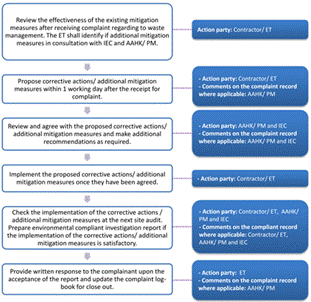
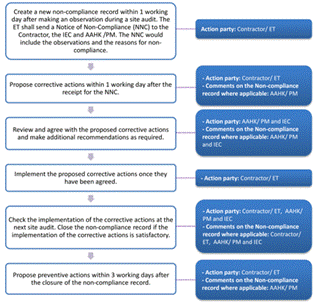
7.1.2.4The
ET shall check the disposal records for C&D materials and audit the
trip-ticket system (TTS) for off-site delivery of surplus inert C&D
materials to the designated disposal grounds. The ET shall also check that all
wastes are appropriately recorded and disposed in accordance with the
contract-specific WMPs.
7.1.2.5 A summary of all key types of waste arising and the
reuse and disposal methods proposed during the construction phase is presented
in Table 7‑2.
Table 7‑2: Summary of Waste Arising during Construction Phase
|
Waste Type |
Key Sources of Waste Generation |
Timing of Waste Generation (1) |
Estimated Total Quantity of Waste Generation (1) |
Waste Reuse or Disposal |
Handling Methods |
|
Inert C&D Material |
Excavation for APM & BHS tunnels, new APM depot and airside tunnels; piling works for T2C & other buildings; superstructure construction works; surplus surcharge material; modification of existing northern seawall; excavation and demolition as well as superstructure construction works for T2 expansion; excavation for improvement of road networks; and Horizontal Directional Drilling (HDD) for diversion of existing submarine pipelines |
Q1 of 2016 to Q3 of 2024 |
9,543,500 m3 (in-situ volume) |
About 3,639,230 m3 of the inert C&D materials generated would be reused on-site as fill materials for the proposed land formation works. The remaining 5,904,270 m3 would be delivered off-site to any identified projects that need fill materials and/or to the government’s PFRF for beneficial use by other projects in Hong Kong. |
Segregation of inert C&D material to avoid contamination from other waste arising Stockpile areas should be covered and applied with regular water spraying |
|
Non-inert C&D Material |
Site clearance of the golf course area; demolition works for T2 expansion; and superstructure construction works for various buildings / facilities |
Q3 of 2017 to Q3 of 2024 |
96,200 m3 (in-situ volume) |
The non-inert C&D material will be disposed of at landfills after on-site sorting and segregation of recyclable materials |
Separation of non-inert C&D materials from inert C&D materials Stored in compatible containers in designated area on-site |
|
Excavated Marine Sediments
|
Excavation at the cable field joint area |
Q3 of 2017 |
About 10,200 m3 (in-situ volume) |
Type 1 open sea disposal for Category L sediment or Type 1 open sea disposal at dedicated sites for Category Mp sediment, according to PNAP ADV-21 (subject to endorsement by MFC of CEDD and EPD as well as obtaining dumping permit from EPD under DASO) |
Stockpile with tarpaulin covers with earth bunds and sand bags barriers, if applicable.
|
|
Piling works of the T2C, APM & BHS tunnels, airside tunnels and other facilities on the proposed land formation area |
Q4 of 2017 to Q2 of 2023 |
About 705,350 m3 (in-situ volume) |
Treatment by cement mixing and stabilisation and on-site reuse of treated sediments as backfilling materials in accordance with the Proposal of Further Development on Treatment Level / Details and Reuse Mode for Marine Sediment.(2) |
||
|
Piling works of marine sections of the approach lights for the third runway |
2018 to 2019 (subject to detailed design) |
Western approach lights: about 530 m3 of marine sediments (in-situ volume) Eastern approach lights: about 1,060 m3 of DCM-treated sediment (in-situ volume) |
Treatment by cement mixing and stabilisation and on-site reuse of treated sediments as backfilling materials in accordance with the Proposal of Further Development on Treatment Level / Details and Reuse Mode for Marine Sediment.(2) |
||
|
Piling works of new HKIAAA beacons |
2018 to 2019 (subject to detailed design) |
About 220 m3 (in-situ volume) |
Treatment by cement mixing and stabilisation and on-site reuse of treated sediments as backfilling materials in accordance with the Proposal of Further Development on Treatment Level / Details and Reuse Mode for Marine Sediment. (2) |
||
|
Basement works of T2 expansion |
Q3 of 2017 to Q4 of 2019 |
About 50,730 m3 (in-situ volume) |
Treatment by cement mixing and stabilisation and on-site reuse of treated sediments as backfilling materials in accordance with the Proposal of Further Development on Treatment Level / Details and Reuse Mode for Marine Sediment. (2) |
||
|
Excavation works of APM depot |
Q1 of 2018 to Q3 of 2020 |
About 9,770 m3 (in-situ volume) |
Treatment by cement mixing and stabilisation and on-site reuse of treated sediments as backfilling materials in accordance with the Proposal of Further Development on Treatment Level / Details and Reuse Mode for Marine Sediment. (2) |
||
|
Chemical Waste |
Used cleansing fluids, solvents, lubricating oil, waste fuel, etc., from maintenance and servicing of construction plant and equipment |
2016 to Early 2024 |
Anticipated as small quantity To be quantified in the site Waste Management Plan to be prepared by the Contractor |
Disposal of at the Chemical Waste Treatment Centre or other licensed recycling facilities |
Stored in compatible containers in designated area on-site |
|
General Refuse & Floating Refuse |
Food scraps, waste paper, empty containers, etc. generated from the construction workforce
|
2016 to Early 2024 |
General refuse: maximum daily arising of up to 9,100 kg
|
Encourage segregation of recyclable materials (e.g., paper, tin-cans, etc.) for collection by outside recyclers Collection of non-recyclable refuse by a reputable collector for disposal at designated landfill sites. |
Provide on-site collection points together with recycling bins
|
|
Floating refuse trapped or accumulated in the newly constructed seawall |
2017 to Early 2024 |
Floating refuse: roughly 65 m3/year to be collected from the newly constructed seawall |
Collection by a reputable waste collector for disposal at designated landfill sites |
Provide on-site collection points |
Note: (1) Timing and the quantity of waste generation was based on the information provided in the EIA Report of the Project. The update information on waste generation is provided in “Construction Waste Statistic” presented in the EM&A Reports.
(2) Proposal of Further Development on Treatment Level / Details and Reuse Mode
for Marine Sediment was developed in accordance with the Waste Management Plan
(WMP) of 3RS and has been approved by EPD. The details of the proposal can be
found in Table 4.1 of the online version of 3RS WMP.
7.1.3
Mitigation
Measures
7.1.3.1 The implementation
schedule of the recommended waste management mitigation measures is presented
in Appendix C and the WMP.
7.2
Operation
Phase Monitoring
7.2.1.1Wastes produced
during operation phase would be generated by a variety of landside and airside
activities and mainly comprise of general refuse, chemical waste, sludge from
greywater treatment plant and floating refuse that may be trapped on the
artificial seawall of the expanded airport site.
7.2.1.2Operation WMP shall be submitted to EPD no later than 3 months before
the commencement of operation of the project in accordance to EP Condition
2.25.
7.2.1.3During operation phase, upon
completion of construction of the artificial seawall of the expanded airport
island, AAHK will carry out inspections of the seawall on a quarterly basis for
the first year and continuing on an as needs basis thereafter. AAHK will take
note of the no entry zone and height restriction requirement of the HKIAAA if
the inspection is undertaken by marine vessel. When trapped floating refuse is
found on the artificial seawalls of the expanded airport island causing interruption
to the airport operation, the locations of such refuse will be recorded and
special arrangements will be made to collect and clear the refuse from the
seawall. Wastes collected from the seawall will be sent to the WENT Landfill
via the Tuen Mun – Chek Lap Kok Link.
7.2.1.4With the implementation of the
recommended mitigation measures for handling, transportation and disposal of
the identified waste arisings, no adverse residual impacts are anticipated
during operation phase of the project. Therefore, no other specific waste
monitoring during operation phase is required.
8
Land Contamination
8.1
Construction
Phase Monitoring
8.1.1.1 Since some of the
assessment areas (i.e. fuel tank room within T2 building, fuel tank room to the
west of CAD antenna farm, seawater pump house and switching station, pumping
station and fire training facility) were not accessible for site reconnaissance,
further site reconnaissance would be conducted once these areas are accessible in order to identify any land
contamination concern for the areas. Subject to the further site reconnaissance
findings, a supplementary Contamination Assessment Plan (CAP) for additional
site investigation (SI) (if necessary) shall be prepared by the ET in
accordance with EP Condition 2.20 and submitted to EPD for endorsement prior to
the commencement of SI at these areas.
8.1.1.2 Since all the areas identified with potential
contamination issues are under on-going use, the SI works are proposed to be
carried out after removal / decommissioning of the concerned facilities but
prior to the commencement of construction works at those areas.
8.1.1.3 After completion of the SI, the Contamination
Assessment Report (CAR) will be prepared and submitted to EPD for approval
prior to the commencement of construction works at the golf course, the
underground and above-ground fuel storage tank areas, emergency power
generation units, airside petrol filling station and fuel tank room. Should
remediation be required, Remediation Action Plan (RAP) and Remediation Report
(RR) will be prepared for EPD’s approval prior to commencement of the proposed
remediation and any construction works respectively.
8.1.1.4 All soil and groundwater remediation works should be
carried out to clean up to levels in compliance with the relevant Risk-based
Remediation Goals (RBRG) prior to commencement of any construction works at all
areas identified with contamination issues (if any).
8.1.1.5
During construction phase, EM&A is to be carried out in the form of
regular site inspections. All related procedures and facilities for handling
or storage of chemicals and chemical wastes will be audited regularly to ensure
they are in order, intact and reported in the EM&A reports accordingly.
8.2
Operation
Phase Monitoring
8.2.1.1
As land remediation is not anticipated during the operation phase, no
environmental monitoring and audit for land contamination is considered
necessary.
9
Terrestrial Ecological Impact
9.1
Ecological
Mitigation Measures
9.1.1.1 Mitigation measures
were recommended in accordance with Annex 16 of the EIAO-TM. The recommended
mitigation measures extracted from Section 12.7 of EIA Report are listed below
and the implementation schedule is presented in Appendix C. In relation to
the pre-construction egretry survey, the requirement of submission of an
Egretry Survey Plan is also specified in EP Condition 2.14.
Avoidance
Land Formation Area
9.1.1.2 The land formation area is not located in a habitat of
high ecological sensitivity, therefore the impact to terrestrial ecology is
greatly avoided in the project design stage and no specific terrestrial
ecological mitigation measures is deemed necessary for the loss of terrestrial
habitat.
HDD Daylighting
Location
9.1.1.3 The originally proposed daylighting location is immediately
opposite the existing AFRF which minimises the pipe connection works. However
given the presence of the egretry, the daylighting location is now shifted
northwards. This measure aims to avoid direct impacts to the egretry (an
avoidance measure based on the outcomes of the impact assessment) and
furthermore, the daylighting location and mooring of flat top barge, if
required, will be kept away from the egretry (original daylighting location
refers to Section 12.6.3.1 of the EIA Report and alternative location specified
as blue zone in Drawing
MCL-P132-EMA-9-001). The vegetation at the northeastern side of Sheung
Sha Chau Island near the proposed daylighting location is short and shrubby
which is less suitable for egretry use. Only a small works area (about 10 m x
10 m) will be needed at the tentative daylighting location. This alternative is
chosen as the preferred option owing to the ecological concerns, despite a
longer pipe connection being required. The final daylighting location within
the blue zone is subject to further adjustment to avoid direct encroachment on
the egretry, giving due consideration to the findings of the pre-construction
monitoring for Sha Chau egretry, which was conducted before
the commencement of the HDD drilling works at HKIA. With the adjustment of the
daylighting location, direct encroachment onto the egretry will be
avoided.
Timing of Construction Works
9.1.1.4 All HDD and related construction works on Sheung Sha
Chau Island will all be scheduled outside the ardeids’ breeding season (between
April and July). No night-time construction work will be allowed on Sheung Sha
Chau Island during all seasons except the contingency event as specified in
Sections 12.6.3.4 and 12.6.3.5 of the EIA Report. With these avoidance measures
the impact can be largely minimised.
Minimisation
Preservation of Nesting Vegetation
9.1.1.5 The HDD daylighting location proposed in the blue zone
identified in Drawing
MCL-P132-EMA-9-001 will be located within a rock area near the
seashore, whilst the connecting pipelines will be aligned along the seashore
(above the shoreline). This proposed arrangement will avoid the need for tree
cutting, therefore trees that are used by ardeids for nesting will be
preserved.
9.2
Pre-construction Egretry Survey
9.2.1.1 As a mitigation measure to avoid disturbance to the
egretry, the HDD daylighting location and associated works will be conducted
outside the Sha Chau egretry’s boundary. The location of the HDD daylighting
location is indicated as blue zone in Drawing
MCL-P132-EMA-9-001. It is noted that the egretry’s
status and location could change from time to time even in the absence of human
disturbance. Therefore, a pre-construction survey is recommended to update the
latest boundary of the egretry during the breeding season before commencement
of the HDD drilling works at HKIA. The survey will update the latest boundary
of the egretry and to ensure the daylighting location will avoid direct
encroachment on the egretry. Subject to the pre-construction survey findings,
the daylighting location/ works area will be adjusted to avoid the future
egretry location.
9.2.1.2 The pre-construction survey has been conducted once
per month in the breeding season, i.e. between April and July, prior to the
commencement of HDD drilling works. The survey works was conducted by qualified
ecologist with at least three years’ experience on egretry monitoring. Ardeid
species and abundance were recorded whilst the latest boundary of the egretry
was identified. The information collected through the pre-construction survey
was incorporated into the Egretry Survey Plan, which has been submitted to EPD
no later than 1 month before the commencement of HDD drilling works. The result
of the egretry survey and the decision on HDD daylighting location has been
agreed with EPD and Agriculture Fisheries and Conservation Department (AFCD) by
submission of an Egretry Survey Plan prior to the commencement of HDD drilling
works.
9.3
Ecological
Monitoring
9.3.1.1 During the HDD construction works period from August
to March, ecological monitoring shall be undertaken monthly at the HDD
daylighting location on Sheung Sha Chau Island to identify and evaluate any
impacts with appropriate actions taken as required to address and minimise any
adverse impact found. Attention shall also be given to the months either side
of the ardeids breeding season, i.e. March and August, to identify any early or
late breeding activities that might be subject to disturbance. The monitoring
during works period shall be undertaken by experienced ecologist competent in
detecting any potential disturbance to the egretry.
10
Marine Ecological Impact
10.1
Introduction
10.1.1.1The EIA Report has predicted the project
would lead to some ecological impacts
and has
recommended a series of measures to avoid, minimise, and mitigate the impacts to an acceptable level.
According to EIAO-TM Annex 16, an ecological EM&A programme would be needed to ensure
the recommended measures are properly implemented. In addition, the EM&A
programme also serves other purposes, including but not limited to verifying
the accuracy of the ecological assessment study, detecting any unpredicted
ecological impacts and recommending adaptive management in response to
unpredicted impacts.
10.1.1.2It is recommended that an EM&A programme for
ecology be undertaken during the baseline (pre-construction), construction,
post-construction and operation phases of the project. The objectives of the pre-construction phase EM&A
are to undertake baseline monitoring for the corals and Chinese White Dolphins
(CWDs). The construction, post-construction and operational audit objectives
are to ensure that the ecological mitigation measures recommended in the EIA
Report are carried out as specified and are effective. The construction
and operation phase monitoring will be to monitor the CWDs over the
construction period and also determine the effectiveness of the mitigation on
CWD numbers. The EM&A will also be undertaken to verify the predictions in
the EIA Report.
10.2 Ecological
Monitoring
10.2.1 Background
10.2.1.1 It is predicted in the EIA Report that there will be direct impact on the coral communities along
the northern seawall of the existing airport island. A pre-construction phase
dive survey is recommended in the EIA Report
to review the feasibility of coral translocation and preparation of
translocation and monitoring plan where necessary. It is also predicted in the
EIA Report that the area immediately
north of the existing airport platform, which is predominantly used as a
travelling area for the CWD, will be affected by the project but that
alternative routes for travelling east and west during construction phase and
initial operational phase will be available to CWDs, potentially shifted to an
area further north of the new platform.
10.2.1.2 In addition,
habitat will be lost permanently as a result of the 3RS project and there will
be construction phase disturbance to the CWDs movement and behaviour.
Therefore, it is proposed to conduct ecological monitoring during the baseline,
construction, post-construction and operation phases of the project, with the
aims to monitor the effects on the CWDs over the construction period, including
the potential shift in the CWD travelling areas and habitat use, to monitor the
effectiveness of the High Speed Ferry (HSF) speed and routing restrictions to
the CWDs, as well as the proposed new Marine Park (when it comes into
operation) on CWD distribution and numbers. Post-construction refers to the 12
months period after the completion of marine works while operational monitoring
refers to the completion of the 3RS project as a whole.
10.2.1.3 The CWD monitoring
will be conducted by the ET, led by a CWD monitoring team leader with five
years of post-graduate experience in CWD monitoring. An overarching goal of
these surveys is to provide a dataset that can be compatible with the AFCD long
term monitoring, be stratified in such a way as to allow the calculation of
density and abundance for the various different phases listed above and to
facilitate the calculation of trends from these estimates, providing some
assessment of how the project and cumulative effects may be impacting the
CWDs.
10.2.1.4 Methods of the
baseline, construction, post-construction and operation phase surveys will be
as consistent as possible with the AFCD long-term monitoring programme to allow
for direct comparisons of results among different phases, thus allowing an
evaluation of trends and impact assessments. Further details are provided
below.
10.2.1.5 Regular meetings with the Authority and relevant
Government Departments e.g. EPD and AFCD will be arranged on a quarterly basis
when the construction phase surveys commence to review CWD distribution and
abundance trends. The data collected from vessel line transect survey,
land-based surveys and theodolite tracking and the Passive Acoustic Monitoring
(PAM) will be reviewed to derive the distribution and abundance trends, which
will be checked against the transect survey conducted under other projects and
AFCD’s long-term monitoring. It will also be conducted in conjunction with the
review of stranding data to interpret the full picture of CWD’s latest status
during construction phase. It is expected that the 3RS reclamation
activities would result in the temporary movement of CWDs away from 3RS works
areas during the construction period, and this may be indicated by a further
decline in CWD abundance in the Northwest Lantau survey area over the period of
construction. Actions may also be explored, where necessary, for remediating
unpredictable impacts or changes in abundance that are identified during the
monitoring, recognising that actions that serve to prolong the period of
reclamation activity may in themselves have an adverse impact on CWDs.
10.2.2 Pre-construction Phase Coral Dive
Survey
10.2.2.1 It is proposed to
conduct a pre-construction phase dive survey for corals along the northern and
northeastern seawall of the existing airport island and at the daylighting
location on Sha Chau that may subject to direct habitat loss and disturbance as
a precautionary measure prior to marine construction works. The aim is to
identify any coral colonies suitable for translocation. The potential for coral
translocation will depend on the conservation value, the health status and the
translocation feasibility. A detailed coral translocation plan has been
submitted to EPD no later than 3 months before the commencement of marine
construction works at areas with potential to affect coral colonies in
accordance to EP Condition 2.12. The determination of the translocation was
based on the conservation importance of the coral species (including hard
corals, soft corals and octocorals), the coral health conditions, size of the
communities and feasibility for translocation (e.g. attached to large boulders but
<50 cm in diameter and considered as manageable of translocation with
minimal destruction of the coral communities). Locations of pre-construction
coral dive surveys for the directly affected site are shown in Drawing
No. MCL/P132/EMA/10-001, the locations for the potential recipient
site(s) were determined as part of the translocation plan. In addition, it
should be noted that the daylighting location on Sha Chau will be finalised
based on the findings from the pre-construction egretry survey as indicated in Section
9.2, as well as to avoid affecting any coral colonies in the area.
Therefore, pre-construction phase coral dive survey will only be carried out at
Sha Chau if there are any marine works with potential to affect coral colonies
as identified by the ET. The preliminary methodology for coral dive survey will
be as follows:
Coral Dive Survey at Directly Affected Site and Potential Recipient Site(s)
10.2.2.2 Based on the
sub-tidal coral dive survey at hard substrates conducted in the EIA Report, the
underwater visibility within the western Lantau waters are generally low. It is
proposed to conduct the pre-construction survey at sites which would be
directly affected by the project. Suitable substrates with coral communities
will be identified, supervised by qualified marine ecologists with at least 5
years of coral dive survey experience.
10.2.2.3 The pre-construction survey was conducted by
spot-check dive followed by Rapid Ecological Assessment (REA) should coral
communities recorded. The survey was conducted at hard bottom subtidal habitats
along the northern artificial seawall of the existing airport island, and at
the proposed daylighting location on Sha Chau as shown in Drawing
No. MCL/P132/EMA/10-001 during daytime. If coral communities suitable
for translocation are identified at these directly affected sites, coral dive
surveys including spot-check dive followed by REA will also be conducted at
potential recipient site(s).
10.2.2.4 The spot-check dive
survey was conducted by swimming in a search pattern along pre-determined areas
at a density sufficient to cover any major coral areas and to assess the type
of benthos existing in the proposed survey area, recording any presence of hard
corals (order Scleractinia), octocorals (sub-class Octocorallia), and black
corals (order Antipatharia). Information including estimated number of
colonies, number of species, coral cover, and partial mortality (if any) will
be recorded during the actual dive.
10.2.2.5 The following data
was recorded during the survey:
● Temperature, time and date;
● Location (GPS);
● Depth range;
● Visibility;
● Substratum type (i.e. hard substratum seabed, intertidal rocky area); and
● Other invertebrates present.
10.2.2.6 Any special features encountered in the coral areas,
such as non-typical reef structures, unusual coral species associations, unique
or peculiar assemblages of the local incipient reef formations, and reefs that
are almost completely dominated by one particular species, will be recorded.
10.2.2.7 Representative photographs of the habitat and coral
species, and other ecological features will be taken to facilitate the
determination of suitable similar habitats as recipient site.
Rapid Ecological Assessment Survey
10.2.2.8 With reference to
the data collected during the spot-check dive survey, REA surveys will be
carried out at locations where coral communities were identified and at potential
recipient site(s). Transects of 100m in length will be laid following the
contour of the seabed at areas where corals communities identified during the
spot-check dives / at potential recipient site(s).
10.2.2.9 The REA survey will
be conducted underwater in a two-tier approach to assess the sub-littoral
substrata and benthic organisms in an area:
● Tier I assessed the relative coverage of major benthic groups and substrata.
● Tier II provided an inventory of sedentary/ sessile benthic taxa, which will be ranked in terms of their abundance at the survey site.
10.2.2.10 The taxon
categories will be ranked in terms of relative abundance of individuals, rather
than the contribution to benthic cover along each transect. The ranks will be
made by visual assessments of abundance, rather than quantitative counts of
each taxon.
10.2.2.11 The benthic
coverage, taxon abundance, and ecological attributes of the transects will be
recorded in a swath of about 2m wide, with about 1m on either side of the
transects.
10.2.2.12 Representative
photographs of any important ecological features and corals will be taken to
facilitate the determination of suitable similar habitats as recipient site and
as baseline information for future post-translocation monitoring.
10.2.3 CWD Monitoring Phases
10.2.3.1 The CWD monitoring
by vessel surveys will be conducted during baseline, construction, post
construction and operational phases. Supplementary surveys including land-based
theodolite tracking and underwater acoustic monitoring using PAM or equivalent
devices are also proposed to provide additional information (such as behaviour
change of CWD associated with concurrent activities and habitat use of CWD
during day and night) for facilitating the review of effectiveness of
mitigation measures proposed and the need for adaptive management.
10.2.3.2 Monitoring for CWDs
is proposed to be conducted by vessel surveys at a frequency of two full
surveys per month of the Northeast Lantau (NEL) and Northwest Lantau (NWL)
covering the Airport West (AW), West Lantau (WL) and Southwest Lantau (SWL)
transects, including focal follows and photo-identification, during the
baseline, construction, post-construction and operational phases. The full
surveys refer to completion of two survey transects for NEL / NWL, WL and SWL
per month, irrespective of the number of days of effort required. Ad hoc
monitoring of other CWD habitat areas will be undertaken as required and on an
as-needed basis to be determined during the course of the monitoring. The
monitoring periods for vessel surveys will be as follows:
1) Baseline Monitoring – 6 months of baseline surveys has been undertaken before the commencement of land-formation related construction works at a frequency of two full surveys per month. The commencement date of baseline survey was agreed between the ET / IEC / AAHK / PM to ensure timely submission of the baseline monitoring report to EPD and relevant authorities. The purpose of the baseline monitoring is to establish pre-construction conditions prior to the commencement of the marine construction works. The vessel-based dolphin monitoring transects in baseline monitoring are shown in Drawing No. MCL/P132/EMA/10-002.
2) Construction Phase Monitoring – This will be conducted for the duration of the land-formation related construction works for the project at a frequency of two full surveys per month with regular reviews on frequency on at least an annual basis. The purpose of the construction phase monitoring is to evaluate conditions during construction and provide data for the preparation of Marine Park establishment and management plan.
3) Post Construction Phase Monitoring – This will be conducted upon the completion of marine construction works for 12 months at a frequency of two full surveys per month. The purpose of the post construction phase monitoring is to evaluate conditions after completion of all marine works and collect data for the review of recovery of the marine environment.
4) Operation Phase Monitoring - This will be conducted for a period of at least 12 months after the full implementation of proposed Marine Park at a frequency of two full surveys per month. The main purpose of the monitoring is to detect any rebound in use of areas north and east of HKIA during the implementation of the proposed Marine Park as mitigation for habitat loss for the airport expansion, and to evaluate the overall, long-term impacts of the project on CWDs. The vessel based dolphin monitoring transects in construction, post-construction and operation phases monitoring are shown in Drawing No. MCL/P132/EMA/10-003, with transects for operation phase monitoring subject to refinement based on the actual boundaries for the extension of HKIAAA and 3RS Marine Park.
10.2.3.3 The vessel monitoring data will be used to monitor the
effectiveness of the mitigation measures proposed for the amelioration of
construction, post-construction and operation phase impacts. In particular, the
vessel monitoring data in the northwest Lantau area together with the data of
marine traffic tracking system (e.g. Automatic Identification System (AIS)
data) will be used as an audit tool to review and determine the effectiveness
of the reduction in speed for the diverted SkyPier HSF on disturbance to the
CWDs around the north of Sha Chau and Lung Kwu Chau Marine Park (SCLKCMP) (see Drawing
No. MCL/P132/EMA/10-002). In addition to the proposed vessel
transect monitoring, some additional monitoring is proposed in the form of
land-based theodolite tracking, combined with underwater acoustic monitoring to
provide additional information on CWD behaviour and occurrence during 3RS
construction works to supplement the details on CWD abundance patterns obtained
from vessel transect surveys. The main aim for these two monitoring types is to
supplement the vessel transect survey findings detailed above and to help in
verifying the predictions in the EIA Report. The effectiveness of these
additional measures in monitoring data collection will be reviewed during the
construction phase, to confirm the need and required frequency that will be
applied for post-construction and operation phase monitoring.
10.2.3.4 Land-based theodolite tracking is proposed to cover
the 6-months baseline and it will also cover the whole duration of the land
formation related construction works to provide adequate seasonal data with the
data serving to provide fine-scale information on CWD behaviour and activity
during construction, specifically swimming and movement patterns of CWD groups,
and to further capture CWD response to vessels and travel patterns. The
theodolite station established on Sha Chau is proposed to be used, given its
good aspect overlooking the proposed 3RS reclamation area north of HKIA.
Another land-based monitoring station at north of Lung Kwu Chau is proposed to
supplement the vessel monitoring data in determining the effectiveness of the
reduction in speed for the SkyPier HSF on disturbance to the CWDs (Drawing No. MCL/P132/EMA/10-004). The frequency of the theodolite
tracking will be two days per month at both Sha Chau station and Lung Kwu Chau
station during the 6-month baseline monitoring survey and the first six months
of SkyPier HSF route diversion and speed restriction plan implementation
(hereafter referred to as SkyPier HSF Plan). During the construction
phase, the frequency of the theodolite tracking for impact monitoring will be
one day per month at the Sha Chau station and one day per month at the Lung Kwu
Chau station. The frequency of CWD land-based monitoring will be subject to
review after reviewing the data from the baseline monitoring and from the
initial six months of SkyPier HSF Plan implementation. Should any changes in
the theodolite stations or tracking frequency be proposed as a result of the
review, the proposed changes will be agreed with EPD and AFCD. Any available
land-based survey data collected near the Lung Kwu Tan and Urmston Road areas
by other projects will also be reviewed to supplement the survey results for
the report to Advisory Council on the Environment (ACE) on the effectiveness of
the mitigation measures on CWDs.
10.2.3.5 Underwater acoustic
monitoring using PAM or equivalent devices as adopted in the EIA assessment
will also be undertaken during the same periods including 6 months of baseline
and within the whole duration for land formation related construction works.
Data would be used in tracking diurnal patterns of CWD presence and vocal
activity, and providing information on ambient noise level in the underwater
environment. As the information obtained from these surveys does not quantify
CWD density and abundance, it is not useful to set an Action / Limit Level
based on data from these supplemental PAM or equivalent devices. It is proposed
to deploy the PAM station at the southern water of SCLKCMP boundary in order to
coincide and supplement the data collected from the land-based monitoring
station at south of Sha Chau (Drawing
No. MCL/P132/EMA/10-005), which
will be subject to review. Should any changes in the PAM station be
proposed as a result of the review, the proposed changes will be agreed with
EPD and AFCD.
10.2.3.6 In conjunction with
the above monitoring efforts, and given the uncertainty on the levels of HSF
traffic from SkyPier / the Intermodal Transfer Terminus (ITT) in future years,
the EM&A will also monitor actual numbers of HSFs operating from SkyPier after
the HZMB and HKBCF commence operations by obtaining HSF movement data including
AIS vessel tracking data from the SkyPier operators.
10.2.4 CWD Monitoring Methods
Small Vessel Line Transect Surveys
10.2.4.1 Vessel-based CWD
surveys provide data for density and abundance estimation and other assessments
using distance-sampling methodologies, specifically, line-transect
analysis. These surveys also include photo-identification of individual
dolphins within the monitoring area when conditions are suitable, to provide
data on individual use of this specific area. Focal follow data from the
vessel may also potentially be collected, depending on a series of factors such
as the presence of special features for identification of individuals (like
presence of scratches, nick marks, cuts, wounds and distinguished color
patterns) and favourable weather conditions.
10.2.4.2The surveys involve small vessel
line-transect data collection and have been designed to be similar to, and
consistent with, previous surveys for monitoring of small cetaceans in Hong
Kong. The survey was designed to provide systematic, quantitative measurements
of density, abundance and habitat use by line transect methods.
10.2.4.3 The transects to be monitored will cover NEL, NWL, AW,
WL and SWL and will be consistent with the AFCD long-term monitoring programme
(except AW) during the baseline, construction, post-construction and operation
phases. Due to the progressive extension of the works area that will be
demarcated by floating booms during construction and permanent land formation
footprint during operation, the transects will be adjusted in the construction,
post-construction and operation phases to outside the area that can no longer
be accessed by the survey vessel. The AW transect has not been previously
surveyed in the AFCD programme due to the restrictions of HKIAA. Nevertheless,
this transect was established during the EIA of the 3RS project, with the aim
to collect project specific baseline information within the HKIAAA to fill the
data gap that was not covered by the AFCD programme. This will provide a larger
sample size for estimating the densities and patterns of movement in the
broader study area of the project. The baseline, construction, post
construction and operation phase line transects are shown in Drawing
No. MCL/P132/EMA/10-002 and MCL/P132/EMA/10-003
respectively.
10.2.4.4 A 15-20 m vessel
with a flying bridge observation platform about 4 to 5 m above water level and
unobstructed forward view, and a team of three to four observers will be
deployed to undertake the surveys. Two observers are to be on search
effort at all times when following the transect lines with a constant speed of
7 to 8 knots (i.e. 13 to 15 km per hour), one using binoculars and the other
using unaided eyes and recording data.
10.2.4.5 When CWDs are seen, the observer team will be taken off-effort,
the dolphins will be approached and photographed for photo-ID information
(using a Canon 7D [or similar] camera and long 300 mm+ telephoto lens), then
followed until they leave the study area or are lost. At that point, the boat
returns (off effort) to the survey line and begins to survey on effort again.
CWD density (D), abundance (N), and their associated precision (CV) will only
be calculated from dolphin sightings and effort data collected under conditions
of Beaufort 0-3 and visibility of approximately 1200 m or greater (in practice,
surveys should normally be postponed when visibility is below 1 km and/or when
Beaufort 5 is reached), using conventional line transect methods and the
formulae as detailed below:
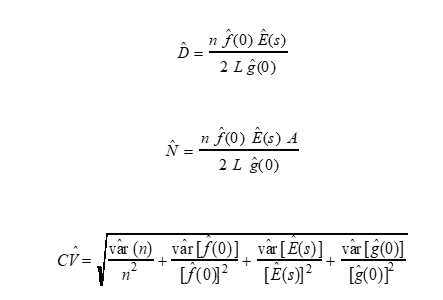
10.2.4.6 Based on the vessel survey data, seasonal differences in
dolphin density and use of the study area will then be examined annually, using
the solar seasons (Winter: December-February, Spring: March-May, Summer:
June-August, Autumn: September-November) and/or oceanographic seasons (Dry:
October-March, Wet: April-September).
10.2.4.7 Focal follows of dolphins would be used for providing
supplementary information only where practicable (i.e. when individual dolphins
or small stable groups of dolphins with members that could be readily
identified with unaided eyes during observations and weather conditions are
favourable). These involve the boat following (at an appropriate distance
to minimize disturbance) an identifiable individual dolphin for an extended
period of time, and collecting detailed data on its location, behaviour,
response to vessels, and associates. This type of data allows information to be
gathered on the movement paths and travel corridors used by dolphins in the
survey region.
Land-based Surveys and Theodolite Tracking
10.2.4.8 Land-based monitoring has been able to obtain
fine-scale information on the time of day and movement patterns of the
CWDs. A digital theodolite (Sokkia/Sokkisha Model DT5 or similar
equipment) with 30-power magnification and 5-s precision will be used to obtain the vertical and horizontal angle of each
dolphin and vessel position. Angles
are converted to geographic coordinates (latitude and longitude) and
data will be recorded using Pythagoras software, Version 1.2 (Gailey &
Ortega-Ortiz, 2002). This
method delivers precise positions of multiple
spatially distant targets in a short amount of time. The
technique is fully non-invasive, and allows for time and cost-effective
descriptions of dolphin habitat use patterns at all times of day (Würsig et al.
1991; Piwetz et al. 2012). Examples of modern statistical techniques to
describe movements relative to habitat and anthropogenic influences are
described in Gailey et al. (2007) and Lundquist et al. (2012).
10.2.4.9 Land-based observation and theodolite tracking station
will be set up at two locations facing east/south/west on the southern slopes
of the island of Sha Chau, and an audit location for SkyPier HSF facing north,
northeast, and northwest, at Lung Kwu Chau. The proposed location (D and
E) are shown with position coordinates, height of station and approximate
distances of consistent theodolite tracking capabilities for CWDs in Table 10‑1 and shown in Drawing MCL/P132/EMA/10-004.
Table 10‑1: Land-based Survey Station Details
|
Station |
Location |
Geographical Coordinates |
Station Height (m) |
Approx. Tracking Distance (km) |
|
D
|
Sha Chau
|
22° 20’ 43.5” N 113° 53’ 24.66” E |
45.66 |
2 |
|
E |
Lung Kwu Chau |
22° 22’ 44.83” N 113° 53’ 0.2” E |
70.40 |
3 |
10.2.4.10 The frequency of the theodolite tracking will be two days per month at
both the Sha Chau station and Lung Kwu Chau station during the 6-month baseline
monitoring and during the initial six months of implementation of the SkyPier
HSF Plan. The monitoring frequency during the construction phase for
marine works will be one day per month at both Sha Chau station and Lung Kwu
Chau station. The monitoring frequency and stations in the construction phase
are subject to review based on the baseline monitoring findings and a review of
the effectiveness of the SkyPier HSF Plan route diversion and speed control
measures during the first six months that these are in effect. Surveys will be
undertaken during a period of about 5-6 hours per day from the monitoring stations,
with some days longer than this but others truncated due to weather-related
deterioration of sighting conditions. Three surveyors (one theodolite
operator, one computer operator, and one person scanning with binoculars) will
be involved in each survey. Observers will search for dolphins using unaided
eyes and handheld binoculars (7X50). A theodolite tracking session will be
initiated when an individual CWD or group of CWD is located. Where
possible, a distinguishable individual will be selected, based on colouration,
within the group. The focal individual is then continuously tracked via
the theodolite, with a position recorded each time the dolphin surfaces. If an
individual cannot be positively distinguished from other members, the group
will be tracked by recording positions based on a central point within the
group whenever the CWDs surface (Bejder, 2005; Martinez, 2010). Tracking
continues until animals are lost from view, move beyond the range of reliable
visibility (>1-3 km, depending on station height), or environmental
conditions obstruct visibility (e.g., intense haze, Beaufort sea state >4,
or sunset), at which the research effort will be terminated. During the
baseline phase, in addition to the tracking of CWDs, all vessels that move
within 2-3 km of the station will be tracked, with effort made to obtain at
least two positions for each vessel. It is anticipated that this will not
be feasible during the construction phase in the 3RS construction area, and
possibly for some space outside this area also, due to the anticipated high
volume of construction-related traffic.
Theodolite Tracking Data Analysis
10.2.4.11Theodolite tracking will include focal follows of CWD
groups and vessels (the latter to be undertaken when possible). Focal follow
data will be filtered to include only CWD tracks with greater than 2 positional
fixes and 10 minutes or greater in duration. The ten minute window has been
statistically validated for theodolite tracking analyses (Gailey et al. 2007,
Lundquist 2012), and such a logical bound is also described in Turchin
(1998). If two consecutive dolphin tracks are more than 5 min apart, they
will be split and analysed separately. A broad time of day category is
assigned for each track (morning = first position recorded before 12 pm;
afternoon = first position recorded at 12 pm or later). CWD response variables
that will be calculated for each track include mean reorientation rate,
swimming speed and linearity. Reorientation rate is the degrees per minute of
changes in direction of a tracked individual or group of CWDs. Mean swimming
speed is calculated by dividing the distance travelled by the duration between
two consecutive positions (Gailey et al. 2007). Linearity is an index of net
movement ranging from 0 to 1, with 0 equating to no net movement and 1 equating
to straight line movement. It is calculated by taking the sum of distances
travelled for each leg and dividing by the net distance between the first and
last fix of a track.
10.2.4.12 In order to evaluate variation in CWD movement patterns in the presence
of vessels, it is necessary to establish a distance threshold. Consistent with
general practice and the data gathered for the EIA of this study, when vessels
are within 500 m of the focal individual or group, they will be considered
present. The 500 m threshold was chosen since Sims et al. (2012) showed that
most vessels exceeded background noise when less than 500m away, but not at
greater distances. The threshold has been used in other marine mammal
situations for similar reasons and direct measurement of animal reactions, such
as in Lundquist et al. (2012) for southern right whales (Eubalaena australis).
As it is not possible to record geographic locations of all targets
simultaneously, positions for CWDs and vessels will be interpolated post hoc
(i.e. during analysis in the lab), allowing for a more precise estimation
of vessel distances from dolphins at a given time. All types of vessels
within 500m are considered, including high speed ferries. The high speed
ferries travel through the area much more rapidly than fishing, recreational,
industrial vessels carrying cargo and will therefore be noted and assessed as a
separate category.
10.2.4.13 ArcMap will be used to plot CWD and vessel
positions, Microsoft Excel will be used to conduct computational
analysis of leg speed, and linearity and R statistical software will be
used to perform statistical analyses. Data will be tested for normality and
transformed if residuals are not normally distributed. Because dolphin focal
follows tend to vary in duration, each CWD track is split into 10-minute
segments. In order to reduce pseudo-replication, analysis will be run to
determine the temporal lag at which two segments from the same focal group are
no longer auto-correlated. Univariate statistical analyses (one-factor Analysis
of Variance, ANOVA) will be run to evaluate variation between factors.
10.2.4.14 Similar to vessel-based surveys, seasonal differences in relative CWD
occurrence and use of the study area will be examined for land-based surveys,
using both the solar seasons (Winter: Dec-Feb, Spring: Mar-May, Summer:
Jun-Aug, Autumn: Sep-Nov) and oceanographic seasons (Dry: Oct-Mar, Wet:
Apr-Sep; see Chen et al. 2010). In addition, behavioural descriptions and
potential avoidance/association by CWDs relative to vessels or other on-water
anthropogenic activities will be analysed by multi-variate analyses, as in
Gailey et al. (2007) and Lundquist et al (2012).
Passive Acoustic Monitoring (PAM)
10.2.4.15 Acoustic data will be gathered to listen for CWDs occurrence patterns
and to obtain anthropogenic noise information simultaneously. Autonomous PAM
was designed to provide daytime and night-time information on CWD occurrence
and vocal activity. This work involves a type of PAM (Wiggins and Hildebrand
2007) termed an Ecological Acoustic Recorder (EAR) (Lammers et al. 2008), with
bottom-mounted broad-band recording capability operable from 20 Hz to
32 kHz. The EAR is proposed to be positioned at the south of Sha Chau
Island to coincide with the land-based theodolite survey (Drawing No. MCL/P132/EMA/10-005). Analysis (by a specialized team
of acousticians) involves manually browsing through every acoustic recording
and logging the occurrence of vessel transits and other unusual sounds. This
approach for data analysis is adopted because generally high ambient noise
conditions in these waters have meant that an automatic algorithm cannot be
reliably used to detect dolphin sounds. All data therefore need to be
re-played by computer and listened to by human ears for accurate assessment of
dolphin group presence. Vessels will be logged when discrete transits passing
the EAR can be differentiated from background noise, and thus there can be more
than one vessel detection per file.
10.2.4.16 To improve the length of deployments, speed of data gathering, and
efficiency in data analysis, the C-POD and its successor the F-POD (developed
by Chelonia Limited, UK) are proposed in replacement of the previous EAR in
early 2021 at the same location. The C-POD/F-POD can detect cetaceans by
recognising the trains of echolocation clicks in the range 20-160 kHz and
records the click trains automatically. The C-POD has also been adopted by the
AFCD in marine mammal monitoring for collection of useful data on night-time
usage of dolphins at the SCLKCMP and the Brothers Marine Park (BMP). Analysis
is performed using the proprietary software (CPOD.exe/ FPOD.exe developed by
Chelonia Limited, UK). Objective automated data analyses to detect and identify
echolocation click trains produced by marine mammals are conducted. The click
data detected by the C-POD/F-POD are processed using the KERNOF classifier in
the software to identify click trains and their likely sources and to ensure
similar sounds, such as boat sonar noise in the ambient environment, are not
counted as dolphin detection. Experienced analysts then perform visual
validation to assess the overall rate of false dolphin detection positive
minutes (DPMs) as identified by the classifier. The visual validation is based
on a representative sampling of all detections and examining the
characteristics of clicks, multi-path clusters, and click trains.
10.2.4.17 Comparisons of CWD detections during theodolite tracks with
corresponding C-POD/ F-POD click records will be made post hoc, that is
after both sets of data have been separately analysed, positions are known, and
the positions can be compared to frequencies of CWD detections.
10.2.4.18 A review of CWD sightings from the land-based survey data in relation to
the PAM device will also be undertaken to provide data on the approximate
locations of the CWDs at the time their signals are detected. Thus, overlaps of
land-based CWD sightings and the PAM records of CWDs will be analysed.
10.2.5 Review of Construction Phase CWD
Monitoring Programme
10.2.5.1 Subject to details of the marine construction
programme established during the detailed design stage, the aforementioned CWD
monitoring programme will be reviewed by the ET. Where the CWD monitoring
programme requires revision or updating according to the detailed construction
programme, the ET will revise or update the monitoring programme accordingly,
and the revised monitoring programme will be verified by IEC before submission
to EPD and AFCD for approval prior to commencement of the marine construction
works.
10.2.6
Cumulative
Impacts for Travel Corridors/ Areas and Connectivity between Core Habitat Areas
10.2.6.1 It is clear from past and present data that the area
north of the existing airport is used for a variety of CWD behavioural
functions, including travel between Northwest and Northeast Lantau. The
longer that cumulative construction activities exist in and near this general
area, the greater will be the effect on efficient habitat use of CWD, with both
the project and the HZMB Hong Kong Link Road (HKLR) / HKBCF / Tuen Mun-Chek Lap
Kok Link (TM-CLKL) projects forcing the CWDs to move further north towards the
Tuen Mun area. However, the corridor/ area between the project and waters
to the north should still be available and useable for CWDs to transit between
western and eastern waters north of the airport. As these implications
could increase with all the projects being constructed and implemented
concurrently, a long-term monitoring programme is recommended, consistent with
that being undertaken by AFCD (i.e. by using vessel transect monitoring) as
discussed in Section 10.2.4 above.
10.3 Detailed
Implementation of Dolphin Exclusion Zone
10.3.1 Dolphin Exclusion Zone Plan
10.3.1.1 According to Environmental Permit No. EP-489/2014
Condition 3.1(v), detailed implementation of Dolphin Exclusion Zone (DEZ) shall
be included in this updated EM&A Manual. This section provides the
technical guidelines for the implementation of DEZ. The actual marine
construction activities that require the implementation of DEZ were determined
in the DEZ Plan, which was prepared by the ET based on an objective assessment
of noise levels and noise intensities from different marine construction activities
as methodologies were finalised.
10.3.1.2 A DEZ with 250 m radius from the boundary of the works
will be established for marine construction activities that require the implementation
of DEZ. The DEZ Plan has been submitted to EPD for approval at least 1 month
prior to commencement of construction activities requiring DEZ. The DEZ serves
as a short-term approach to provide appropriate and immediate action should
CWDs be sighted within the DEZ for construction activities requiring a DEZ.
Should the Action Level for CWD monitoring be exceeded, the DEZ monitoring area
shall be increased to 500 m for daytime works until the ET notify the resume of
the 250 m DEZ. Details of the DEZ are described below:
10.3.2
Daytime Monitoring of Dolphin Exclusion Zone
10.3.2.1 In the 3RS EIA Report, the impact significances of
acoustic disturbance from daytime and night-time reclamation related
construction works were evaluated as “Low-Moderate” and “Moderate”
respectively. DEZs have been adopted in Hong Kong for other previous projects
involving similar marine works activities as the 3RS project and are therefore
proposed as a precautionary and a mitigation measure respectively to address
the impacts identified from certain daytime and night-time marine works
activities.
10.3.2.2A DEZ set at a certain distance from potentially harmful marine works
activities (e.g. certain marine works known to be very noisy) will be
established during all periods of each of the marine construction activities requiring a DEZ. The DEZ
monitoring will be carried out from the shore or on a stationary barge or
vessel depending on the type of construction activity requiring the DEZ, with
an unobstructed elevated view of the DEZ, by using naked eyes and occasionally
with the aid of binoculars (e.g. Steiner Navigator 7X50 HD-stabilized Compass
or model with similar or more advanced specification) for confirmation, or by
using combination of high definition pan-tilt-zoom network camera and
closed-circuit television system (CCTV). The use of CCTV or alternative
approach proposed by the contractor for achieving effective DEZ monitoring must
be tested in the site before actual use for DEZ monitoring, and all the tests
shall be witnessed and verified by AAHK, ET and IEC. The actual monitoring
locations will be proposed in the DEZ Plan which will be determined by the ET
and thereafter subject to update based on the marine construction programme.
10.3.2.3 At least two dolphin observers will carry out the
monitoring on shift (e.g. rotate every 30 minutes), in order to minimise
fatigue. The dolphin observers must be adequately
trained and qualified, preferably with a degree in biological sciences or
equivalent, experience in observing dolphins, and basic knowledge of literature
on CWDs in Hong Kong. The dolphin observers should be appointed by, but must be
independent of, the construction contractor. The dolphin observers shall be
trained by the ET, who shall also provide regular competence checking on the
effective implementation of the DEZ.
10.3.2.4
Prior to the commencement of construction activities that require the
implementation of a DEZ, the DEZ will be thoroughly scanned for dolphins for an
initial period of 30 minutes. If dolphins are observed in the DEZ, the dolphin
observers will immediately inform the Site Supervisor or relevant person
through mobile phone or handheld transceivers to delay the commencement of the
construction activities in the works area within the DEZ, until the dolphins
leave and the DEZ is continuously free of dolphin for a period of 30 minutes.
10.3.2.5
If dolphins are observed within the DEZ during construction works, the
dolphin observers will inform the Site Supervisor or relevant person through
mobile phone or handheld transceivers to cease the construction activities
within the DEZ. The dolphin observers will continue to monitor the dolphins.
When the dolphins leave the DEZ and the DEZ is clear of dolphins for a period
of 30 minutes, the dolphin observers will inform the Site Supervisor or
relevant person that the construction activities within the DEZ could be
resumed.
10.3.2.6
If dolphins are observed in close vicinity but outside the DEZ, the
dolphin observers will also inform the Site Supervisor about the presence of
the dolphins. The dolphin observers will remain in position and closely observe
the movement of the dolphins as well as searching for the appearance of any
other dolphins within the DEZ.
10.3.2.7
All vessel captains involved in construction activities in and around
the DEZ shall be advised to pay special attention to the presence of dolphins
around the DEZ and to use appropriate slow speed when travelling within or near
to the DEZ area in order to reduce chance of collision with or other adverse
impacts to the dolphins.
10.3.2.8In case of injury or live-stranded dolphins being found within the DEZ,
the dolphin observers will immediately inform the Site Supervisor to suspend
the construction activities within the works area around the DEZ and contact
AFCD through “1823” marine mammal stranding hotline.
10.3.2.9 Each DEZ monitoring team has to fill in a data record
sheet for data keeping purpose when they are on duty. General information not
limited to those listed below will be recorded at the beginning of the
monitoring:
● Commencement Time of Monitoring; and
● Commencement Time of Construction Activity.
10.3.2.10 In case dolphins are
detected within the DEZ, the information included but not limited to the
following will be recorded:
● First Sighting Time within DEZ;
● Last Sighting Time within DEZ;
● Cessation Time of Construction Work;
● Re-start Time of Construction Work;
10.3.3
Night-time
Monitoring of Dolphin Exclusion Zone
10.3.3.1 The PAM result during the 3RS EIA study suggested that
night-time CWD activity in the 3rd runway footprint area may be more extensive
than previously thought, and therefore implications for disturbance and loss of
area could be higher than the daytime use alone would indicate. Therefore, the
implementation of an effective DEZ monitoring scheme during night-time periods
was also recommended in the 3RS EIA Report.
10.3.3.2Night-time DEZ monitoring will be
conducted by using night vision device (NVD) that greatly enhance the small
amount of available light at night to make visual observing of CWDs possible.
The NVD is suggested to be in the form of hand-held, head-mounted or
tripod-mounted units depending on the location of the DEZ monitoring station
(e.g. ATN model PS15-CGTI Night Vision Goggles with 3X lens or model with
similar or more advanced specification and performance).
10.3.3.3 Similar to daytime DEZ monitoring, the use of NVD to
assist the implementation of DEZs shall be carried out from the shore or a
stationary barge or other vessel, and experienced personnel shall be used,
dedicated 100% to the dolphin searching effort (i.e. not ancillary to other
activities). Night-time DEZ monitoring will follow a similar procedure to the
daytime DEZ monitoring except for the complete use of NVD over naked eyes for
scanning. It is recommended that two night-time observers scan the exclusion
zone, with appropriate staggered rest periods to avoid eye fatigue and general
fatigue.
10.3.3.4 All selected NVD shall be tested before actual use for
night-time DEZ monitoring. This test is to be conducted by experienced
dolphin-monitoring researchers, preferably at a site or sites where dolphins
occur with regularity and can be tracked by theodolite in the late afternoon
hours, so that visual day-time tracking can be “handed off” to night-time NVD
sighting as darkness descends. All tests shall be witnessed and verified by the
AAHK/ PM, ET and IEC. Only after such dedicated testing has provided confidence
that the NVD technique allows for reliable detection of dolphin at night shall
the use of NVD be adopted. The feasibility of using PAM involving the use of
hydrophones or automated cetacean detectors with real-time data capability, or
CCTV involving high definition network camera with night vision could be
explored by the Contractor for the DEZ monitoring in case the NVD is found to
be ineffective for night-time CWD detection. Alternative night-time monitoring
devices, including using PAM or CCTV should be witnessed
and verified by the AAHK/ PM, ET and IEC with satisfactory performance, prior
to the adoption for implementation of night-time DEZ monitoring.
10.4 Acoustic Decoupling
10.4.1.1 According to Environmental Permit No. EP-489/2014
Condition 3.1(v), detailed implementation of acoustic decoupling shall be
included in this updated EM&A Manual. This section provides the technical
guidelines for the acoustic decoupling devices to be implemented to minimise
the indirect disturbance to CWD during marine construction.
10.4.1.2 CWD whistle communication frequencies in the 4-8 kHz
octave band are well above the frequencies produced by most large vessels used
in shipping and marine construction activities. Based on available
experience in Hong Kong, these types of vessels are not considered to be a
significant source of acoustic disturbance. Main engines of the proposed
working vessels are therefore not considered to be a significant source of
acoustic disturbance and will not be considered as source of noise and vibration.
However, there is still a small possibility that noise would be transmitted
from the noisy Powered Mechanical Equipment (PME) on vessels (i.e. air
compressors, generators and winch generators) into the sea. Therefore,
acoustic decoupling measures for noisy equipment which are not embedded on
vessels are required to minimise the possible noise impact on CWD / marine
ecology.
10.4.1.3Noise isolation pad could be one of
the acoustic decoupling devices to separate the noisy PME from the deck or hull
in order to reduce noise transmission to the sea via the vessel. The size
of the isolation pad for the identified noisy PME should be large enough to
cover the whole base with thickness of at least 24 mm. A schematic diagram of
noise isolation pad is shown Drawing
MCL/P132/EMA/10-006.
10.4.1.4 The noisy PME on vessels should be fixed on noise
isolation pad instead of directly mount on the deck. Contractor should
ensure the foundation of equipment is flat and level prior to
installation. Adequate clearance all around the PME should be kept to
avoid direct vibration transmission to other materials and machineries.
10.5 Action/Limit Levels and Event Action
Plan for CWD
10.5.1.1 As mentioned in Section 10.2.1.5 and the EIA Report,
it is expected that the 3RS reclamation activities would result in the
temporary movement of CWDs away from 3RS works areas during the construction
period, and this may be indicated by a further decline in CWD abundance in the
Northwest Lantau survey area over the period of construction. As part of the
set of required mitigation measures for the construction of the project, an
Event and Action Plan framework has been developed that is intended to detect
any deterioration in ambient environmental quality that could endanger CWDs or
result in an overall decline in CWD numbers in Lantau waters (NEL, NWL, AW, WL
and SWL) as a whole below a certain threshold level. Appropriate remedial
actions are described and would be taken as part of the plan, intended to
prevent unacceptable deterioration in environmental quality or a reduction in
CWD numbers in Lantau waters as a whole below the Limit Level that may be caused by 3RS
construction works.
10.5.1.2 The Event and Action Plan has been reviewed and
consolidated based on the data from the baseline CWD monitoring surveys, with
reference to historical data on some key parameters that are indicative of the
health of the CWD population (and specifically the portion that uses Hong Kong
waters as part of their range), and can be monitored as part of regular
EM&A efforts during construction, providing early warning when particularly
serious impacts may be occurred. The results would be used as a management
tool, so that if the decline in overall CWD encounter rate is determined to be
from the 3RS construction process, appropriate measures may then be triggered /
considered to minimise possible impacts with short term response to events
after reviewing the monitoring data for each month. A set of criteria that may
trigger certain identified actions have been developed and are detailed in the
following sections.
10.5.2 Action Response Approach
10.5.2.1 The approach proposed for formulating the AL and LL
for construction phase CWD monitoring involves using the encounter rate. The
encounter rate provides a direct indicator of the health of CWD population and
it can be determined from the EM&A effort (i.e. CWD monitoring). Actions
will be taken when these levels in the overall Lantau waters covering NWL, AW,
NEL, WL and SWL have been triggered.
10.5.2.2Both the Encounter Rate of Number of
Dolphin Sightings (STG) and Encounter Rate of Number of Dolphins (ANI) from the
baseline survey are adopted as the parameters for determining the AL and LL.
The calculation of the CWD encounter rates for determining AL and LL made use
of the dataset from the CWD Baseline Monitoring undertaken for this project as
part of the EM&A requirement under the Environmental Impact Assessment
Ordinance (EIAO). The formulas for calculating STG and ANI encounter rates are shown
below:
Quarterly Encounter Rate of Number of Dolphin
Sightings (STG)

Quarterly Encounter Rate of Number of Dolphins
(ANI)

(Notes: 1. Only data collected under Beaufort 3 or below condition was used;
2. A quarter refers to three survey months, and data collected within a quarter was counted and calculated to obtain the total no. of on-effort sightings, total no. of dolphins from on-effort sightings and total amount of survey effort)
10.5.2.3 According to the approved 3RS EIA Report, 3RS
construction works are expected to result in CWDs temporarily moving away from
the project works area during the construction phase. The use of the encounter
rate approach, making use of the quarterly dolphin vessel survey findings to
compare with baseline STG and ANI values provides a short to medium term
frequency method for monitoring and responding appropriately to changes in CWD
abundance as project works progress. It is proposed that AL and LL are
established for Lantau waters covering NEL, NWL, AW, WL and SWL as a whole, as
it has been anticipated in the EIA Report that the number of CWDs in North
Lantau waters will decline due to the project, and CWDs may move to other areas
around Lantau including West Lantau and Southwest Lantau. A combined encounter
rate can present a general picture of the entire waters around the Project area
and Lantau.
10.5.2.4
Natural seasonal fluctuations of CWD
encounter rates across the four seasons may cause non-project related
triggering of the AL and/or the LL, therefore historical CWD data has been
reviewed to take into account the effect of seasonal fluctuations on the CWD
encounter rate. The seasonal variations of CWD quarterly encounter rates based
on the AFCD long term marine mammals monitoring over the past six years
covering the NEL, NWL, WL and SWL waters were reviewed. The findings showed
that in general, the first quarter or winter/spring (Q1, i.e. January to March)
of the year is the low season for CWD encounters, with the values of STG and
ANI consistently being the lowest during Q1 compared to other quarters over the
years with a decreasing trend. The CWD encounter rates generally increase in
late spring/ early summer (Q2, i.e. April to June). The CWD baseline monitoring
conducted between mid-December 2015 and mid-June 2016 for the 3RS project shows
a similar trend (i.e. encounter rates are lowest in during Q1 (winter/spring)
and increase during Q2 (late spring/early summer).
10.5.2.5The dataset of the CWD Baseline Monitoring for this
project has been taken mainly during Q1 to Q2 of 2016, during which time the
quarterly encounter rates for STG and ANI were collected in the Q1, thereby
capturing the low season. The dataset is therefore suitable for establishing
the AL and/or LL for future impact monitoring. Review of the AL and LL has been
undertaken in the 1st annual EM&A report with full year data
collected covering the peak season encounter rates. It is recommended to maintain
the existing AL/LL derived from the CWD Baseline Monitoring Report. The
criteria for triggering the AL and LL during CWD impact monitoring are detailed
in Table 10‑2 and Table
10‑3 below.
Table 10‑2: Approach for Defining Action Level and Limit Level
|
|
NEL, NWL, AW, WL and SWL as a Whole |
|
Action Level |
Running quarterly* STG & ANI < low season quarterly encounter rates derived from baseline monitoring data |
|
Limit Level |
Two consecutive running quarterly^ (3-month) STG & ANI < low season quarterly encounter rates derived from baseline monitoring data |
Table 10‑3: Derived Values of Action Level and Limit Level
|
|
NEL, NWL, AW, WL and SWL as a Whole |
|
Action Level |
Running quarterly* STG < 1.86 & ANI < 9.35 |
|
Limit Level |
Two consecutive running quarterly^ (3-month) STG < 1.86 & ANI < 9.35 |
[Notes for Table 10-2 and Table 10-3:
*Action Level – running quarterly STG & ANI will be calculated from the
three preceding survey months; If both quarterly STG and ANI are lower than the
baseline values 1.86 and 9.35 respectively the AL will be triggered.
^Limit Level – two consecutive running quarterly encounter rates will be
reviewed; If both STG and ANI for two consecutive running quarters are lower
than the baseline values, the Limit Level will be triggered.]
10.5.2.6 The adoption of the running quarter encounter rate
approach will allow a short to medium term response to events that may trigger
the AL / LL after reviewing the monitoring data for each month. This is
preferable to the traditional quarterly encounter rate approach whereby AL / LL
may only be triggered after 3 to 4 months of impact monitoring. Therefore, the
running quarter encounter rate approach is expected to be more effective in
mitigating short term effects that may arise from 3RS construction phase
impacts.
10.5.2.7 The review of encounter rates has been undertaken in
the 1st annual EM&A report with full year data collected covering the peak
season encounter rates, and no update to the Event and Action Plan for CWD was
recommended. Should any updates to the Event and Action Plan be required in
subsequent annual review when more data are available, agreement will be sought
from the EPD / AFCD after certification by the ETL and verification by the IEC
prior to implementation of the updated Event and Action Plan.
10.5.3 Event and Action Plan for CWD
10.5.3.1 Details of events and actions corresponding to the AL
and LLs are presented inTable 10-4.
Table 10-4: Event and Action Plan for CWD
|
Event |
Dolphin Expert / ETL |
IEC |
Action AAHK / PM |
Contractor |
|
Action Level |
1. Check monitoring data; 2. Repeat data analysis to confirm findings; 3. Review all available and relevant data covered in the EM&A and the survey data collected at the Lantau waters, i.e. NWL, SWL, WL and NEL to ascertain the exceedance is due to natural variation or works related; 4. Identify source(s) of impact; 5. Inform the AAHK/ PM, IEC and Contractor; 6. Instruct an increase in the DEZ area to be monitored from 250m to 500m for daytime works; and 7. Increase site inspection and audit frequency to ensure all the dolphin protective and/or precautionary measures (e.g. consider enhancing dolphin watch patrols, phasing of construction works, review of construction methods, etc.) and other relevant measures are fully and properly implemented. |
1. Check monitoring data submitted by ET and the Contractor; 2. Check the data review outcome by ET with the ETL; and 3. Conduct additional site inspection and audit with ET to ensure all the dolphin protective measures are fully and properly implemented and advise AAHK / PM the audit results and findings accordingly. |
1. Discuss the need for increase site inspection and audit frequency proposed by ET with the ETL, IEC, and the Contractor; and 2. Check the audit results and findings from ET and IEC. |
1. Inform the AAHK /PM and confirm notification of the non-compliance in writing; 2. Conduct site inspection and audit with the ETL and IEC; and 3. Ensure all the dolphin protective measures are fully and properly Implemented. |
|
Limit Level |
1. Check monitoring data; 2. Repeat statistical data analysis to confirm findings; 3. Review all available and relevant data covered in the EM&A and the survey data collected at the Lantau waters, i.e. NWL, SWL, WL and NEL to ascertain the exceedance is due to natural variation or project related; 4. Identify source(s) of impact; 5. Inform the AAHK / PM, IEC and Contractor; 6. Repeat review with the Contractor representatives and IEC to ensure all the dolphin protective measures are fully and properly implemented and advise on additional measures if necessary; 7. Review previous occurrence of non-compliance events to investigate if there is a longer term trend that needs attention; and 8. ET provides evidence of the suspected source of impact that may be caused by any of the construction activity under works contracts of the project, ET arranges a meeting to discuss with AAHK / PM, IEC and Contractors on the need for further monitoring and/or any other potential mitigation measures (e.g. consider modified design, or consider controlling or temporarily stopping relevant marine works etc.), consultation with EPD and AFCD and submit to IEC any proposal on additional dolphin monitoring and/or mitigation measures for certification where necessary. |
1. Check monitoring data submitted by ET and Contractor; 2. Discussing monitoring results and findings with the ET, Dolphin Experts and the Contractor; 3. Review with the Contractor representatives and ET to ensure all the dolphin protective measures are fully and properly implemented; 4. Discuss further mitigation measures with AAHK / PM, ET and Contractor; 5. Review proposals for additional monitoring and any other mitigation measures submitted by ET and Contractor and advise AAHK / PM of the results and findings accordingly; and 6. Supervise / audit the implementation of additional monitoring and/or any other mitigation measures and advise AAHK / PM the results and findings accordingly. |
1. Convene an expert panel involving IEC (and dolphin experts), EPD and AFCD to review the situation and determine any necessary actions based on the options / mitigation details as proposed by the ET/ Contractors. 2. Discuss further mitigation measures with the ET, IEC and Contractor; and 3. Supervise the implementation of additional monitoring and/or any other mitigation measures. |
1. Inform the AAHK/ PM and confirm notification of the non-compliance in writing; 2. Discuss further mitigation measures with the ETL, IEC and AAHK / PM; 3. Review with ET and IEC again to ensure all the dolphin protective measures are fully and properly implemented and carried out additional measures when advised by ET and agreed by AAHK / PM and IEC; 4. Jointly submit with ET to IEC and expert panel a proposal of additional dolphin monitoring and/or any other mitigation measures when necessary; and 5. Implement the agreed additional dolphin monitoring and/or any other mitigation measures. |
10.6 Ecological
Audit Requirement
10.6.1 Baseline, Construction and
Post-Construction Phases
10.6.1.1 Specific marine ecological mitigation and precautionary
measures are proposed for the construction phase in the EIA Report. The
Project Design Team and Contractor should be responsible for the design and
implementation of these measures under the supervision of the AAHK / PM and
monitored by the ET. The implementation schedule of the recommended
ecological mitigation measures is presented in Appendix C. The key construction
phase mitigation and precautionary measures for the CWDs are:
● Acoustic decoupling of noisy construction equipment – Air compressors and other noisy equipment (i.e. generators and winch generators) that must be mounted on construction vessels will be acoustically-decoupled to the greatest extent as feasible, for instance by using noise isolation pad. These noise isolation pad should be made of materials having a density in excess of 250 kg/m3 of thickness at least 24mm with vibration absorbing efficiency of at least 10 dB;
● Construction vessel speed limits, predefined vessel routing and skipper training – A “Marine Travel Routes and Management Plan for Construction and Associated Vessels” has been prepared by the ET and submitted to the relevant Authority according to EP Condition 2.9 no later than 3 months prior to the commencement of construction for approval, to define the routings for construction vessels within Hong Kong waters;
● Dolphin Exclusion Zones – DEZ will be implemented during certain marine construction works known to be very noisy (e.g. ground improvement, water jetting works for submarine cables diversion, open trench dredging at the field joint locations and seawall construction, etc.). Details of the actual marine construction activities that require the implementation of DEZ will be determined in the DEZ Plan when the detailed design of the construction works are available;
● Spill response plan – According to EP Condition 2.16, a Spill Response Plan has been submitted by the ET no later than 3 months before the commencement of construction of the project; and
● SkyPier high speed ferries’ speed and routing restrictions – According to EP Condition 2.10, a Marine Travel Routes and Management Plan for High Speed Ferries of SkyPier has been submitted by the ET no later than 3 months before the commencement of construction of the project.
10.6.1.2 Further details are provided in the Implementation
Schedule provided in Appendix C.
10.6.1.3 In addition to the above measures, the EP Condition 2.11
also require the Project Proponent to submit a Marine Mammal Watching Plan no
later than 3 months before the commencement of reclamation related marine works
or works involving deployment of silt curtains of the project.
10.6.1.4 During the pre-construction, construction phase and
post-construction phases the Contractors will be required to undertake the
following ecological measures of the recommended EIA mitigation and
precautionary measures, while the ET will conduct the ecological monitoring and
conduct regular site inspection to review the implementation of mitigation
measures. The IEC will be required to conduct regular site audit and to verify
the submissions and findings prepared by the ET:
● Implementation of acoustic decoupling for land formation works and the vessel restrictions requirements, as provided by the specifications prepared prior to commencement of marine construction works;
● Implementation of the DEZ during marine works in accordance with the specifications prepared by the ET prior to commencement of marine construction works;
● The ET shall review and submit the “Marine Travel Routes and Management Plan for Construction and Associated Vessels”, to be verified by the IEC, no later than 3 months before the commencement of construction of the project and audit the construction vessel adherence to this specification. During the construction phase, the ET is required to review the specific Plan submitted by the Contractors regularly, where necessary, the Plan shall be reviewed to reflect the marine travel routes arrangement of the construction and associated vessels in different phases of the marine works;
● The ET shall review and submit the Spill Response Plan, to be verified by the IEC, no later than 3 months before the commencement of construction of the project;
● The ET shall review and submit the “Marine Travel Routes and Management Plan for High Speed Ferries of SkyPier”, to be verified by the IEC, no later than 3 months before the commencement of construction of the project. The ET is required to audit the compliance of SkyPier high speed ferries’ speed and routing restrictions in accordance with the Plan. A review report on the effectiveness of the proposed mitigation measures on CWD will be provided to ACE summarising and analysing the data gathered from the initial 6 months of SkyPier HSF Plan implementation. During the construction phase, the ET is required to review the Plan regularly, where necessary, the Plan shall be reviewed to reflect the marine travel routes arrangement of the SkyPier HSF with an aim to minimise the impact on the CWD hotspot;
● The ET shall conduct the pre-construction coral dive survey at the artificial seawall at northern and northeastern airport island, and the daylighting location at Sha Chau if there are any marine works with potential to affect coral colonies is identified by the ET to check the status of Balanophyllia sp. and other coral species and review the feasibility of translocation. A pre-construction coral dive survey plan and report will be prepared by the ET according to EP Condition 2.12 and verified by the IEC for agreement with the Authority. A coral translocation plan shall be submitted no later than 3 months before the commencement of construction works (See Section 10.2.2);
● The ET is required to conduct the baseline, construction and post-construction phase dolphin monitoring and the findings to be verified by the IEC (see Section 10.2.4);
● The ET is required to audit the actual numbers of HSFs operating from SkyPier after the HZMB and HKBCF commence operations during construction phase by review of information obtained from the SkyPier operators, including the AIS vessel tracking data; and
● The ET is required to conduct cumulative assessment on CWD for construction phase in an annual basis by using the monitoring data collected from the vessel based, land-based and underwater acoustic monitoring (see Section 10.2.6).
10.6.2
Operational
Phase
10.6.2.1 Specific mitigation measures and precautionary
measures for marine ecology during the operation phase will be implemented by
AAHK. The implementation schedule of the recommended ecological mitigation
measures is presented in Appendix C.
The key operation phase mitigation measures and precautionary measures for the
marine ecology are:
● Compensation of a Marine Park of size around 2,400 ha to connect between the existing SCLKCMP and BMP for the loss of marine habitats in northern Lantau waters. AAHK shall submit a Marine Park Proposal, establishment of Marine Ecology Enhancement Fund and Submission of Marine Ecology Conservation Plan according to EP Conditions 2.7 and 2.8 respectively no later than 3 months before the commencement of reclamation related marine works of the project;
● Chemical/ Oil spill response plan; and
● SkyPier high speed ferries’ speed and routing restrictions.
10.6.2.2 During the operational phase, the ET will be required
to undertake the following ecological audit measures of the recommended EIA
mitigation measures for a period of 12 months. The IEC will be required to
verify the findings of the ET audits.
● Audit the Spill Response Plan once every 6 months for a period of one year; and
● Audit the SkyPier high speed ferries’ speed and routing restrictions in accordance with the latest updated Marine Travel Routes and Management Plan for High Speed Ferries of SkyPier for once every 3 months for a period of one year.
10.6.2.3 During the operational phase, the ET will be required to
conduct the operational phase CWD monitoring, with the detailed monitoring plan
(with reference to Section 10.2.4) submit to EPD in consultation with
AFCD 3 months prior to the completion of project construction.
11
Fisheries Impact
11.1
Introduction
11.1.1.1 The EIA Report
conducted for the 3RS indicated there will be temporary and permanent loss of
fisheries habitats (and resources) and fishing ground upon completion of
construction of land formation and associated marine works. The sites of
fisheries importance including the Brothers Marine Park (BMP), SCLKCMP and the
spawning ground for commercial fisheries resources in northern Lantau may also
be affected indirectly during the construction and operational phases, as a
result of change in water quality and hydrodynamics effect. A suite of
mitigation measures for water quality has been proposed in the EIA Report,
which could also minimise the impact on fisheries resources and fishing ground.
Apart from this, a new marine protected area is proposed which will be
connected with the existing SCLKCMP to the north, the BMP to the east, the
marine mammals conservation area at the Mainland waters to the west, with the
extended HKIAAA as fisheries no-take zone.
11.1.1.2 The EIA Report has
concluded that, with the implementation of the recommended water quality
mitigation measures and proposed establishment of new Marine Park to compensate
the permanent loss of fisheries habitats (and resources) and fishing ground, no
adverse residual impact on fisheries is anticipated. Apart from the above
mitigation measures, the consideration of alternative construction methods e.g.
use of non-dredge ground improvement methods by DCM would also reduce the
potential release of contaminant to the water column and reduce the indirect
impact on fisheries resources. Water quality monitoring and audit has been
proposed at locations covering sites of fisheries importance during
construction and operation phases to monitor the effectiveness of the proposed
mitigation measures, thus fisheries specific monitoring is considered not
necessary.
11.1.1.3The Fisheries Management Plan has
been submitted no later than 3 months before the commencement of reclamation
related marine works of the project in accordance to EP Condition 2.13.
11.2
Mitigation Measures
11.2.1.1 Recommended
mitigation measures for water quality that would minimise the impacts on
fisheries habitats (and resources), fishing ground and fisheries activities are
proposed for the construction phase in the EIA Report. The Project Design
Team and Contractor should be responsible for the design and implementation of
these measures under the supervision of the AAHK / PM and monitored by the
ET. The implementation schedule of the recommended water quality
mitigation measures is presented in Appendix
C. Key operation phase mitigation measure for the fisheries is the
establishment of a Marine Park of size around 2,400 ha for the loss of
fisheries habitats (and resources) and fishing ground in northern Lantau
waters.
12
Landscape and Visual Impact
12.1
Introduction
12.1.1.1 The EIA Report has
recommended the EM&A for landscape and visual resources is undertaken
during both the construction and operational phases of the project. The
implementation and maintenance of landscape compensatory planting measures is a
key aspect of this and shall be checked to ensure that they are fully realised
and that potential conflicts between the proposed landscape measures and any
other project works and operational requirements are resolved at the earliest
possible date and without compromise to the intention of the mitigation measures.
In addition, implementation of the mitigation measures recommended by the EIA
Report shall be monitored through the construction phase site audit programme.
12.2
Baseline Monitoring
12.2.1.1
Baseline monitoring for the landscape and visual resources comprise a
one-off survey was conducted within the project site boundary prior to
commencement of construction works. The commencement date of baseline
monitoring has been agreed between the ET / IEC / AAHK / PM to ensure timely
submission of the baseline monitoring report to EPD and relevant authorities.
12.2.1.2 This includes a vegetation survey of the entire site
area and within compounds undertaken on an “area” basis. Representative
vegetation types were identified along with typical species composition. An
assessment of landscape character was made against which future change can be
monitored. The landscape resources and elements of particular concern are
noted.
12.2.1.3 A photographic record of the site at the time of the
contractor’s possession of the site shall be prepared by the contractor and
approved by the AAHK / PM. The approved photographic record shall be submitted
to the AAHK / PM, ET, IEC and EPD for record.
12.2.1.4 The landscape and visual baseline has been determined
with reference to the Landscape Resources and Landscape Character Area maps
included in the EIA Report.
12.3
Mitigation
Measures
12.3.1.1
The following mitigation measures are proposed to avoid and reduce the
identified impacts during the construction stage and are illustrated in Drawing MCL/P132/EMA/12-001.1 to MCL/P132/EMA/12-001.6:
● The construction area and contractor’s temporary works areas shall be minimised to avoid impacts on adjacent landscape (CM1);
● Reduction of construction period to practical minimum (CM2);
● Phasing of the construction stage to reduce visual impacts during the construction phase (CM3);
● Construction traffic (land and sea) including construction plants, construction vessels and barges shall be kept to a practical minimum (CM4);
● Erection of decorative mesh screens or construction hoardings around works areas in visually unobtrusive colours (CM5);
● Avoidance of excessive height and bulk of site buildings and structures (CM6);
● Control of night-time lighting by hooding all lights and through minimisation of night working periods (CM7);
● All existing trees shall be carefully protected during construction. Detailed Tree Protection Specification shall be provided in the Contract Specification. Under this specification, the Contractor shall be required to submit, for approval, a detailed working method statement for the protection of trees prior to undertaking any works adjacent to all retained trees, including trees in contractor’s works areas (CM8);
● Trees unavoidably affected by the works shall be transplanted where practical. A detailed Tree Transplanting Specification shall be provided in the Contract Specification, if applicable. Sufficient time for necessary tree root and crown preparation periods shall be allowed in the project programme (CM9); and
● Land formation works shall be followed with advanced hydroseeding around taxiways and runways as soon as practical (CM10).
12.3.1.2
The following mitigation measures are proposed to remedy and compensate
unavoidable impacts during the operation phase (it should be noted that while
the benefits of these mitigation measures will be felt in the operation phase,
many of the measures are implemented either partially or entirely in the design
phase):
● Sensitive landscape design of reclamation edge by incorporating different angles of gradient and the use of a range of armour rock sizes placed randomly in a riprap approach for an irregular appearance. Planting of native coastal plants shall be incorporated (OM1);
● All above ground structures, including, Vent Shafts, Emergency and Firemen’s’ Accesses etc. shall be, either fully integrated with the planned buildings, or sensitively designed in a manner that responds to the existing and planned urban context, and minimises potential adverse landscape and visual impacts (OM2);
● Sensitive design of buildings and structures in terms of scale, height and bulk (visual weight) (OM3);
● Use appropriate building materials and colours in built structures to create cohesive visual mass (OM4);
● Lighting units to be directional and minimise unnecessary light spill and glare (OM5);
● Greening measures, including vertical greening, green roofs, road verge planting and peripheral screen planting shall be implemented (OM6);
● Compensatory Tree Planting for all felled trees shall be provided to the satisfaction of relevant Government departments. Required numbers and locations of compensatory trees shall be determined and agreed separately with Government during the Tree Felling Application process under the relevant technical circulars (OM7);
● Streetscape (e.g. paving, signage, street furniture, lighting etc.) shall be sensitively designed in a manner that responds to the existing and planned urban context, and minimises potential adverse landscape and visual impacts (OM8);
● All streetscape areas and hard and soft landscape areas disturbed during construction shall be reinstated to equal or better quality (due to implementation of screen planting, road verge planting etc.), to the satisfaction of the relevant Government departments (OM9);
● Aesthetic improvement planting of viaduct structure through greening of structure to mitigate visual impact of viaduct form (OM10); and
● Sensitive design of footbridges, noise barriers and enclosures with greening (screen planting / climbers / planters) and chromatic measures (OM11).
12.3.1.3
The operation phase measures listed above shall be adopted during the
detailed design, and be built as part of the construction works so that they
are in place at the date of commissioning of the 3RS (as stated in Section 12.3.1.2 above).
12.4
Environmental
Monitoring and Audit Requirements
12.4.1.1
An approved landscape contractor shall be employed by the contractor for
the implementation of landscape construction works and subsequent maintenance
operations during the 12-month establishment period. The establishment works
shall be undertaken throughout the contractor’s one-year maintenance period
which will be within the first operation year of the project.
12.4.1.2 All measures undertaken by both the contractor and the
landscape contractor during the construction phase and first year of the
operation phase shall be audited by a landscape architect, as a member of the
ET, on a regular basis to ensure compliance with the intended aims of the
measures. Site inspections shall be undertaken at least once every two months
during the operation phase.
12.4.1.3 The broad scope of the audit is detailed below.
Operation phase auditing will be restricted to the 12-months establishment
works of the landscaping proposals, with the AAHK / PM taking over the
maintenance and monitoring after this period, and thus only the items below
concerning this period are relevant to the operation phase:
● The extent of the agreed works areas shall be regularly checked during the construction phase. Any trespass by the contractor outside the limit of works, including and damage to existing trees and woodland all noted and remedial action determined;
● The progress of the engineering works all be regularly reviewed on site to identify the earliest practical opportunities for the landscape works to be undertaken;
● All existing trees and vegetation within the study area which are not directly affected by the works shall be retained and protected;
● The methods of protecting existing vegetation proposed by the contractors shall be acceptable and enforced;
● All landscaping works shall be carried out in accordance with the specifications;
● The planting of trees and shrubs shall be carried out properly and within the right season as far as practical;
● The species and mix of the new trees and shrubs to be planted shall suitable; and
● The newly planted trees and grasses areas shall be maintained throughout the establishment period, particularly in respect of the following:
– Regular watering, weeding and fertilising of all trees and shrub planting and areas of grass reinstatement;
– Regular grass cutting for reinstated areas;
– Firming up of trees after periods of strong winds;
– Regular checks for eradication of pests, fungal infection, etc.;
– Pruning of dead or broken branches; and
– Prompt replacement of dead plants and regressing of failed areas of grass.
12.4.1.4The Landscape and Visual Plan shall be
submitted no later than 3 months before the commencement of construction works
on the formed land of the project in accordance to EP Condition 2.18.
12.5
Monitoring Programs
12.5.1.1
The design, implementation and maintenance of landscape and visual
mitigation measures shall be checked to ensure that any potential conflicts
between the proposed landscape measures and any other works for the project
would be resolved as early as practical without affecting the implementation of
the mitigation measures.
12.5.1.2 Site inspection and audit shall be undertaken as
necessary in the construction and operation phases.
Table 12‑1: Monitoring Programme for Landscape and Visual
|
Stage |
Monitoring Task |
Monitoring Report |
Form of Approval |
Frequency |
|
Detailed Design |
Checking of design works against the recommendations of the landscape and visual impact assessments within the EIA shall be undertaken during detailed design and tender stage, to ensure that they fulfil the intention of the mitigation measures. Any changes to the design, including design changes on site shall also be checked. |
Report by AAHK / PM confirming that the design conforms to requirements of EP. |
Approved by Client |
At the end of the Detailed Design Phase |
|
Construction |
Checking of the contractor’s operations during the construction period. |
Report on Contractor's compliance, by ET |
Counter signature of report by IEC |
Weekly |
|
Establishment Works |
Checking of the planting works during the twelve-month Establishment Period after completion of the construction works. |
Report on Contractor's compliance, by ET |
Counter signature of report by IEC |
Every two months |
|
Long Term Management (10 year) |
Monitoring of the long-term management of the planting works in the period up to 10 years after completion of the construction works. |
Report on Compliance by ET or Maintenance Agency as appropriate |
Counter signature of report by Management Agency |
Annually |
12.6
Construction Phase & Establishment Period
12.6.1.1 An implementation programme will be prepared as
required by EIAO-TM. Reference will be made to the ETWB TC(W) No. 2/2004 on
Maintenance of Vegetation and Hard Landscape Features which defines the
management and maintenance responsibilities for natural vegetation and
landscape works, including both soft works and hard works, and authorities for
tree preservation and felling. The format of the preliminary arrangement of
implementation programme is listed in Table 12‑2
below.
Table 12‑2: Preliminary Funding, Implementation, Management and Maintenance Proposal
|
Landscape and Visual Mitigation Measure ID No. |
Funding Agency |
Implementation Agency |
Management Agency |
Maintenance Agency |
|
Construction Phase |
||||
|
CM1 – CM10 |
AAHK |
Contractor |
- |
- |
|
Operation Phase |
||||
|
OM1, OM5, OM8, OM10, OM11 |
AAHK |
Design Engineer |
AAHK |
AAHK |
|
OM2 – OM4 |
AAHK |
Design Engineer |
Building Operator |
Building Operator |
|
OM6, OM7, OM9 |
AAHK |
Contractor |
AAHK |
AAHK |
12.6.1.2 The implementation of landscape construction works and
subsequent maintenance operations during the 12-month establishment period must
be supervised by a qualified Landscape Resident Site Staff (Registered
Landscape Architect or Professional Member of the Hong Kong Institute of
Landscape Architects).
12.6.1.3 Measures to mitigate landscape and visual impacts
during construction shall be checked and monitored by a Registered Landscape
Architect to ensure compliance with the intended aims of the measures.
12.6.1.4 The progress of the engineering works shall be
regularly reviewed on site to identify the earliest practical opportunities for
the landscape works to be undertaken.
12.6.1.5 The planting works shall be monitored during the first
10 years of the operation phase of the project. Any areas of vegetation which
fails to establish, shall be corrected by the relevant management and
maintenance parties at the earliest opportunity. The maintenance requirement of
the planting works stated under the Ten-Year Management Programme is included
in the monitoring requirement.
12.7
Event
and Action Plan
12.7.1.1
Should non-compliance of the landscape and visual impacts occur, actions
in accordance with the Event and Action Plan stated in Table 12‑3 below shall be carried out.
Table 12‑3: Event and Action Plan for Landscape and Visual
|
Event Action Level |
Action |
|||
|
ET |
IEC |
AAHK / PM |
Contractor |
|
|
Design Check |
Check final design conforms to the requirements of EP and prepare report. |
Check report. Recommend remedial design if necessary. |
Undertake remedial if design necessary. |
|
|
Non-conformity on one occasion |
Identify source. Inform AAHK / PM and IEC. Discuss remedial actions with AAHK / PM, IEC and Contractor. Monitor remedial actions until rectification has been completed. |
Check report. Check Contractor’s working method. Discuss with ET and Contractor on possible remedial measures. Advise AAHK / PM on effectiveness of proposed remedial measures. Check implementation of remedial measures. |
Notify Contractor. Ensure remedial measures are properly implemented. |
Amend working methods to prevent recurrence of non-conformity. Rectify damage and undertake additional action necessary. |
|
Repeated Non-conformity |
Identify source. Inform AAHK / PM and IEC. Increase monitoring frequency. Discuss remedial actions with AAHK / PM, IEC and Contractor. Monitor remedial actions until rectification has been completed. If non-conformity stops, cease additional monitoring. |
Check monitoring report. Check Contractor’s working method. Discuss with ET and Contractor on possible remedial measures. Advise AAHK / PM on effectiveness of proposed remedial measures. Supervise implementation of remedial measures. |
Notify Contractor. Ensure remedial measures area properly implemented. |
Amend working methods to prevent recurrence of non-conformity. Rectify damage and undertake additional action necessary. |
13
Cultural Heritage
13.1.1.1
No environmental monitoring and audit
is required for marine archaeology or terrestrial cultural heritage.
14
Environmental Auditing
14.1
Site
Inspection
14.1.1.1 Site inspections
provide a direct means to trigger and enforce the specified environmental
protection and pollution control measures. They should be undertaken routinely
by the ET to inspect the construction activities in order to ensure that
appropriate environmental protection and pollution control mitigation measures
are properly implemented. With well-defined pollution control and mitigation
specifications and a well-established site inspection, deficiency and action
reporting system, the site inspection is one of the most effective tools to
enforce the environmental protection requirements on the construction site.
14.1.1.2 The ETL is
responsible for formulating the environmental site inspection and auditing,
deficiency and action reporting system, and for carrying out the site
inspection works. He should prepare a proposal for site inspection and
deficiency and action reporting procedures to the IEC for agreement, and to
AAHK / PM for approval. The Contractor’s proposal for rectification would be
made known to the AAHK / PM and IEC.
14.1.1.3 Regular site
inspections led by the ETL should be carried out at least once per week. The
areas of inspection should not be limited to the environmental situation,
status of implementation of pollution control and mitigation measures within
the construction works areas; it should also review the environmental situation
outside the project sites which is likely to be affected, directly or
indirectly, by the site activities. The ET should make reference to the
following information in conducting the inspection:
● The EIA and EM&A recommendations / assumptions on environmental protection and pollution control mitigation measures;
● The EP conditions and any approval plans / submissions under the EP, any subsequent VEP FEP;
● On-going results of the EM&A programme;
● Works progress and programme;
● Individual works methodology proposals (which should include proposal on associated pollution control measures);
● Contract specifications on environmental protection;
● Relevant environmental protection and pollution control laws; and
● Previous site inspection results.
The ET should evaluate the overall performance of the implementation of the recommendations in the EIA Report and ensure the appropriate control measures are properly implemented. A summary of recommendations on environmental protection and pollution control mitigation measures of the EIA Report is provided in Appendix C.
14.1.1.4 The ET and IEC
shall monitor and check the Contractors’ / Operators for SkyPier HSF
implementation of the relevant measures, actions, programmes and/or
recommendations as given in approved EP submissions, including but not limited
to the following:
● Marine Park Proposal;
● Marine Travel Routes and Management Plan for Construction and Associated Vessels;
● Marine Travel Routes and Management Plan for High Speed Ferries of SkyPier;
● Marine Mammal Watching Plan;
● Coral Translocation Plan;
● Egretry Survey Plan;
● Silt Curtain Deployment Plan;
● Spill Response Plan;
● Detailed Plan of DCM;
● Landscape and Visual Plan;
● Waste Management Plan;
● Plans related to land contamination and remediation of contaminated land, if any; and
● Relics and Antiques Rescue Plan if any.
14.1.1.5 The ET should
monitor and check the Contractors’ implementation of the DEZ, marine mammal
watching and the vessel skippers’ implementation of safe vessel operations in
the presence of CWDs.
14.1.1.6 The Contractor
should keep the ETL updated with all relevant information on the construction
contract necessary for him to carry out the site inspections. Inspection
results and associated recommendations for improvements to the environmental
protection and pollution control works should be submitted to the IEC and the
Contractor within 24-hours for reference and for taking immediate action. The
Contractor should follow the procedures and time-frame stipulated in the
environmental site inspection, and the deficiency and action reporting system
formulated by the ETL, to report on any remedial measures subsequent to the
site inspections.
14.1.1.7 The ET should also
provide advice to the Contractors on environmental improvement, awareness and
on-site enhancement measures and review of latest site inspection and audit
results against the previous results and flag up any persistent
non-conformities or poor performing areas to the AAHK / PM and IEC.
14.1.1.8 The ET and IEC
should also carry out ad hoc site inspections if significant environmental
problems are identified. Inspections may also be required subsequent to receipt
of an environmental complaint, or as part of the investigation work.
14.2
Compliance
with Legal and Contractual Requirements
14.2.1.1 There are
contractual environmental protection and pollution control requirements as well
as environmental protection and pollution control laws in Hong Kong with which
construction activities must comply.
14.2.1.2 In order that the
works are in compliance with the contractual requirements, relevant sections
(e.g. sections related to environmental measures) of works method statements
submitted by the Contractor to AAHK / PM for approval should be sent to the ETL
for vetting to see whether sufficient environmental protection and pollution
control measures have been included.
14.2.1.3 The ETL should also
keep himself informed of the progress and programme of the works to check that
relevant environmental laws have not been violated, and that any foreseeable
potential for violation can be prevented.
14.2.1.4 The Contractor
should regularly copy relevant documents to the ETL so that works checking can
be carried out. The document should at least include the updated Works Progress
Reports, updated Works Programme, any application letters for different
licences / permits under the environmental protection laws, and copies of all
valid licences / permits. The site diary should also be made available for the
ETL’s inspection upon his request.
14.2.1.5 After reviewing the
documentation, the ETL should advise the Contractor of any noncompliance with
contractual and legislative requirements on environmental protection and
pollution control for them to take follow-up actions, including any potential
violation of requirements.
14.2.1.6 Upon receipt of the
advice, the Contractor should undertake immediate action to correct the
situation. AAHK / PM should follow up to ensure that appropriate action has
been taken in order to satisfy contractual and legal requirements.
14.3
Checklist
of Key EIA Assumptions
14.3.1.1 A checklist of key
assumptions adopted in the EIA Report, including those that have become part of
the EP conditions, is provided in Appendix
E.
14.3.1.2 During the
construction phase, the ET should perform monthly review of the relevant key
EIA assumptions in the checklist to determine whether the assumptions remain
valid. If any significant changes in the key EIA assumptions that would affect
the EIA findings are identified, the ET should inform the AAHK/ PM and IEC, and
propose suitable follow-up actions/ further investigation within 24 hours or
next working day for approval by the AAHK/ PM and IEC. The findings of monthly
review of the relevant key EIA assumptions should be summarised in the monthly
EM&A reports.
14.3.1.3 During the
operation phase, it is proposed that AAHK should carry out the first review of
the relevant key EIA assumptions after the first year of operation of the 3RS
and then the subsequent reviews at least every five years during the first 20
years of operation of the project. If any significant changes in the key EIA
assumptions that would affect the EIA findings are identified, AAHK will study
the implications of the identified changes to the EIA findings and where
necessary propose follow-up actions/ further investigation accordingly.
14.4 Environmental Complaints
14.4.1.1 In accordance with
EP Condition 2.1, a Complaint Management Plan has been submitted to EPD no
later than 3 months before the commencement of construction of the project. The
Complaint Management Plan specifies a dedicated complaint hotline and an email
channel for timely response to complaints, and describes the complaint
management process.
14.4.1.2 The Complaint
Management Plan also specifies the handling of environmental complaints
received from other communication channels such as via the Community and
Professional Liaison Groups (CLG and PLG). All written complaints received from
such other channels will be passed directly to the ET for handling in
accordance with the Complaint Management Plan. For any questions or comments
received from CLG / PLG members during CLG / PLG meetings, these will be
responded directly in the meetings or in subsequent CLG / PLG meetings. For any
other non-written complaints, the complainant will be referred to the dedicated
complaint hotline and/or email channel for registering their complaint.
14.4.1.3 The ET has set up
and managed the dedicated complaint hotline and email channel in accordance
with EP Condition 2.1 and the Complaint Management Plan.
14.4.2
Dedicated
Complaint Hotline and Email Channel for the Project
14.4.2.1 The ET established
both the dedicated complaint hotline and email channel for receiving any public
comments. The ET has set up and managed both the mailing address and fax number
in order to receive written environmental comments raised up by the public.
These channels are publicised on the dedicated project website. Table 14-1 shows the information of all the aforesaid
channels.
Table 14-1: Environmental Complaint Channels
|
Environmental Complaint Channels |
Details |
|
Dedicated Hotline Number |
+852 3908 0354 |
|
Fax Number |
+852 3747 6050 |
|
Dedicated Email Address |
env@3rsproject.com |
|
Mailing Address |
Airport Authority Hong Kong HKIA Tower, 1 Sky Plaza Road Hong Kong International Airport Lantau, Hong Kong (Attn: Environmental Team Leader Mr Terence Kong c/o Mr Lawrence Tsui |
|
Dedicated Project Website Address |
http://env.threerunwaysystem.com |
14.4.3 Environmental Complaint Procedures
14.4.3.1 All complaints
should be referred to the ET for actions. The ET should follow the procedures
specified in the Complaint Management Plan to record, investigate and report on
the findings of the complaint investigation. Details of the complaint
procedures include the following:
● The ET shall record the details of the environmental complaint and the details of the complainant (if provided by the complainant);
● The ET shall log the details of environmental complaint in the complaint log-book;
● The ET shall inform the AAHK / PM and IEC immediately and refer the environmental complaint to relevant Contractors and other parties where applicable;
● The ET shall issue an interim reply within 3 working days to acknowledge receipt and notify the complainant of the referral of their complaint to the relevant parties where appropriate;
● The Contractor shall provide information related to the construction activities and site conditions surrounding the date, time and location of the complaint to the ET for investigation;
● The ET shall investigate the complaint to determine its validity, and assess whether the source of the problem is due to the construction activities of the project;
● The ET shall review the environmental monitoring data and conduct additional environmental monitoring if necessary;
● If the complaint is confirmed to be valid and due to the construction works of the projects, the ET shall review the effectiveness of the existing mitigation measures and identify any additional mitigation measures needed in consultation with the IEC and AAHK / PM;
● The Contractor shall check their implementation of the mitigation measures as specified and required in the EIA Report, the EM&A Manual, the EP and their works contracts, as well as any other mitigation measures previously requested by, and agreed with, the AAHK / PM, and agree with the ET and IEC on any additional mitigation measures / corrective actions / preventive actions where necessary, for ensuring environmental compliance and preventing similar environmental complaints in future;
● The ET / IEC shall undertake additional monitoring and audit to verify the updated situation and the effectiveness of the additional mitigation measures / corrective actions, if required;
● The ET shall compile the environmental complaint investigation report containing all the relevant information and responses from other parties and follow up actions taken (i.e. mitigation measures and additional monitoring) for submission to the AAHK / PM and IEC;
● The ETL shall certify the environmental complaint investigation report, and obtain the IEC’s verification and AAHK / PM’s approval before submission of the report;
● Where comments on the environmental complaint investigation report are received, the ET shall re-submit the investigation report;
● Upon final acceptance of the environmental complaint investigation report, the ET shall provide a written response to the complainant. (except in cases where the complaint is referred from EPD). The time that would take to investigate a complaint depends on the circumstances involved and would be different for each individual case, but the complainant will be contacted within 4 weeks from the receipt of the complaint and provided with an update of the investigation, and will also be given the investigation results when available. For cases where the complaint is referred from EPD, the ET shall provide the final complaint investigation report (certified by the ET and verified by the IEC) to EPD for their reply to the complainant;
● The ET shall update the record of the complaint investigation, follow up actions and other relevant information of the complaint in the complaint log-book;
● The ET / IEC shall update their records of environmental monitoring, mitigation measures and site inspection and audit checklists to reflect any updates to the EM&A requirements associated with follow up actions / additional measures resulting from the environmental complaint investigation which needs to be implemented as part of future works to prevent re-occurrence and ensure continued environmental compliance; and
● The ET shall record the complaint, investigation findings, follow up actions and the results in the monthly EM&A reports.
14.4.3.2 The environmental
complaint process flow diagram is presented in Drawing No. MCL/P132/EMA/14-001.
14.4.3.3 During the
complaint investigation work, the Contractor and AAHK / PM should cooperate
with the ET in providing all necessary information and assistance for
completion of the investigation. If mitigation measures are identified as
required during in the investigation by the ET, the Contractor should promptly
carry out the mitigation works. AAHK / PM should ensure that the measures have
been carried out by the Contractor.
14.4.4
Environmental
Complaint Reporting
14.4.4.1 For every environmental
complaint that is confirmed to be valid and due to the project’s activities,
the ET shall compile an environmental complaint investigation report containing
all the relevant information and responses from other parties and the follow up
actions taken.
14.4.4.2 The key areas to be
covered in the environmental complaint investigation report include, but are
not limited to the following:
● Details of the complaint received such as received channel, date, time etc.;
● Details of the complainant such as name, contact number, email etc. (if known);
● Description of the complaint such as date, time, location, complaint circumstances etc.;
● Details of the information from the relevant Contractors and the investigation findings;
● Details of the mitigation measures, additional monitoring and follow up actions where applicable; and
● Recommendations to prevent recurrence of similar complaint.
14.5 Environmental Log-book
14.5.1.1 The ETL keeps a
contemporaneous log-book of each and every instance or circumstance or change
of circumstances, which may affect the compliance with the recommendations of
the EIA Report and the EP. The ETL will notify the IEC within one working day
of the occurrence of any such instance or circumstance or change of
circumstance. The ETL’s log-book is kept readily available for inspection
by all persons assisting in supervision of the implementation of the
recommendations of the EIA Report (such as AAHK / PM, IEC and Contractor) and
the EP or by EPD or his authorised officers in accordance to EP condition 2.2.
An environmental log-book sample is shown in Appendix D.
14.5.1.2 The IEC will verify
the environmental log-book. In accordance to EP condition 2.3, the IEC will notify
the EPD by fax, within one working day of receipt of notification from the ETL
of each and every change of circumstances or non-compliance with the
recommendations of the EIA Report and the EP, which might affect the monitoring
or control of adverse environmental impacts from the project.
15
Reporting
15.1
Introduction
15.1.1.1 The reporting
requirements of EM&A are based upon a paper-documented approach. However,
the same information can be provided in an electronic medium upon agreeing the
format with the AAHK / PM, IEC and EPD (for construction phase), and with AAHK
/ PM and EPD (for operation phase). This would enable a transition from a paper
/ historic and reactive approach to an electronic / real time proactive
approach.
15.1.1.2 The types of
reports that the ETL should prepare and submit include baseline monitoring
report, monthly EM&A report, quarterly EM&A report, annual EM&A
report and final EM&A review report. In accordance with Annex 21 of the
EIAO-TM, a copy of the monthly, quarterly summary and final review EM&A
reports should be submitted to the EPD. The exact details of the frequency,
distribution and time frame for submission should be agreed with the AAHK / PM,
IEC and EPD prior to commencement of works.
15.1.1.3 The monthly
EM&A Reports shall include a summary of all non-compliance (exceedances) of
the environmental quality performance limits i.e., Action and Limit
Levels. The monthly EM&A Reports shall also present a summary of the
implementation status of the environmental protection, pollution control,
mitigation measures and associated EM&A requirements, as recommended in the
EIA Report and/or the relevant submissions made under the EP.
15.1.1.4 All environmental
monitoring and audit data and results should be provided to the public through
a dedicated website no later than two weeks after such information is
available.
15.2
Baseline
Monitoring Reports
15.2.1.1 The ETL should
prepare and submit 4 hard copies and 1 electronic copy of relevant Baseline
Monitoring Reports to EPD at least two weeks prior to commencement of
construction works, except for the Baseline Monitoring Report on Water Quality
and Chinese White Dolphin which shall be submitted at least two weeks prior to
commencement of marine works. The Baseline Monitoring Reports should be
certified by the ETL and verified by the IEC prior to submission. Copies of the
Baseline Monitoring Reports should be made available to the Contractor, the
AAHK / PM and IEC. The ETL should liaise with the relevant parties on the exact
number of copies they require. The report format and baseline monitoring data
format should be agreed with the AAHK / PM, IEC and EPD prior to submission.
15.2.1.2 The Baseline
Monitoring Reports should include at least the following:
i. Up to half a page of executive summary
ii. Brief project background information
iii. Drawings showing locations of the baseline monitoring stations
iv. An updated construction programme with milestones of environmental protection / mitigation activities annotated
v. Monitoring results (in both hard and diskette copies) together with the following information:
– Monitoring methodology
– Name of laboratory and types of equipment used and calibration details
– Parameters monitored
– Monitoring locations (and depth, where relevant)
– Monitoring date, time, frequency and duration
– QA / QC results and detection limits
vi. Details of influencing factors, including:
– Major activities, if any, being carried out on the site during the period / monitoring
– Weather conditions during the period / monitoring
– Other factors which might affect results
vii. Determination of the Action and Limit Levels for each monitoring parameter and statistical analysis of the baseline data, the analysis should conclude if there is any significant difference between control and impact stations for the parameters monitored
viii. Revisions for inclusion in the EM&A Manual
15.3
Monthly EM&A Reports
15.3.1.1 The results and
findings of all EM&A work carried out during the month should be recorded
in the monthly EM&A reports prepared by the ETL. 4 hard copies and 1
electronic copy of EM&A report should be prepared and submitted to EPD
within two weeks after the end of each reporting month. The report should be
certified by the ETL and verified by the IEC prior to submission. Copies of
monthly EM&A report should be submitted to the following parties: AAHK /
PM, IEC and the Contractor. Before submission of the first EM&A report, the
ETL should liaise with the parties on the required number of copies and format
of the monthly reports in both hard copy and electronic medium.
15.3.1.2 The ETL should
review the number and location of monitoring stations and parameters every six
months, or on as needed basis, in order to cater for any changes in the
surrounding environment and the nature of works in progress.
15.3.2
First
Monthly EM&A Report
15.3.2.1 The first monthly
EM&A report should include at least but not be limited to the following:
i. Executive summary (one to two pages):
– Breaches of Action and Limit Levels
○ Summary of Action and Limit Levels exceedance, if any, at each monitoring location during the reporting period
– Complaint log
○ Summary of complaints received in relation to the environmental impact during the reporting period
– Notifications of any summons and status of prosecutions
○ Summary of notifications of summons or prosecutions received during the reporting period.
– Changes made that affect the EM&A
○ Summary of changes made during the reporting period.
– Future key issues
○ List of the major site works scheduled to be commissioned in the coming month after the reporting period.
ii. Basic project information:
– Project organisation including key personnel contact names and telephone numbers
– Scope of works of the project
– Construction programme
– Works undertaken during the month with illustrations (such as location of works etc.)
– Drawings showing the project area, any environmental sensitive receivers and the locations of the monitoring and control stations (with coordinates of the monitoring locations).
iii. A brief summary of EM&A requirements including:
– All monitoring parameters
– Environmental quality performance limits (Action and Limit Levels)
– Event-Action Plans
– Environmental mitigation measures, as recommended in the EIA Report
– Review of the key assumptions adopted in the EIA Report
– Environmental requirements in contract documents
iv. Environmental status
– Advice on status of compliance with environmental permit including the status of submissions under the environmental permit
v. Implementation status
– Implementation status of environmental protection and pollution control / mitigation measures, as recommended in the EIA Report
vi. Monitoring results (in both hard and diskette copies) together with the following information:
– Monitoring methodology
– Name of laboratory and types of equipment used and calibration details
– Parameters monitored
– Monitoring locations
– Monitoring date, time frequency, and duration
– Weather conditions during the period / monitoring
– Graphical plots of the monitored parameters in the month annotated against
– The major activities being carried out on site during the period
– Weather conditions that may affect the monitoring results
– Any other factors which might affect the monitoring results
– QA / QC results and detection limits
vii. Analysis of monitoring results, non-compliance, complaints, and notifications of summons and status of prosecutions:
– Analysis and interpretation of monitoring results in the month
– Any non-compliance (exceedances) of the environmental quality performance limits (Action and Limit Levels)
– Changes made that affect the EM&A during the month
– Summary of environmental complaints received including locations and nature of complaints, findings of the investigation, actions and follow-up measures taken and final status
– Notification of summons and status of prosecutions for breaches of current environmental protection / pollution control legislation, including locations and nature of the breaches, investigation, follow-up actions taken, results and summary
– Reasons for and the implications of non-compliance, complaints, summons and prosecutions including review of pollution sources and working procedures
– Actions taken in the event of non-compliance and deficiency, and follow-up actions related to earlier non-compliance
viii. Others
– An account of the future key issues as reviewed from the works programme and work method statements
– Comment on the solid and liquid waste management status during the month including waste generation and disposal records
– Outstanding issues and deficiencies
– Comments on effectiveness of the environmental management systems, practices, procedures and mitigation measures, recommendations (for example, any improvement in the EM&A programme) and conclusions
– Review of the relevant key EIA assumptions
ix. Appendix
– Monitoring schedule for the present and next reporting period
– Cumulative statistics on complaints, notifications of summons and successful prosecutions
– Outstanding issues and deficiencies
15.3.3
Subsequent
Monthly EM&A Reports
15.3.3.1 The subsequent
monthly EM&A reports should include the following:
i. Executive summary (one to two pages):
– Breaches of Action and Limit Levels
○ Summary of Action and Limit Levels exceedance, if any, at each monitoring location during the reporting period
– Complaint log
○ Summary of complaints received in relation to the environmental impact during the reporting period
– Notifications of any summons and status of prosecutions
○ Summary of notifications of summons or prosecutions received during the reporting period.
– Changes made that affect the EM&A
○ Summary of changes made during the reporting period.
– Future key issues
○ List of the major site works scheduled to be commissioned in the coming month after the reporting period.
ii. Environmental status:
– Advice on status of compliance with environmental permit including the status of submissions under the environmental permit
– Review of the key assumptions adopted in the EIA Report
iii. Implementation status:
– Implementation status of environmental protection and pollution control / mitigation measures, as recommended in the EIA Report
iv. Monitoring results (in both hard and diskette copies) together with the following information:
– Monitoring methodology
– Name of laboratory and types of equipment used and calibration details
– Parameters monitored
– Monitoring locations
– Monitoring date, time frequency, and duration
– Weather conditions during the period / monitoring
– Graphical plots of the monitored parameters in the month annotated against:
○ The major activities being carried out on site during the period
○ Weather conditions that may affect the monitoring results
○ Any other factors which might affect the monitoring results
○ QA / QC results and detection limits
v. Analysis of monitoring results, non-compliance, complaints, and notifications of summons and status of prosecutions:
– Analysis and interpretation of monitoring results in the month
– Any non-compliance (exceedances) of the environmental quality performance limits (Action and Limit Levels)
– Changes made that affect the EM&A during the month
– Summary of environmental complaints received including locations and nature of complaints, findings of the investigation, actions and follow-up measures taken, and final status
– Notification of summons and status of prosecutions for breaches of current environmental protection / pollution control legislation, including locations and nature of the breaches, investigation, follow-up actions taken, results and summary
– Reasons for and the implications of non-compliance, complaints, summons and prosecutions including review of pollution sources and working procedures
– Actions taken in the event of non-compliance and deficiency, and follow-up actions related to earlier non-compliance
vi. Others
– An account of the future key issues as reviewed from the works programme and work method statements
– Comment on the solid and liquid waste management status during the month including waste generation and disposal records
– Outstanding issues and deficiencies
– Comments on effectiveness of the environmental management systems, practices, procedures and mitigation measures, recommendations (for example, any improvement in the EM&A programme) and conclusions
– Review of the relevant key EIA assumptions
vii. Appendix
– Monitoring schedule for the present and next reporting period
– Cumulative statistics on complaints, notifications of summons and successful prosecutions
– Outstanding issues and deficiencies
15.3.3.2 Some information
concerning the EM&A works, such as the EM&A requirements would remain
unchanged throughout the EM&A programme. In the subsequent monthly EM&A
Reports, the first monthly EM&A Report can be referred instead of repeating
the description of the unchanged information.
15.4
Quarterly
EM&A Report
15.4.1.1 A quarterly
EM&A report should be produced and should contain at least the following
information. In addition, the first quarterly summary report should also
confirm if the monitoring work is proving effective and that it is generating
data with the necessary statistical power to categorically identify or confirm
the absence of impact attributable to the works.
i. Up to half a page executive summary
ii. Basic project information including a synopsis of the project organization and programme, and a synopsis of works undertaken during the quarter
iii. A brief summary of EM&A requirements including:
– Monitoring parameters
– Environmental quality performance limits (Action and Limit Levels)
– Environmental mitigation measures, as recommended in the EIA Report
– Review of the key assumptions adopted in the EIA Report
iv. Drawings showing the project area, environmental sensitive receivers and the locations of the monitoring and control stations
v. Implementation status of environmental protection and pollution control / mitigation measures, as recommended in the EIA Report
vi. Graphical plots of the monitored parameters over the past four months (the last month of the previous quarter and the present quarter) for representative monitoring stations annotated against:
– The major activities being carried out on site during the period
– Weather conditions during the period
– Any other factors which might affect the monitoring results
vii. Advice on the solid and liquid waste management during the quarter including waste generation and disposal records
viii. A summary of non-compliance (exceedances) of the environmental quality performance limits (Action and Limit Levels)
ix. A brief review of the reasons for and the implications of any non-compliance, including a review of pollution sources and working procedures
x. A summary description of actions taken in the event of non-compliance and any follow-up procedures related to any earlier non-compliance
xi. A summary of all environmental complaints received including locations and nature of complaints, findings of the investigation, actions and follow-up measures taken, and final status
xii. Comments on the effectiveness and efficiency of the mitigation measures; recommendations on any improvements in the EM&A programme and conclusions for the quarter
xiii. Proponents’ contacts and any hotline telephone number for the public to make enquiries.
15.5
Annual
EM&A Report
15.5.1.1 An annual EM&A
report should be produced and should contain at least the following
information.
i. One to two pages of executive summary
ii. Basic project information including a synopsis of the project organization and programme and a synopsis of works undertaken during the past 12 months
iii. A brief summary of EM&A requirements including:
– Monitoring parameters
– Environmental quality performance limits (Action and Limit Levels)
– Environmental mitigation measures, as recommended in the EIA Report
– Review of the key assumptions adopted in the EIA Report
iv. Drawings showing the project area, environmental sensitive receivers and the locations of the monitoring and control stations
v. Implementation status of environmental protection and pollution control / mitigation measures, as recommended in the EIA Report
vi. Graphical plots of the monitored parameters over the past 12 months for representative monitoring stations annotated against:
– The major activities being carried out on site during the period
– Weather conditions during the period
– Any other factors which might affect the monitoring results
vii. Advice on the solid and liquid waste management during the past 12 months including waste generation and disposal records
viii. A summary of non-compliance (exceedances) of the environmental quality performance limits (Action and Limit Levels)
ix. A brief review of the reasons for and the implications of any non-compliance, including a review of pollution sources and working procedures
x. A summary description of actions taken in the event of non-compliance and any follow-up procedures related to any earlier non-compliance
xi. A summary of all environmental complaints received including locations and nature of complaints, findings of the investigation, actions and follow-up measures taken, and final status
xii. Comments on the effectiveness and efficiency of the mitigation measures; recommendations on any improvements in the EM&A programme and conclusions for the quarter
xiii. Proponents’ contacts and any hotline telephone number for the public to make enquiries.
15.6
Final EM&A Review Report
15.6.1.1 The EM&A program
could be terminated upon completion of those construction activities that have
the potential to cause significant environmental impacts, and / or the
completion of post-construction monitoring requirements.
15.6.1.2 The proposed
termination by the Contractor should only be implemented after the proposal has
been endorsed by the AAHK / PM and IEC followed by final approval from the EPD.
15.6.1.3 The final EM&A
report should include, inter alia, the following information:
i. An executive summary
ii. Basic project information including a synopsis of the project organization and programme, contacts of key management, and a synopsis of work undertaken during the entire construction period
iii. A brief summary of EM&A requirements including:
– Monitoring parameters
– Environmental quality performance limits (Action and Limit Levels)
– Environmental mitigation measures, as recommended in the EIA Report
– Review of the key assumptions adopted in the EIA Report
iv. Drawings showing the project area, any environmental sensitive receivers and the locations of the monitoring and control stations
v. Advice on the implementation status of environmental and pollution control / mitigation measures, as recommended in the EIA Report, summarised in the updated implementation status pro forma
vi. Graphical plots of the monitoring parameters over the construction period for representative monitoring stations, including the post-project monitoring annotated against:
– The major activities being carried out on site during the period
– Weather conditions during the period
– Any other factors which might affect the monitoring results
– The baseline condition
vii. Compare the EM&A data with the EIA predictions
viii. Effectiveness of the solid and liquid waste management
ix. A summary of non-compliance (exceedances) of the environmental quality performance limits (Action and Limit Levels)
x. A brief account of the reasons the non-compliance including a review of pollution sources and working procedures
xi. A summary of the actions taken against the non-compliance
xii. A summary of all environmental complaints received the investigation, actions and follow-up measures taken to address the complaints
xiii. A review of the monitoring methodology adopted and with the benefit of hindsight, comment on its effectiveness (including cost effectiveness)
xiv. A summary of notifications of summons and successful prosecutions for breaches of the current environmental protection / pollution control legislations, locations and nature of the breaches, investigation, follow-up actions taken and results
xv. A review of the practicality and effectiveness of the EM&A programme (e.g. effectiveness and efficiency of the mitigation measures), and recommendation on any improvement in the EM&A programme
xvi. A conclusion to state the return of ambient and / or the predicted scenario as per EIA findings
15.7
Data
Keeping
15.7.1.1 No site-based documents (such as monitoring field records,
laboratory analysis records, site inspection forms, etc.) are required to be
included in the EM&A reporting documents. However, any such document should
be retained by the ETL / Monitoring Team and be ready for inspection upon
request. All relevant information should be clearly and systematically recorded
in the document. Monitoring data should also be recorded in digital format, and
the software copy must be available upon request. Data format should be agreed
with the AAHK / PM, IEC and EPD. All documents and data should be kept for at
least one year following completion of the construction contract and one year
after the completion of operation phase monitoring for construction phase
EM&A and operational phase EM&A respectively.
15.8
Interim
Notifications of Environmental Quality Limit Exceedances
15.8.1.1 For construction
phase EM&A, with reference to the Event and Action Plan, when the
environmental quality performance limits are exceeded, the ETL should
immediately notify the AAHK / PM, IEC and EPD, as appropriate and should keep
them informed of the results of the investigation, proposed remedial measures,
actions taken, updated situation on site, need for further follow-up proposals,
etc. A sample template for the interim notifications is shown in Appendix F. The ETL may modify the
interim notification form for this EM&A programme, the format of which
should be approved by AAHK / PM and agreed by the IEC.
16
Reference
Bejder, L. (2005). Linking short and long-term effects of nature-based tourism on cetaceans (Master’s thesis). Dalhousie University, Halifax, Nova Scotia, Canada.
Chen, T., Hung, S. K., Qiu, Y., Jia, X. & Jefferson, T. A. (2010). Distribution, abundance, and individual movements of Indo-Pacific humpback dolphins (Sousa chinensis) in the Pearl River Estuary, China. Mammalia, 74, 117-125.
Dierauf, L. and F. M. D. Gulland. (eds) (2001). Handbook of Marine Mammal Medicine, second edition, CRC Press, Boca Raton, Florida. 1063 pp.
Gailey, G. A. & Ortega-Ortiz, J. (2002). A note on a computer-based system for theodolite tracking of cetaceans. Journal of Cetacean Research & Management, 4(2), 213-218.
Gailey, G., Würsig, B. & McDonald, T.L.(2007). Abundance, behavior, and movement patterns of western gray whales in relation to a 3-D seismic survey, Northeast Sakhalin Island, Russia. Environmental Monitoring and Assessment 134:75–91.
Gulland, F., H. Pérez-Cortés M., J. Urbán R., L. Rojas-Bracho, G. Ylitalo, J. Weir, S. A. Norman, M. M. Muto, D.., J. Rugh, C. Kreuder and T. Rowles. (2005). Eastern North Pacific Gray Whale (Eschrichtius robustus) Unusual Mortality Event, 1999-2000: A Compilation. U.S. Dep. Commer. NOAA Tech Memo NMFS-AFSC-150. 33p.
Kuehl, D. W. and R. Haebler. (1995). Organochlorine, organobromine, metal, and selenium residues in bottlenose dolphins (Tursiops truncatus) collected during an unusual mortality event in the Gulf of Mexico, 1990. Archives of Environmental Contaminants and Toxicology 28: 494-499.
Lammers, M. O., Brainard, R. E., Au, W. W. L., Mooney, T. A. & Wong, K. B. (2008). An ecological acoustic recorder (EAR) for long-term monitoring of biological and anthropogenic sounds on coral reefs and other marine habitats. Journal of the Acoustical Society of America 123: 1720-1728.
Lundquist, D., Gemmell, N., & Würsig, B. (2012). Behavioural responses of dusky dolphin (Lagenorhynchus obscurus) groups to tour vessels off Kaikoura, New Zealand. PLoS One: 7:1-9, e41969.
Martinez, E. (2010). Responses of South Island Hector’s dolphin (Cephalorhynchus hectori hectori) to vessel activity (including tourism operations) in Akaroa Harbour, Banks Peninsula, New Zealand (Doctoral dis- sertation). Massey University, Auckland, New Zealand.
NOAA Fisheries. (2004). Interim Report on the Bottlenose Dolphin (Tursiops truncatus) Unusual Mortality Event Along the Panhandle of Florida
Sims, P. Q., Hung, S. K. & Würsig, B. (2012). High-speed vessel noises in West Hong Kong waters and their contributions relative to Indo-Pacific humpback dolphins (Sousa chinensis). Journal of Marine Biology, 2012, pp. 11.
Turchin, P. (1998) Quantitative Analysis of Movement: Measuring and modelling population redistribution in animals and plants. Sinauer Associates, Inc., U.S.A.
Wilkinson, D. M. (1996). National Contingency Plan for Response to Unusual Marine Mammal Mortality Events, NOAA Technical Memorandum NMFS-OPR-9, 9/96, Silver Spring, MD.
Wilkin, S. M., J. Cordaro and F. Gulland. 2012. An unusual mortality event of harbour porpoises (Phocoena phocoena) off central California: Increase in blunt force trauma rather than an epizootic. Aquatic Mammals 38:301–310.
Würsig, B., Cipriano, F. & Würsig, M. (1991). Dolphin movement patterns: information from radio and theodolite tracking studies. Pages 79-111 in K. Pryor and K. S. Norris eds. Dolphin societies: Discoveries and puzzles. University of California Press.
[1] As defined by the United States Army Corporation of Engineers (USACE) classification system for silt curtains.
[2] Note, exceedances refer to those that are attributable to DCM works as determined by the findings of exceedance investigation reports.